
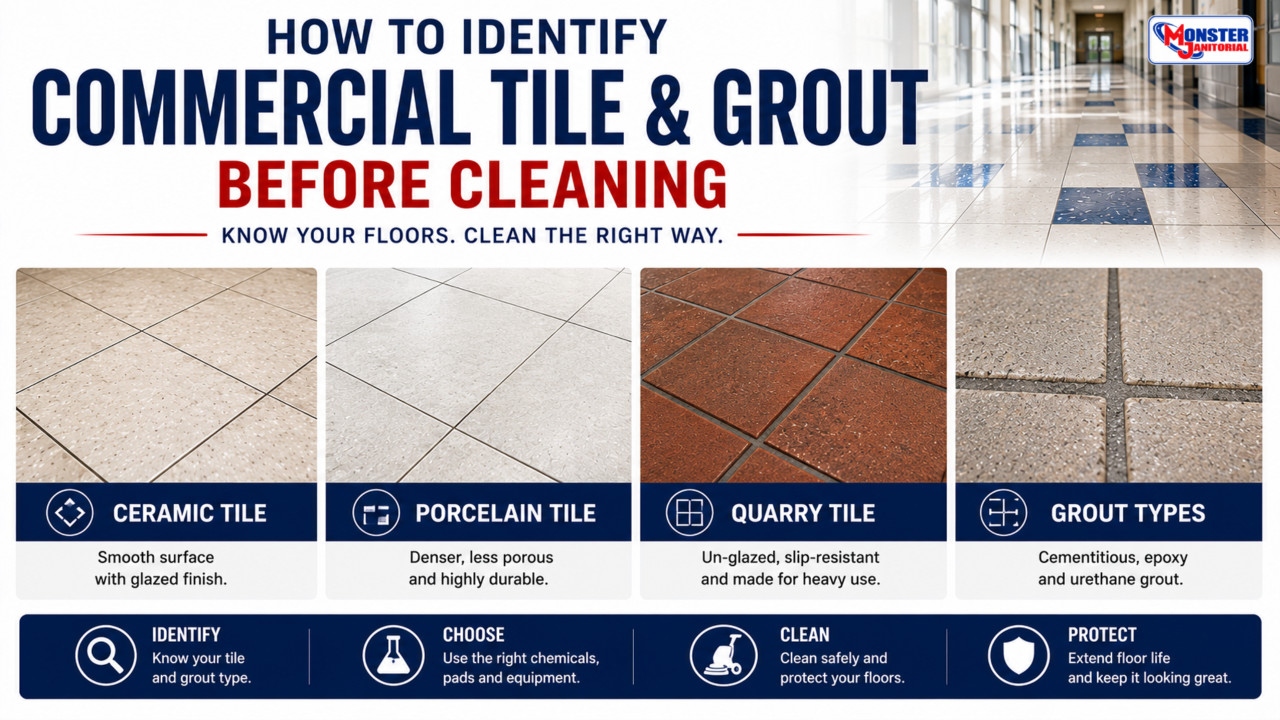
How to Identify Commercial Tile & Grout Before Cleaning: Ceramic, Porcelain, Quarry Tile & Grout Types
Identifying the tile surface and grout system before cleaning helps you choose safer chemistry, brushes, pads, machines, and restoration methods.
Use this guide to compare ceramic, porcelain, quarry, textured tile, cementitious grout, epoxy grout, sealed grout, and common signs of wear or damage.
Why Identify Tile & Grout Before Cleaning?
Commercial tile floors can look similar while having very different surface properties, textures, grout systems, sealers, and chemical tolerances.
Before choosing a cleaner, brush, pad, auto scrubber, floor machine, extractor, or steam cleaner, identify the surface as accurately as possible and test unfamiliar chemistry in a small inconspicuous area.
Four Details to Identify Before Cleaning
A quick inspection can help prevent damage and point you toward the correct maintenance process.
Ceramic Tile
Ceramic tile is common in restrooms, kitchens, schools, healthcare facilities, locker rooms, offices, and commercial buildings.
Porcelain Tile
Porcelain tile is a dense ceramic material commonly used in commercial environments where durability, moisture resistance, and appearance are important.
Quarry Tile
Quarry tile is frequently found in commercial kitchens, food-service environments, back-of-house areas, and other high-use spaces.
Textured & Slip-Resistant Tile
Textured tile can hold soil in small recesses and surface irregularities that a mop or flat pad may not reach effectively.
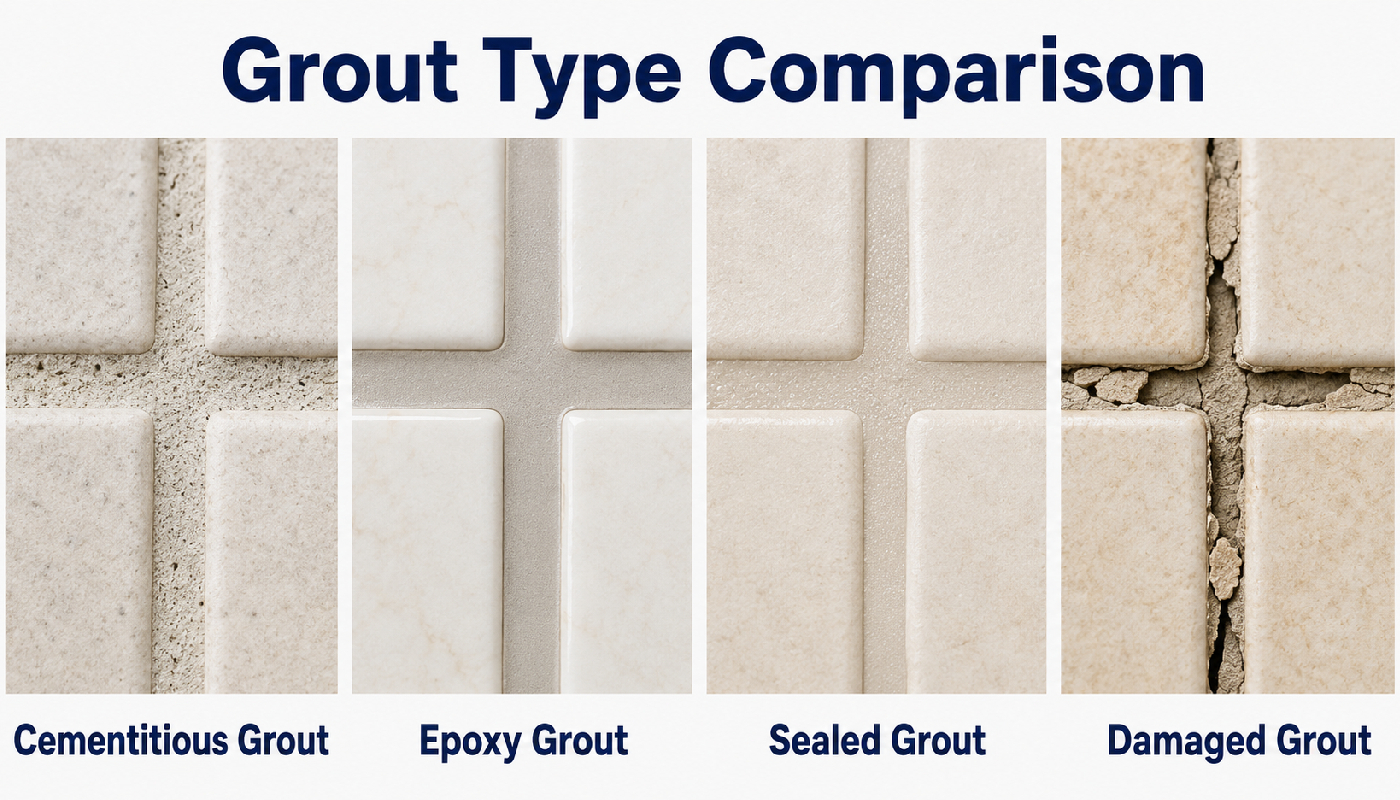
Compare common grout systems and conditions before selecting cleaning chemistry, brushes, or restoration methods.
Common Commercial Grout Types
Identifying the grout matters because grout can react differently to chemicals, moisture, brushing, staining, and sealing.
Traditional Cement-Based Grout
Cementitious grout can be more porous than many tile surfaces and may absorb soil, oils, restroom contamination, or moisture if not properly maintained.
Resin-Based Grout
Epoxy grout is generally less porous and more stain resistant than traditional cementitious grout, but cleaning methods should still follow the grout and tile manufacturer's guidance.
Previously Sealed Grout
A penetrating or topical treatment may reduce absorption, but old or uneven sealer can make grout appearance inconsistent.
Cracked, Missing or Eroded Grout
Cleaning will not repair physically failed grout. Cracking, erosion, missing sections, or loose material may require repair before aggressive cleaning.
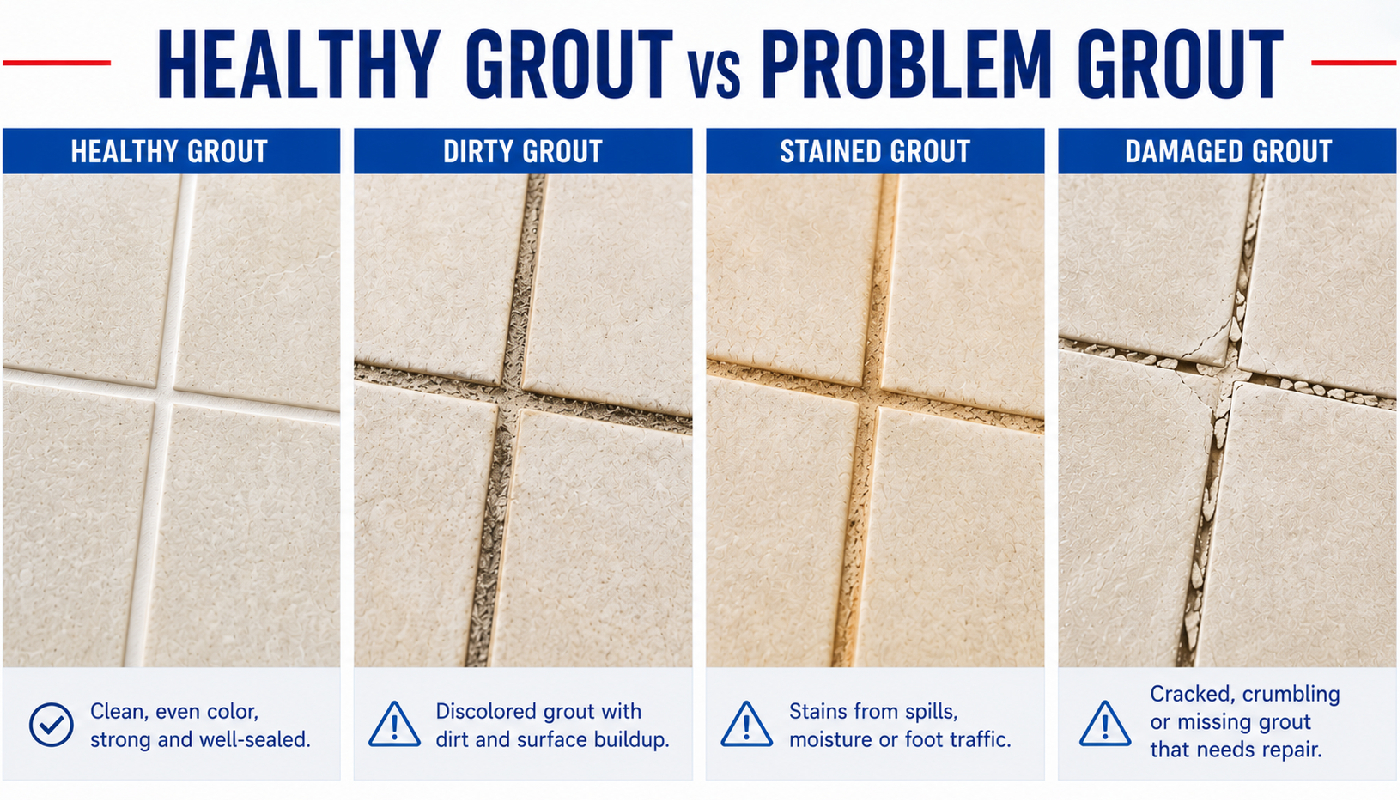
Grout condition helps determine whether the floor needs routine cleaning, deeper restoration, stain treatment, or physical grout repair.
How to Inspect Grout Condition
May indicate embedded soil, grease, residue, moisture, or staining.
Can indicate physical grout failure that cleaning alone cannot correct.
May result from staining, uneven soil loading, previous repairs, sealer, or grout colorant.
Avoid aggressive brushing until the grout condition has been evaluated.
Tile and Grout May Need Different Cleaning Methods
The tile surface may be relatively smooth and nonporous while the grout lines are recessed, porous, textured, and heavily soiled.
A process that cleans the tile face successfully may still leave dirty grout lines behind. This is why brush selection, dwell time, agitation, rinsing, and recovery can be especially important on tile-and-grout floors.
Simple Identification Checks
Run a visual and tactile inspection for smooth, glazed, matte, textured, or profiled surfaces.
Chips, exposed edges, and damaged areas may provide clues about the tile body and construction.
Uneven gloss, water behavior, color changes, or visible coatings may indicate sealer or topical treatment.
Use a small inconspicuous area before applying unfamiliar chemistry or aggressive agitation across the entire floor.
Do Not Identify Tile by Appearance Alone
Modern porcelain, ceramic, stone-look, and textured commercial tiles can closely resemble other materials.
When the flooring cannot be identified confidently, check building records, manufacturer information, installation documentation, or test the cleaning process conservatively before using aggressive chemistry or equipment.
Choosing Brushes, Pads & Equipment
Once the tile, grout, texture, and condition are understood, choose equipment based on the cleaning objective and surface profile.
When Should You Test the Cleaner First?
Test unfamiliar chemistry when the tile or grout type is uncertain, when a coating or sealer may be present, or when stronger restorative chemistry is being considered.
Always follow product-label instructions and the flooring manufacturer's care guidance when available.
What to Avoid
Ceramic, porcelain, quarry, textured, and specialty tile can require different cleaning approaches.
The grout may be more sensitive, porous, or damaged than the tile face.
Pad and brush selection should be based on the surface, machine, soil, and manufacturer recommendations.
Cracked tile, failed grout, loose material, and moisture problems cannot be corrected by stronger cleaning.
Before Cleaning Commercial Tile & Grout
- Identify the tile material as accurately as possible.
- Check whether the surface is smooth, glazed, matte, textured, or slip resistant.
- Inspect grout type and condition.
- Look for cracks, missing grout, loose tile, or damaged areas.
- Determine whether sealer, coating, grout colorant, or previous treatment may be present.
- Identify the primary soil: routine dirt, grease, soap scum, minerals, restroom contamination, or residue.
- Choose the least aggressive compatible chemistry and agitation method.
- Test unfamiliar processes before cleaning the entire floor.
Tile & Grout Floor Care Learning Library
Explore the complete commercial tile and grout floor care series, from identification and chemistry through equipment, deep cleaning, troubleshooting, restoration, and long-term maintenance.
How to Identify Commercial Tile & Grout Before Cleaning: Ceramic, Porcelain, Quarry Tile & Grout Types
Identify ceramic, porcelain, quarry, textured tile, grout types, treatments, and floor condition before cleaning.
Current GuideBest Cleaning Chemicals for Commercial Tile & Grout Floors
Match chemistry to routine soil, grease, restroom contamination, residue, and mineral buildup.
Read Guide →Auto Scrubbers, Floor Machines & Brushes for Commercial Tile & Grout Floors
Compare disc and cylindrical scrubbers, floor machines, brushes, pads, and extraction equipment.
Read Guide →How to Deep Clean Commercial Tile & Grout Floors: Removing Dark, Dirty & Discolored Grout
Deep clean tile while addressing embedded soil and dark, dirty, stained, or discolored grout.
Read Guide →Commercial Tile & Grout Floor Problems
Diagnose dark grout, haze, streaks, odors, slippery floors, residue, and efflorescence.
Read Guide →Commercial Tile & Grout Restoration Guide: When to Deep Clean, Extract, Steam Clean, Reseal or Repair
Know when cleaning should move to extraction, steam cleaning, resealing, color restoration, repair, or replacement.
Read Guide →Complete Commercial Tile & Grout Floor Cleaning & Maintenance Guide
The complete tile and grout floor-care reference covering identification, chemistry, equipment, maintenance, deep cleaning, troubleshooting, restoration, sealing, and repair.
Read Complete Guide →Tile & Grout Identification FAQs
How can you tell porcelain tile from ceramic tile?
Appearance alone may not be enough. Porcelain is a type of ceramic tile with different manufacturing and performance characteristics, so installation records or manufacturer information are the most reliable sources when available.
How can you identify quarry tile?
Quarry tile is commonly found in commercial kitchens and back-of-house areas and often has a matte, textured, reddish or earth-toned appearance. Confirm the flooring whenever possible rather than relying only on color.
How do you know if grout is sealed?
Existing sealer can be difficult to identify visually. Maintenance records, installation information, manufacturer documentation, and cautious testing may help determine whether the grout has been treated.
Should tile and grout use the same cleaning method?
Not always. The tile face may be relatively smooth while grout lines are recessed or porous, so additional brush agitation, dwell time, rinsing, or extraction may be needed.
What should you do if the tile type is unknown?
Use the least aggressive cleaning process, check facility or installation records when possible, follow product-label instructions, and test unfamiliar chemistry or agitation in an inconspicuous area before proceeding.
Need Help With Commercial Tile & Grout Floor Care?
Monster Janitorial can help you compare cleaning chemicals, auto scrubbers, floor machines, extractors, steam cleaners, brushes, pads, and other equipment for commercial tile and grout maintenance.
Tax-exempt purchasing and purchase-order support are available for qualifying schools, universities, government agencies, healthcare facilities, municipalities, and other institutional customers.