
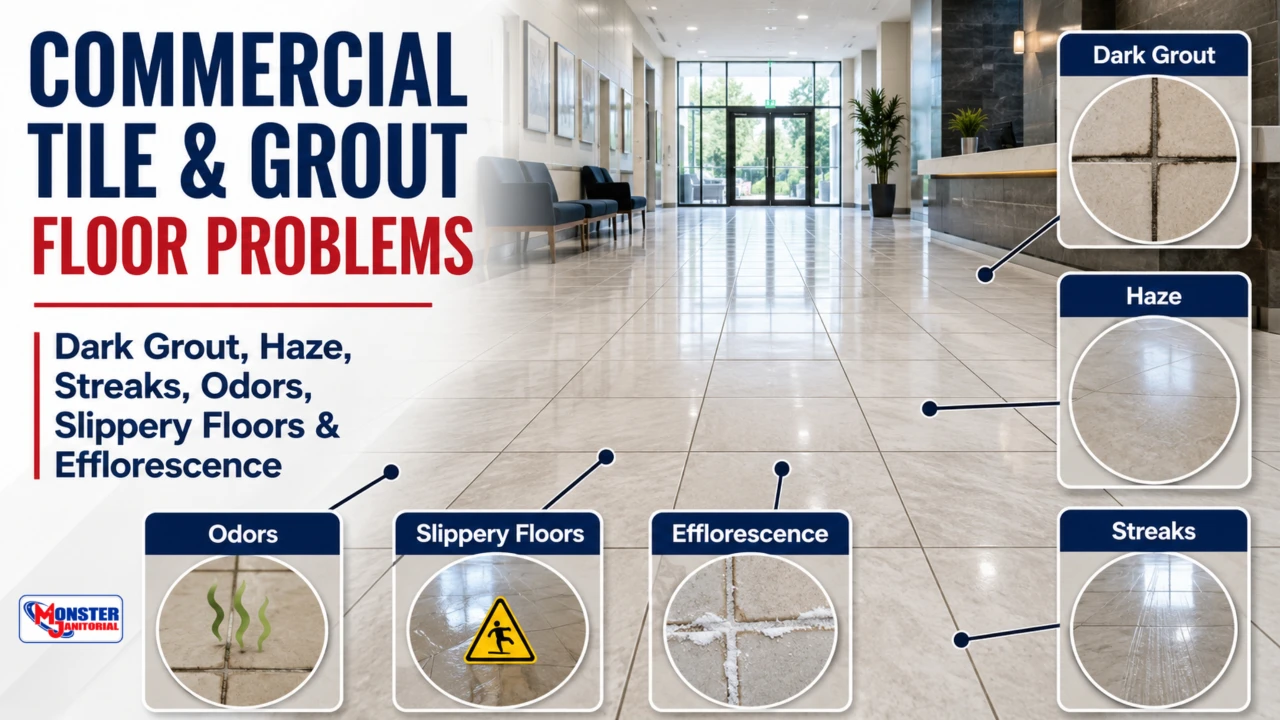
Commercial Tile & Grout Floor Problems: Dark Grout, Haze, Streaks, Odors, Slippery Floors & Efflorescence
Tile and grout problems often look similar on the surface even when the causes are completely different.
Use this guide to diagnose dark grout, floor haze, streaks, persistent odors, greasy or slippery conditions, and efflorescence before deciding whether the floor needs routine cleaning, deep cleaning, extraction, rinsing, or repair.
Diagnose the Symptom Before Changing the Cleaning Process
Dark grout may be embedded soil or staining. Haze may be cleaner residue or minerals. Streaks may be caused by uneven solution application or poor recovery. Odors may come from contamination trapped in grout or surrounding areas. Slippery floors may be caused by grease or residue. Efflorescence usually points to mineral salts and moisture movement rather than ordinary dirt.

Dark grout, haze, and streaking can have different causes. Correct diagnosis helps avoid repeatedly using stronger chemistry when the real issue may be residue, incomplete rinsing, poor recovery, staining, or floor condition.
Start With the Symptom
Dark Grout
Recessed grout lines can collect soil that routine mopping or flat floor pads may not fully remove.
Before using stronger chemistry, determine whether the grout is actually dirty or whether the dark appearance is caused by permanent staining, previous colorant, moisture, sealer variation, or physical deterioration.
Haze After Cleaning
Haze can occur when cleaning solution, loosened soil, minerals, or other residue dries on the tile surface.
Review chemical dilution, rinsing requirements, water quality, pad or brush condition, and dirty-water recovery before assuming the floor needs stronger cleaning chemistry.
Streaks & Uneven Appearance
Streaking may be caused by excess chemistry, uneven solution application, dirty cleaning tools, worn squeegee blades, poor recovery, or residue left behind during drying.
Correct the cleaning process and recovery system before repeating the same procedure with a stronger product.
Persistent Odors
Odors can remain when contamination is trapped in porous grout, corners, wall edges, drains, fixtures, or other areas not reached during routine floor cleaning.
Identify and remove the source rather than simply adding fragrance. Persistent moisture or recurring contamination may require investigation beyond the visible tile surface.
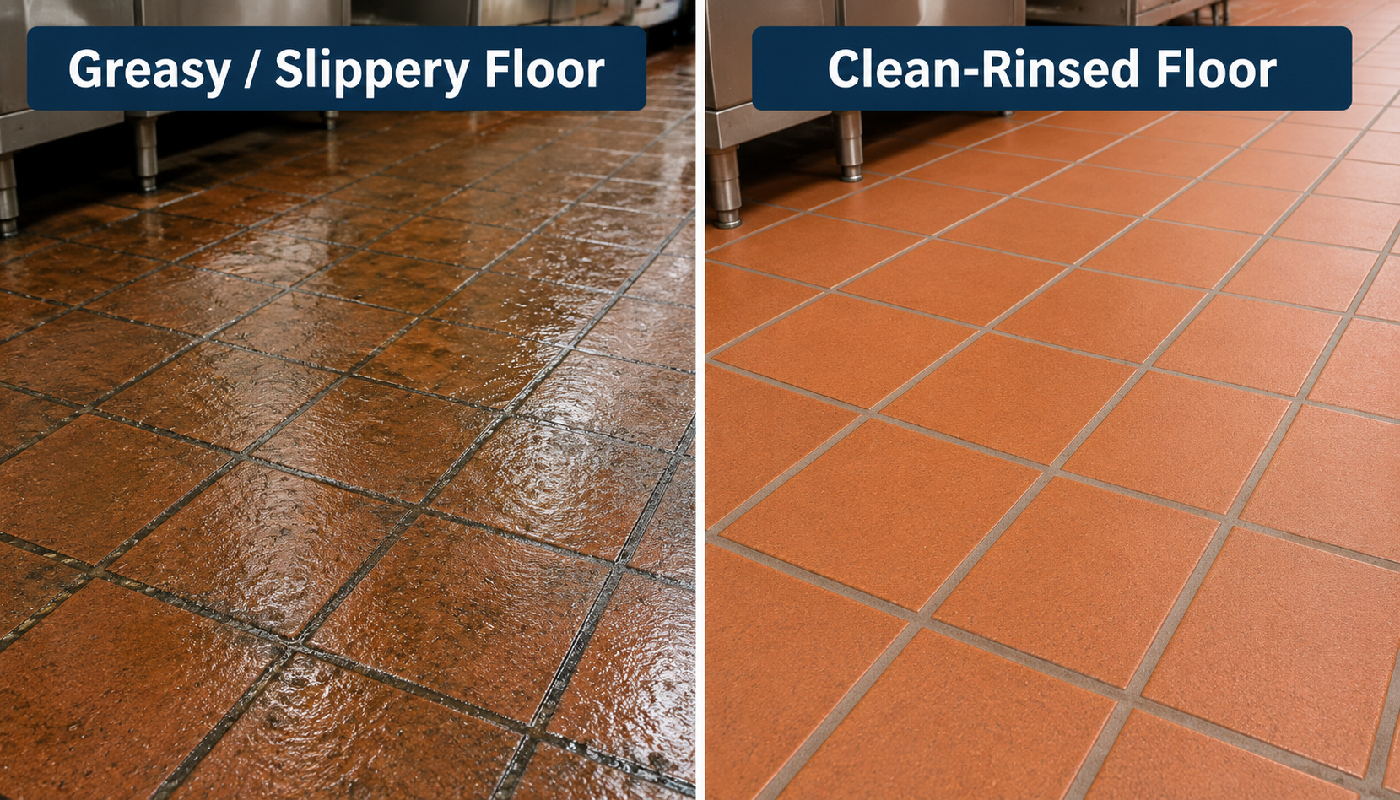
Grease and cleaning residue can both contribute to poor floor conditions. Proper chemistry, agitation, rinsing when required, and complete recovery are all important.
Greasy or Slippery Tile Floors
Grease, oil, food residue, detergent film, or incomplete rinsing can leave commercial tile floors feeling slick or sticky.
Use chemistry compatible with the soil and floor, follow dilution instructions, provide enough agitation, rinse when required, and recover contaminated solution thoroughly. Cleaning can improve floor conditions, but it should not be treated as a guarantee of slip resistance.
Why Quarry Tile Can Stay Greasy
Commercial kitchens combine grease, textured quarry tile, recessed grout, heavy traffic, and frequent cleaning. A flat pad or quick mop may clean the high points while leaving contamination deeper in the floor profile.
Brush agitation and complete dirty-water recovery are often important when greasy soil is embedded in grout and texture.

Efflorescence is a mineral-related condition and should not be treated as ordinary soil. Recurring deposits may indicate an underlying moisture source.
Efflorescence & White Mineral Deposits
Efflorescence appears when soluble mineral salts are carried by moisture and deposited at the surface as the moisture evaporates.
Cleaning may remove visible deposits, but recurring efflorescence may continue until the underlying moisture movement is addressed.
Do Not Treat Every White Deposit With Strong Acid
Strong acidic chemistry can damage certain grout, natural stone, metal fixtures, and surrounding materials. Identify the deposit and verify product and surface compatibility before using mineral-removal chemistry.
Cleaner Residue vs. Embedded Soil
A floor can look dull, hazy, sticky, or streaked even when the problem is not heavy soil.
Overdosing cleaner, repeatedly adding chemical without rinsing, using dirty solution, or failing to recover contaminated water can leave residue that attracts new soil.
Why Grout Gets Dark Again After Cleaning
Grout can quickly appear dirty again if contaminated solution is redistributed rather than removed.
Other causes can include insufficient brush contact, grease remaining below the tile surface, cleaning residue, high traffic, porous grout, or permanent staining.
When Poor Recovery Is the Real Problem
Chemistry and agitation loosen soil. If the contaminated solution is not recovered effectively, that soil can remain on the floor or settle back into recessed grout. Inspect squeegee blades, vacuum performance, recovery equipment, cleaning technique, and the amount of solution being left behind.
Stronger Cleaner Is Not Always Better
Increasing chemical concentration beyond label directions can increase residue, create rinsing problems, damage incompatible surfaces, and raise operating cost without correcting poor dwell time, agitation, or recovery.
When Tile or Grout Needs Repair
Cracked tile, loose tile, missing grout, crumbling joints, failed caulk, substrate movement, or recurring moisture problems cannot be corrected with stronger cleaning. These conditions require repair or investigation of the underlying floor system.
Common Tile & Grout Problems by Area
Problem → Likely Cause → First Action
Check for embedded soil, staining, grease, moisture, or previous treatments.
Review dilution, rinsing, water quality, residue, and recovery.
Inspect application, cleaning tools, squeegee condition, and recovery.
Find the contamination or moisture source instead of masking the odor.
Check grease removal, chemical dilution, rinsing, and dirty-water recovery.
Identify mineral deposits and investigate recurring moisture movement.
When Routine Cleaning Is Not Enough
When embedded soil and dark grout remain after routine maintenance.
When loosened soil needs stronger flushing and immediate recovery.
For compatible detail areas where steam can help loosen soil.
When grout, tile, joints, substrate, or moisture conditions have physically failed.
Tile & Grout Floor Care Learning Library
Continue with the guide that matches your next cleaning or restoration task.
How to Identify Commercial Tile & Grout Before Cleaning
Identify tile, grout, texture, treatments, and condition.
Read Guide →Best Cleaning Chemicals for Commercial Tile & Grout Floors
Match chemistry to routine soil, grease, restroom soil, and mineral buildup.
Read Guide →Auto Scrubbers, Floor Machines & Brushes for Commercial Tile & Grout Floors
Compare disc, cylindrical, rotary, brush, pad, and extraction systems.
Read Guide →How to Deep Clean Commercial Tile & Grout Floors
Deep clean tile while addressing dark, dirty, stained, and discolored grout.
Read Guide →Commercial Tile & Grout Floor Problems
Diagnose dark grout, haze, streaks, odors, slippery floors, and efflorescence.
Current GuideCommercial Tile & Grout Restoration Guide
Know when to deep clean, extract, steam clean, reseal, or repair.
Complete Commercial Tile & Grout Floor Cleaning & Maintenance Guide
The complete tile and grout cleaning and maintenance reference.
Commercial Tile & Grout Troubleshooting FAQs
Why does grout stay dark after cleaning?
Remaining darkness may be caused by embedded soil, incomplete recovery, permanent staining, previous grout colorant, moisture, or physical deterioration.
Why does tile look hazy after mopping?
Haze may be caused by excess cleaner, dirty solution, mineral residue, incomplete rinsing, or cleaning solution drying on the floor.
Why does a commercial kitchen floor stay greasy?
Grease may remain when chemistry, dwell time, brush agitation, rinsing, or recovery are insufficient for the amount and type of soil.
Is efflorescence the same as dirt?
No. Efflorescence is mineral salt deposition associated with moisture movement. Cleaning can remove visible deposits, but recurring moisture may need to be addressed.
When should tile or grout be repaired instead of cleaned?
Cracked tile, missing or crumbling grout, loose tile, failed joints, or substrate-related problems require repair rather than progressively stronger cleaning.
Need Help Diagnosing a Tile & Grout Floor Problem?
Monster Janitorial can help you compare cleaning chemistry, auto scrubbers, floor machines, brushes, pads, wet recovery equipment, and tile-and-grout extraction systems for your facility.
Tax-exempt purchasing and purchase-order support are available for qualifying schools, universities, government agencies, healthcare facilities, municipalities, and other institutional customers.