
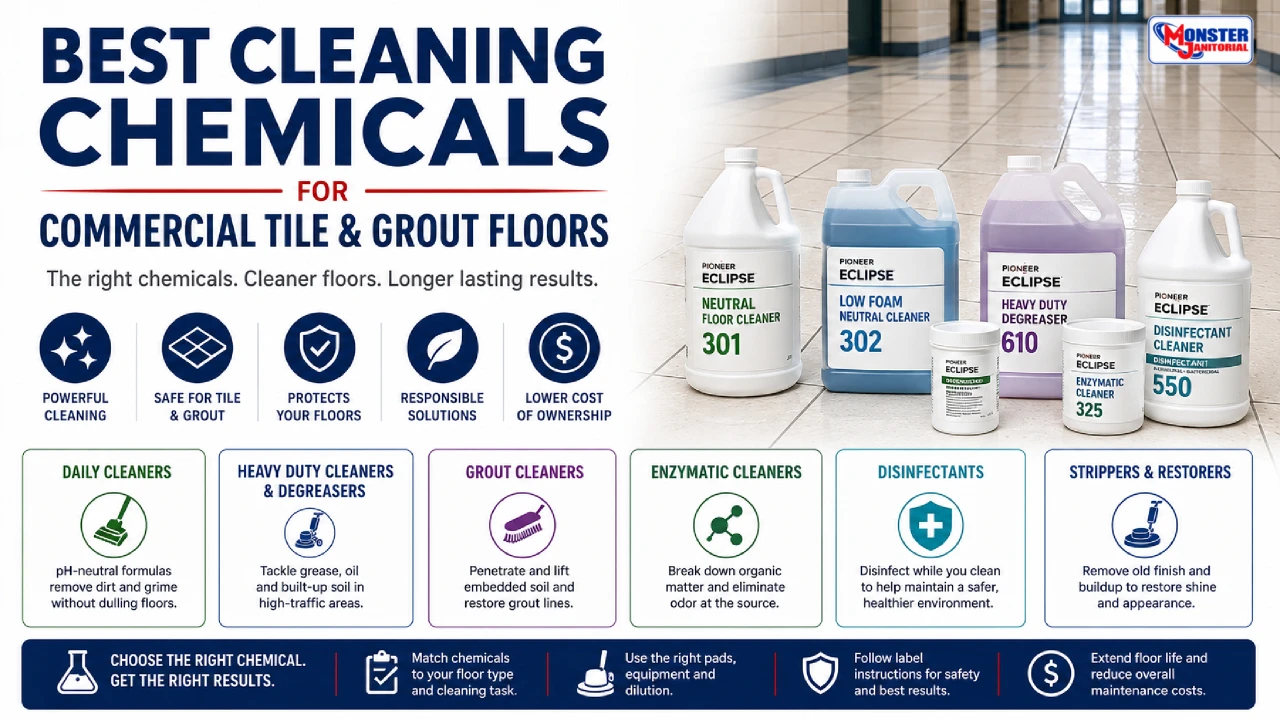
Best Cleaning Chemicals for Commercial Tile & Grout Floors
The best cleaner for commercial tile and grout depends on the tile, grout, soil, equipment, and cleaning objective.
Routine soil may only need a neutral cleaner, while kitchen grease, restroom contamination, mineral buildup, or heavy embedded soil may require a more specialized product.
Match the Cleaner to the Soil
Use a neutral or low-foam cleaner for routine maintenance, a compatible degreaser for heavy grease and food soils, and a restroom cleaner for restroom-specific contamination and mineral-related buildup. Always confirm compatibility with the tile, grout, sealer, and equipment before cleaning.
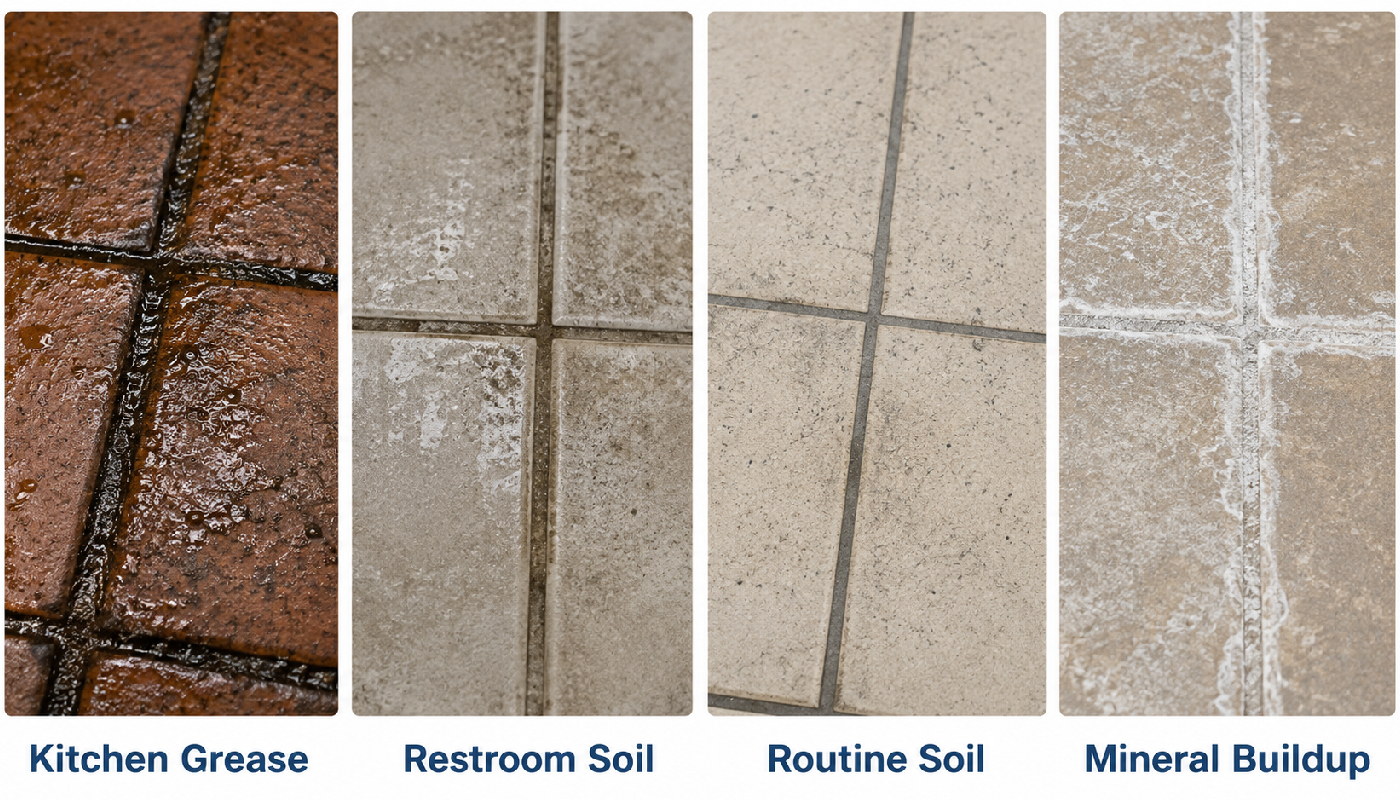
Identify the primary soil before choosing chemistry. Kitchen grease, restroom soil, routine dirt, and mineral buildup often require different cleaning approaches.
Identify These Four Things First
Neutral & Low-Foam Cleaners
For normal daily or scheduled maintenance, start with the least aggressive chemistry that can remove the soil effectively.
Pioneer Eclipse 301 Eclipse Neutral Cleaner
A neutral-cleaner option for routine hard-floor maintenance when stronger chemistry is not required.
View Eclipse 301 →Pioneer Eclipse 302 Low-Foam Neutral Cleaner
Useful when routine floor cleaning requires low-foam chemistry, including many machine-cleaning applications.
View Eclipse 302 →Karcher Neutral Floor Cleaner 8.698-103.0
A neutral floor-cleaning option for routine commercial floor maintenance and compatible cleaning equipment.
View Karcher Neutral Floor Cleaner →TASKI IntelliPods Floor Cleaner Sachets 9321837
A pre-portioned floor-cleaning option that can simplify chemical measuring and preparation.
View TASKI Floor Cleaner IntelliPods →When Routine Neutral Cleaning Is Not Enough
Embedded soils, grease, food residue, and neglected grout may require stronger chemistry than routine maintenance.
Increase cleaning strength only as needed and confirm that the cleaner is appropriate for the tile, grout, sealer, and surrounding materials.
TASKI Heavy-Duty Floor Cleaner IntelliPods 9321843
For heavier floor soil where a low-foaming cleaner is preferred, TASKI Heavy-Duty IntelliPods provide another option for commercial machine-cleaning programs.
View TASKI Heavy-Duty IntelliPodsDegreasers for Commercial Tile & Grout
Kitchen and food-service floors may accumulate oils and grease that a routine neutral cleaner cannot remove efficiently.
Use a compatible degreaser, allow appropriate dwell time, agitate the surface and grout lines, and recover the dirty solution rather than allowing loosened grease to dry back onto the floor.
Karcher Ice Breaker Freezer Floor Cleaner & Degreaser 8.759-329.0
Ice Breaker is a specialty cleaner and degreaser intended for cold-storage and freezer-floor applications. Treat it as application-specific chemistry rather than a general routine tile cleaner.
View Karcher Ice BreakerPioneer Eclipse Triton 324 Non-Acid Washroom Cleaner
Restroom tile and grout can accumulate body oils, restroom soils, soap residue, and mineral-related deposits. Triton 324 provides a non-acid washroom-cleaning option for compatible restroom surfaces.
View Pioneer Eclipse Triton 324Do Not Automatically Reach for Strong Acid
White deposits, scale, and mineral buildup can require different chemistry than routine soil, but stronger acidic products should not automatically be the first choice.
Acids can affect cementitious grout, natural-stone components, metal fixtures, and other surrounding materials. Verify compatibility and use the least aggressive product capable of correcting the problem.
Cementitious vs. Epoxy Grout
Cementitious Grout
Traditional cement-based grout may be more porous and can hold embedded soil. Avoid assuming the grout can tolerate the same aggressive chemistry as the surrounding tile.
Epoxy Grout
Epoxy grout is generally less porous, but cleaner selection should still follow the grout and flooring manufacturer's recommendations.
Why Tile Floors Become Hazy or Sticky
Too much chemical, incorrect dilution, dirty cleaning solution, insufficient recovery, or incomplete rinsing can leave residue on tile and grout.
If a floor looks hazy or becomes sticky shortly after cleaning, investigate the cleaning process before automatically moving to stronger chemistry.
When Should Tile & Grout Be Rinsed?
Follow the chemical label. Some routine cleaners may be designed for low-residue maintenance, while heavier degreasers and restorative processes may require thorough rinsing or additional recovery.
Regardless of chemistry, do not allow heavily contaminated cleaning solution to remain in grout lines or dry back onto the surface.
Match the Soil to the Cleaner
Tile & Grout Chemical Mistakes to Avoid
Overdosing can increase residue rather than improve cleaning.
Grease, mineral deposits, and routine soil are not the same problem.
The grout may respond differently to chemistry than the tile surface.
Increase cleaning strength only when the soil and floor condition justify it.
Commercial Floor Cleaning Chemicals
Which Sealer Should Be Used on Each Tile Type?
Sealer selection depends on whether the tile itself is porous and whether the grout is cementitious, epoxy, sealed, or otherwise treated.
Seal the Grout, Not Usually the Tile
Glazed ceramic tile normally does not need a penetrating sealer on the tile surface. Compatible porous cementitious grout may benefit from sealing.
Recommended: Pioneer Eclipse 426 Penetrating Sealer View Pioneer Eclipse 426 →Usually Grout-Only Sealing
Porcelain is typically very dense. The tile itself often does not require penetrating sealer, but porous cementitious grout may.
Recommended: Pioneer Eclipse 426 Penetrating Sealer View Pioneer Eclipse 426 →Penetrating Protection for Porous Quarry Tile
Porous quarry tile and compatible cementitious grout may benefit from a penetrating sealer after the floor is thoroughly cleaned and dried.
Recommended: Pioneer Eclipse 426 Penetrating Sealer View Pioneer Eclipse 426 →Use a Compatible Penetrating Sealer
Unglazed porous tile may absorb water, oil, and soil more readily than glazed tile. Confirm compatibility before sealing.
Recommended: Pioneer Eclipse 426 Penetrating Sealer View Pioneer Eclipse 426 →Seal Only When the Surface Is Compatible
Do not automatically coat textured or slip-resistant tile. If the tile or cementitious grout is porous and the manufacturer permits sealing, a penetrating sealer may be appropriate.
When Applicable: Pioneer Eclipse 426 View Pioneer Eclipse 426 →Treat It as Porcelain, Not Natural Stone
Stone-look porcelain is still porcelain. The tile itself normally does not need a penetrating sealer, although compatible porous cementitious grout may.
Grout Recommendation: Pioneer Eclipse 426 View Pioneer Eclipse 426 →Do not apply sealer simply because a floor is tile and grout. Confirm whether the tile is glazed, unglazed, porous, dense, textured, or previously treated. Epoxy grout and other nonporous grout systems may not need conventional penetrating sealer. Always follow the tile, grout, and sealer manufacturer's instructions.
Tile & Grout Floor Care Learning Library
Explore the complete commercial tile and grout floor care series, from identification and chemistry through equipment, deep cleaning, troubleshooting, restoration, and long-term maintenance.
How to Identify Commercial Tile & Grout Before Cleaning: Ceramic, Porcelain, Quarry Tile & Grout Types
Identify tile, grout, texture, treatments, and condition before choosing chemistry or equipment.
Read Guide →Best Cleaning Chemicals for Commercial Tile & Grout Floors
Match chemistry to the tile, grout, soil type, equipment, and maintenance objective.
Current GuideAuto Scrubbers, Floor Machines & Brushes for Commercial Tile & Grout Floors
Compare disc and cylindrical scrubbers, floor machines, brushes, pads, and extraction equipment.
Read Guide →How to Deep Clean Commercial Tile & Grout Floors: Removing Dark, Dirty & Discolored Grout
Deep clean tile while addressing embedded soil and dark, dirty, stained, or discolored grout.
Read Guide →Commercial Tile & Grout Floor Problems
Diagnose dark grout, haze, streaks, odors, slippery floors, residue, and efflorescence.
Read Guide →Commercial Tile & Grout Restoration Guide: When to Deep Clean, Extract, Steam Clean, Reseal or Repair
Know when cleaning should move to extraction, steam cleaning, resealing, color restoration, repair, or replacement.
Read Guide →Complete Commercial Tile & Grout Floor Cleaning & Maintenance Guide
The complete tile and grout floor-care reference covering identification, chemicals, equipment, routine maintenance, deep cleaning, troubleshooting, restoration, sealing, repair, and long-term maintenance.
Read Complete Guide →Tile & Grout Cleaning Chemical FAQs
What is the best cleaner for routine commercial tile floors?
A compatible neutral or low-foam floor cleaner is typically a good starting point for routine soil when stronger chemistry is unnecessary.
Can you use degreaser on tile and grout?
A compatible degreaser may be appropriate for grease-heavy areas such as commercial kitchens. Confirm compatibility with the tile, grout, sealer, and surrounding surfaces.
Why does tile look hazy after cleaning?
Haze can result from chemical residue, incorrect dilution, dirty solution, incomplete recovery, mineral deposits, or other surface conditions.
Should tile and grout always be rinsed after cleaning?
Follow the chemical label. Heavy-duty and restorative processes may require more rinsing and recovery than routine low-residue maintenance.
Should every tile and grout floor be sealed?
No. Glazed ceramic and dense porcelain tile often do not need penetrating sealer on the tile itself. Compatible porous grout, quarry tile, unglazed tile, and other absorbent surfaces may benefit from sealing when approved for the surface.
Need Help Choosing Tile & Grout Chemistry?
Monster Janitorial can help you compare cleaners, degreasers, restroom chemistry, auto scrubber chemicals, penetrating sealers, brushes, and equipment for commercial tile and grout floors.
Tax-exempt purchasing and purchase-order support are available for qualifying schools, government agencies, healthcare facilities, municipalities, and other institutional customers.