
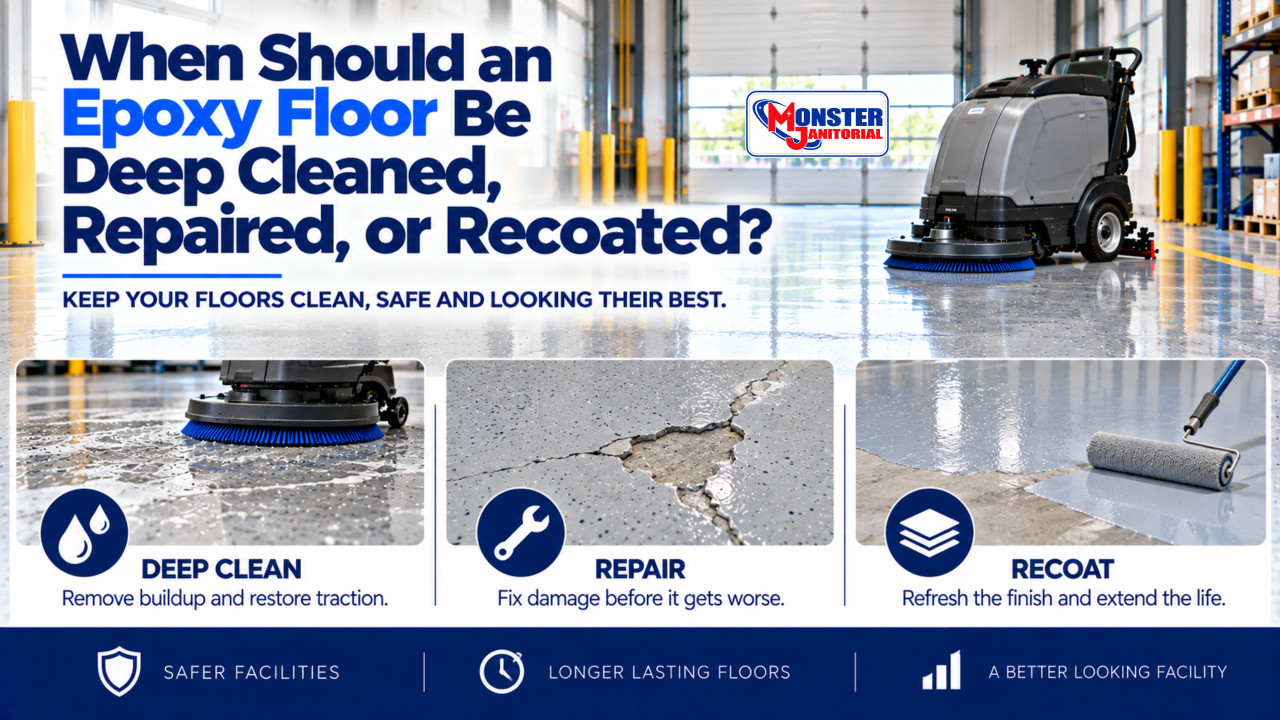
When Should an Epoxy Floor Be Deep Cleaned, Repaired, or Recoated?
Learn how to tell whether a commercial epoxy floor has removable soil, localized damage, or widespread coating failure that may require recoating.
Clean first, then evaluate the coating after the floor is completely dry.
Deep clean an intact coating with heavy buildup. Repair isolated chips, cracks, gouges, or peeling. Consider recoating when wear, delamination, exposed concrete, or loss of performance affects large areas.
Deep Clean, Repair, or Recoat?
The correct next step depends on whether the problem is removable contamination, localized physical damage, or widespread coating failure.
Deep Clean
Choose deep cleaning when the coating is intact but covered by grease, tire marks, residue, haze, embedded soil, or dark traffic buildup.
Repair
Choose localized repair when damage is limited to a crack, chip, gouge, drain edge, joint, impact area, or small section of exposed concrete.
Recoat
Consider recoating when wear, peeling, exposed substrate, chemical damage, or traction loss affects large areas or continues to spread.
Inspect the Floor After Cleaning
Heavy grease, residue, rubber transfer, and embedded soil can hide the true condition of the coating. Evaluate the floor only after removable contamination has been cleaned away and the surface is fully dry.
Signs the Floor Needs Deep Cleaning
Deep cleaning is appropriate when the coating remains bonded and intact but routine maintenance no longer removes the visible buildup.
Signs the Floor Needs Spot Repair
Localized repairs may be practical when the surrounding coating remains well bonded and the cause of the damage can be corrected.
Signs the Floor May Need Recoating
Recoating may be more practical than repeated repairs when the existing surface no longer performs consistently across the facility.
Deep Cleaning vs. Coating Failure
More Likely Removable Soil
- The area improves during controlled test cleaning
- Residue transfers to a clean pad or cloth
- The floor feels oily, sticky, or slippery
- The coating remains fully bonded
- No exposed concrete or peeling is visible
More Likely Coating Failure
- The condition does not change after cleaning
- The coating is peeling or delaminating
- Concrete is exposed
- Deep scratches or erosion are visible
- Texture, gloss, or color is permanently altered
What an Auto Scrubber Can Do
An auto scrubber can remove soil, oily film, residue, and some tire marks when it is equipped with compatible chemistry, pads, brushes, and recovery components.
What an Auto Scrubber Cannot Repair
A scrubber cannot repair peeling, delamination, deep scratches, exposed concrete, chemical etching, moisture failure, or coating that has worn away.
When Spot Repairs Make Sense
Localized repair is usually most practical when the surrounding coating remains well bonded, the damage has a known cause, and the repair area represents only a small portion of the floor.
When Full Recoating May Be More Cost-Effective
Repeated patching may become inefficient when repairs continue to spread, large areas have worn through, or the remaining coating no longer provides consistent appearance, traction, or protection.
Questions to Ask Before Recoating
Recoating without identifying the original cause of failure can allow the same problem to return.
What Does the Floor Need?
Related Epoxy-Floor Guides
Use these guides to identify removable soil and select compatible cleaning equipment and chemicals.
Need Help Evaluating an Epoxy Floor?
Monster Janitorial can help determine whether the condition appears to be removable soil and recommend compatible cleaners, pads, brushes, auto scrubbers, and recovery equipment for corrective cleaning.