
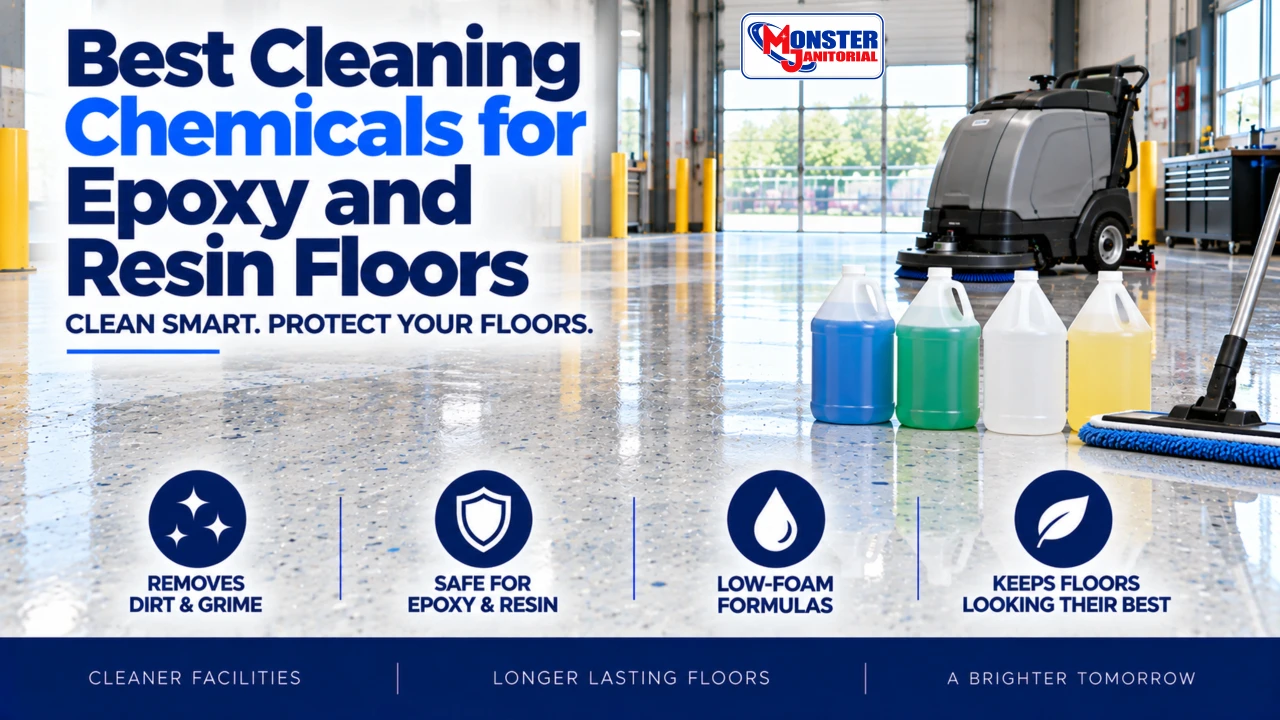
Best Cleaning Chemicals for Epoxy and Resin Floors
Learn which neutral cleaners, low-foam auto scrubber solutions, degreasers, and specialty removers work best on commercial epoxy and resin floors—and which chemical mistakes to avoid.

Why Chemical Selection Matters on Epoxy Floors
Epoxy and resin floors are durable, but they still need the right chemistry. The wrong cleaner can leave a sticky film, dull the appearance, reduce traction, or create unnecessary residue that makes the floor harder to maintain.
In most commercial facilities, the best starting point is a neutral or low-foam neutral cleaner. These products remove normal soil without being overly aggressive, making them a strong choice for schools, warehouses, healthcare environments, retail facilities, manufacturing spaces, and general commercial maintenance.
Heavier soils such as grease, oil, or rubber transfer may require a stronger cleaner or a specialty remover. Those products should normally be used as corrective or targeted solutions rather than everyday floor chemicals.
Best Everyday Cleaners for Epoxy and Resin Floors
Lumen L350 Neutral All-Purpose Cleaner
Best for: daily general cleaning, routine damp mopping, and light commercial auto scrubbing.
This is a strong everyday option when you need a neutral cleaner that works across multiple hard-surface cleaning tasks. It is a good fit for normal soil conditions where residue control and appearance retention matter.
Use it when: the floor is dusty or lightly soiled and does not have heavy grease or rubber transfer.
View ProductEclipse Low-Foam Neutral Cleaner 302
Best for: automatic scrubbers and routine cleaning programs.
Because it is a low-foam neutral cleaner, this is one of the strongest options for epoxy and resin floors cleaned with an auto scrubber. Low foam supports cleaner recovery and helps reduce residue.
Use it when: you want a regular scrubber chemical for warehouses, schools, retail facilities, or commercial buildings.
View ProductKarcher Neutral Floor Cleaner 8.698-103.0
Best for: everyday maintenance on compatible coated commercial floors.
This is another practical neutral option for routine cleaning when you want dependable soil removal without immediately moving to stronger chemistry.
Use it when: you need a straightforward daily cleaner for compatible epoxy or resin-floor maintenance.
View ProductBest Starting Recommendation
Start with a neutral cleaner unless the floor has grease, tire marks, or another soil that requires specialized chemistry.
- Lumen L350 for general hard-surface cleaning
- Eclipse 302 for auto scrubbers and low-foam performance
- Karcher Neutral Floor Cleaner for routine coated-floor maintenance
Confirm compatibility with the floor-coating manufacturer and test the diluted cleaner in an inconspicuous area before full use.
Stronger and Specialty Options for Problem Soils
Eclipse Heavy Duty Degreaser 396
Best for: grease, oil, heavy tracked-in soil, and industrial contamination.
When a neutral cleaner is not enough, a stronger degreaser may be needed. This cleaner is better suited to service areas, production-support spaces, machine shops, and industrial facilities with oily residue.
Use it when: heavy soil remains after routine neutral cleaning.
Karcher Tire Mark Remover & Pre-Soak 8.759-326.0
Best for: rubber marks, tire transfer, and stubborn dark traffic soil.
Epoxy floors in warehouses, loading areas, garages, and industrial facilities can develop black tire marks that routine neutral cleaning may not fully remove. A specialty cleaner can be used as a targeted corrective treatment.
Use it when: visible tire marks or rubber transfer remain after routine cleaning.
What to Use for Each Cleaning Situation
Daily or Frequent Cleaning
Use a neutral cleaner such as Lumen L350, Eclipse 302, or Karcher Neutral Floor Cleaner.
Auto Scrubber Programs
Use a low-foam cleaner, with Eclipse 302 standing out as a practical routine auto-scrubber option.
Grease and Heavy Soil
Use Eclipse Heavy Duty Degreaser 396 when neutral cleaning is not enough and the coating permits stronger chemistry.
Rubber Marks or Tire Transfer
Use Karcher Tire Mark Remover & Pre-Soak as a targeted corrective cleaner after testing compatibility.
Dilution, Testing, and Recovery Matter
A suitable cleaner can still cause problems when it is mixed too strongly, allowed to dry on the surface, or left behind after scrubbing.
What to Avoid on Epoxy and Resin Floors
- Overusing heavy-duty degreasers for routine cleaning
- Applying concentrated chemical directly to the coating
- Leaving cleaning solution or residue behind after scrubbing
- Using harsh chemistry when a neutral cleaner will remove the soil
- Allowing cleaning solution to dry on the floor
- Using solvents without written coating-manufacturer approval
- Combining chemicals or changing dilution without label guidance
- Using specialty tire-mark removers across the full floor unnecessarily
Simple Epoxy-Floor Chemical Program
Step 1
Start neutral. Use a neutral or low-foam neutral cleaner for normal maintenance.
Step 2
Escalate only when needed. Move to a degreaser or specialty remover for a specific problem soil.
Step 3
Recover completely. Remove the dirty solution so the floor dries clean and residue-free.
Confirm Compatibility Before Full Use
Epoxy, polyurethane, polyaspartic, quartz, flake, urethane-cement, and other resin systems may have different chemical-resistance limits. Review the coating manufacturer’s maintenance instructions and test the diluted cleaner before recommending it for the entire floor.
Need Help Choosing the Right Epoxy-Floor Cleaner?
Monster Janitorial can help compare neutral cleaners, low-foam auto-scrubber solutions, degreasers, and specialty removers based on your floor condition, facility type, and cleaning equipment.