
Commercial Concrete Floor Care
How to Remove Tire Marks from Concrete Floors
A step-by-step guide to removing forklift, vehicle, and rubber tire marks from polished, sealed, coated, and unfinished concrete floors.
Tire marks become difficult to remove when heat, pressure, rubber compounds, and repeated traffic transfer residue into the floor surface.
The safest approach is to identify the concrete system first, use a compatible cleaner, allow controlled dwell time, agitate with the correct pad or brush, and recover the dirty solution completely.

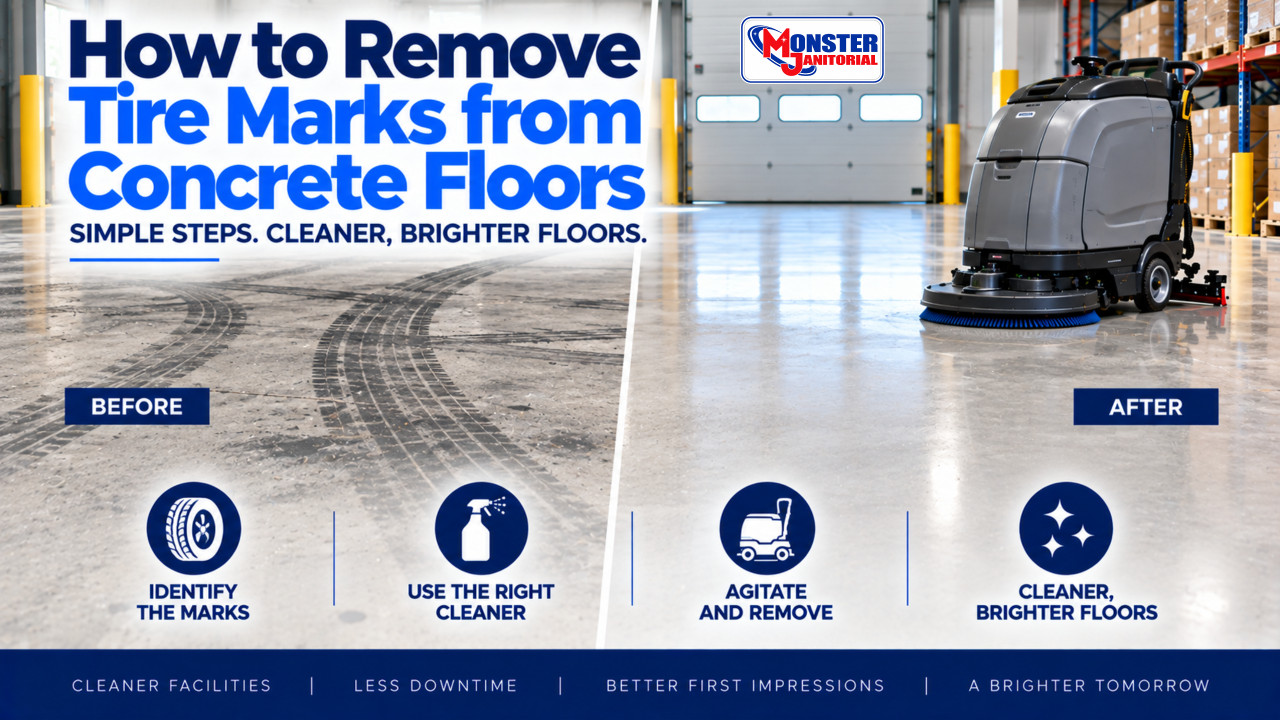
Before-and-after comparison showing tire-marked concrete on one side and cleaned concrete on the other in the same commercial setting.
Quick Answer
Start with the least aggressive compatible method. Use a neutral cleaner on polished or sealed concrete, a concrete-safe tire-mark remover or warehouse cleaner for heavier soil, and a pad or brush matched to the floor texture.
Understanding the Soil
Why Tire Marks Form on Concrete
Turning, braking, and acceleration warm the tire and increase rubber transfer.
Forklifts and loaded vehicles press rubber compounds into the surface.
Rough concrete holds residue in pores, low spots, and surface texture.
Different tire formulas can leave black transfer, oily film, or stubborn scuffing.
Before You Start
Identify the Concrete Surface
A cleaner or pad that is safe on bare warehouse concrete may be too aggressive for polished, sealed, or coated floors.
Polished Concrete
Start with neutral cleaner and a non-aggressive pad. Avoid harsh chemistry and stripping pads that may reduce gloss.
Sealed Concrete
Use products approved for the sealer. Strong solvents or high-alkaline products may haze or soften the coating.
Epoxy or Resin Coating
Use a coating-safe cleaner and soft pad or brush. Test aggressive degreasers before broad use.
Unfinished Concrete
A stronger cleaner and suitable scrub brush may be appropriate because the floor is more porous and textured.
Step-by-Step Removal
The Correct Tire-Mark Removal Process
Increase aggressiveness only when the previous step does not produce acceptable results.
1. Remove Loose Soil
Sweep, dust mop, or vacuum grit and debris before wet cleaning.
2. Test the Cleaner
Test the product in an inconspicuous area and confirm compatibility.
3. Apply and Dwell
Apply the correctly diluted cleaner and allow label-approved dwell time without letting it dry.
4. Agitate the Mark
Use a compatible pad or brush and controlled overlapping passes.
5. Recover the Solution
Pick up suspended rubber and dirty solution with an auto scrubber, wet vacuum, or clean mop system.
6. Rinse and Inspect
Make a clean-water recovery pass when needed and inspect before repeating.
Recommended Products
Cleaners for Tire Marks and Concrete Soil
Match the cleaner to the floor type and severity of the mark. Always follow the product label and dilution instructions.
Specialty Tire-Mark Removal
Karcher Tire Mark Remover & Pre-Soak
Part Number: 8.759-326.0
Monster SKU: MPK87593260
Ready-to-use specialty cleaner for rubber tire marks, scuffs, and greasy soil on compatible washable surfaces.
Shop Tire Mark RemoverPolished and Finished Concrete
Karcher Neutral Floor Cleaner
Part Number: 8.698-103.0
Monster SKU: MPK86981030
Low-foam neutral cleaner for polished concrete, finished floors, and routine auto-scrubber maintenance.
Shop Neutral Floor CleanerWarehouse and Industrial Concrete
Karcher Warehouse Floor Cleaner
Part Number: 8.698-107.0
Monster SKU: MPK86981070
Designed for grit, dense warehouse soil, and concrete-type soil on finished, unfinished, polished, and painted concrete.
Shop Warehouse Floor CleanerHeavy Soil and Grease
Commercial Floor Degreasers
For oily tire residue and industrial soil when the floor coating permits stronger chemistry.
Shop Floor DegreasersFloor Contact Selection
Should You Use a Pad or a Brush?
Use the least aggressive accessory that reaches the entire surface and removes the mark without damaging the floor.
Smooth Polished or Sealed Concrete
Start with a red cleaning pad, white polishing pad, or approved diamond-maintenance pad.
Rough or Textured Concrete
Use a suitable nylon or grit brush that can reach pores, texture, joints, and low spots.
Epoxy or Coated Floors
Use only coating-safe pads or soft brushes and test the cleaner first.
Traffic Type Matters
Forklift Tire Marks vs Vehicle Tire Marks
Forklift Marks
Often heavier because of concentrated weight, repeated turning, solid tires, and frequent traffic in the same lanes.
Vehicle Marks
May cover larger areas and can be mixed with oil, road film, and embedded grit.
Choose the Right Equipment
Manual Cleaning, Floor Machine, or Auto Scrubber?
Use a hand pad, microfiber system, or manual brush.
Use a low-speed or orbital machine, then recover with a wet vacuum.
Use an auto scrubber for application, agitation, and recovery.
A brush-equipped or cylindrical scrubber may provide better contact.
Protect the Floor
What to Avoid
They may discolor concrete or damage sealers and coatings.
They may scratch polished concrete or dull protective systems.
Razor blades and metal tools can gouge coatings and polished surfaces.
Overly strong chemistry can leave residue or alter the floor appearance.
Dried chemical may leave haze or streaking.
Poor recovery can redeposit rubber and soil.
Long-Term Maintenance
How to Prevent Tire Marks from Returning
Remove fresh transfer before it becomes compacted.
Dry soil increases abrasion and makes marks more visible.
Sharp turns, hard braking, and spinning tires increase transfer.
Repair worn guards, sealers, or coatings as recommended.
Troubleshooting
When the Mark Does Not Come Off
Repeat with fresh solution, longer approved dwell time, or the next compatible accessory.
The accessory or cleaner may have been too aggressive.
Make a clean-water rinse and recovery pass, then verify dilution.
The issue may be staining, coating damage, or rubber migration rather than surface soil.
Related Concrete and Floor-Care Guides
Continue Learning
Common Questions
Tire-Mark Removal FAQs
Can tire marks be removed from polished concrete?
Yes, but start with neutral cleaner and a non-aggressive pad to protect gloss.
Can an auto scrubber remove forklift marks?
Yes. Pretreat stubborn marks, use the correct cleaner and accessory, and recover dirty solution immediately.
Should a black stripping pad be used?
Not as the first choice. Aggressive pads may scratch polished concrete or damage coatings.
Why do tire marks keep returning?
Repeated turning, braking, heavy loads, tire compounds, and infrequent cleaning can continually redeposit rubber.
Final Recommendation
Use the Least Aggressive Method That Works
Identify the floor system, test the cleaner, allow controlled dwell time, agitate with the correct pad or brush, and recover the dirty solution completely. Increase aggressiveness only after the safer method has been tested and found insufficient.