
Hard Floor Care Guide
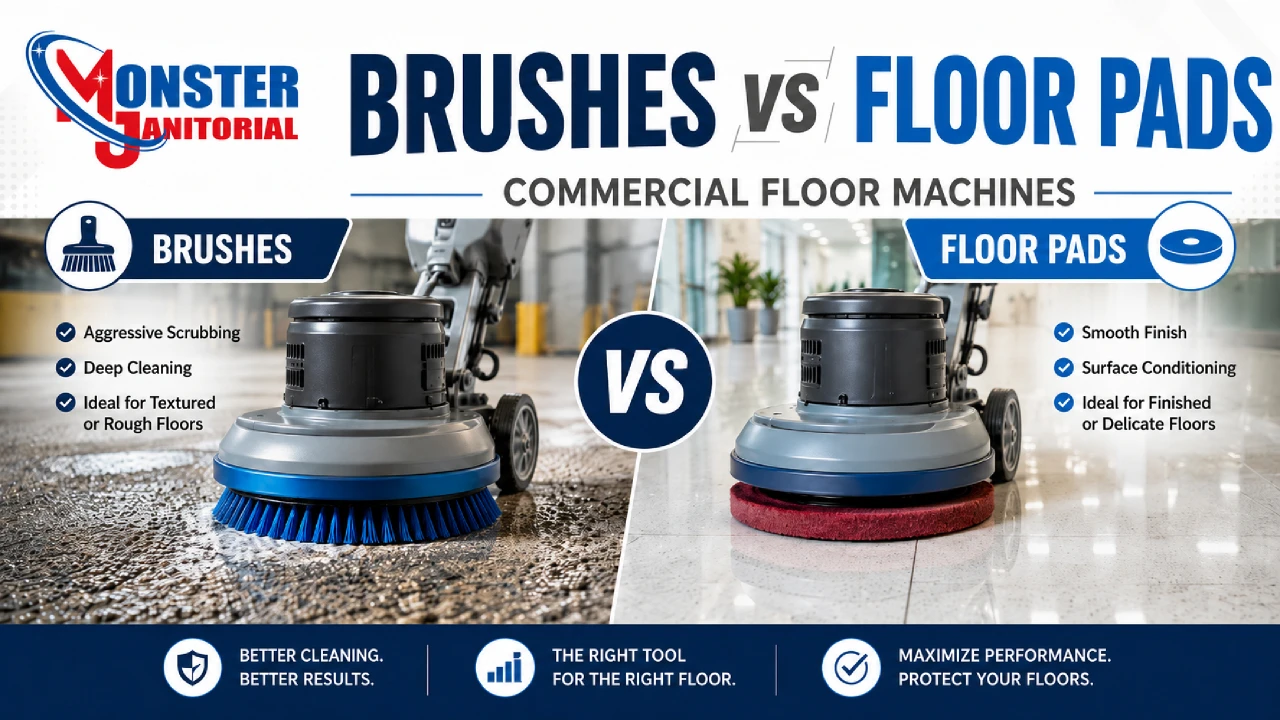
Brushes vs Floor Pads for Commercial Floor Machines
Choose the right floor-contact accessory for auto scrubbers, low-speed floor machines, orbital machines, dual-speed machines, burnishers, and cylindrical scrubbers.
Commercial floor pads and scrubber brushes are designed for different surfaces and maintenance tasks. The correct choice depends on the floor texture, finish, soil level, machine type, operating speed, and desired result.
Pads provide broad, even contact for cleaning and appearance work on smooth floors. Brushes reach into grout lines, texture, seams, and uneven surfaces where a flat pad cannot maintain full contact.
Quick Answer
Use a floor pad on smooth, finished, polished, or appearance-focused floors. Use a brush on rough, textured, uneven, recessed, or heavily soiled surfaces.
The Core Difference
How Pads and Brushes Contact the Floor
Floor Pads
Pads attach to a pad driver and use flat, even friction across the surface.
- Best on smooth and finished floors
- Available in multiple colors and aggressiveness levels
- Used for cleaning, scrubbing, stripping, polishing, buffing, and burnishing
- Available in round, rectangular, and specialty diamond designs
Scrubber Brushes
Brushes use bristles to reach surface texture, low areas, joints, and grout lines.
- Best on rough, textured, or uneven floors
- Provide deeper contact in recessed areas
- Useful for heavier soil and embedded debris
- Available in soft nylon, polypropylene, and grit designs

A scrub brush reaches into rough, textured concrete, while a floor pad provides even contact on smooth, finished flooring.
Quick Selection Guide
Should You Use a Brush or a Floor Pad?
Start with the floor surface and cleaning task, then confirm machine compatibility.
Choose a Floor Pad
For Smooth Floors and Appearance Work
- The floor is smooth, sealed, polished, or finished
- Even surface contact is important
- The task is scrubbing, stripping, polishing, buffing, or burnishing
- You need a specific pad color or aggressiveness level
- You are using a diamond-maintenance program
Choose a Scrubber Brush
For Texture, Recesses, and Heavy Soil
- The floor is rough, textured, uneven, or recessed
- Grout lines or surface patterns need deeper contact
- A flat pad cannot reach the entire surface
- The floor has embedded soil or heavy buildup
- The machine is designed for cylindrical or disc brushes
Special Cases
Try a more aggressive approved pad before switching to a brush.
Use a soft brush and confirm compatibility with the flooring manufacturer.
Use only a burnishing pad rated for the machine speed and floor finish.
Machine Compatibility
Match the Accessory to the Machine
Check accessory diameter, attachment style, pad-driver compatibility, operating speed, and approved applications.
Auto Scrubbers
Disc scrubbers may accept pad drivers or brushes. Choose pads for smooth floors and brushes for texture or heavier agitation.
Low-Speed Floor Machines
Use pads for scrubbing, stripping, spray buffing, and polishing. Compatible brushes may be used for textured surfaces and deep scrubbing.
Orbital Machines
Use pads designed for the machine’s orbital pattern. Common tasks include scrubbing, finish removal, surface preparation, and chemical-free cleaning.
Dual-Speed Machines
Use low speed for scrubbing and stripping and high speed for spray buffing or polishing. Select a pad rated for the chosen speed.
High-Speed Burnishers
Use only burnishing pads rated for the machine speed and floor finish. Brushes and standard stripping pads are not appropriate.
Cylindrical Scrubbers
These machines use cylindrical brushes for textured floors, grout lines, light debris pickup, and selected warehouse applications.
Hard Floor Care Guide
Best Setup by Floor Type
Use the least aggressive accessory that produces acceptable results and follow the flooring manufacturer’s maintenance instructions.
Concrete Floor Care
Pad for Smooth; Brush for Rough
Use red, white, or approved diamond pads on polished or sealed concrete. Use nylon or grit brushes on rough, unfinished, or textured concrete.
Epoxy & Resin Floor Care
Use Non-Aggressive Accessories
Use red pads or soft nylon brushes. Avoid aggressive grit brushes and stripping pads that may scratch or dull the coating.
LVT & LVP Floor Care
Use Soft Cleaning Pads
Use red or manufacturer-approved pads. A soft brush may help on embossed surfaces, but avoid excessive pressure and moisture.
Rubber Floor Care
Match the Surface Pattern
Use red pads on smooth rubber and soft nylon brushes on studded, textured, or athletic rubber.
Stone Floor Care
Use Stone-Safe Pads or Brushes
Use soft pads or approved diamond systems on polished stone. Textured natural stone may require soft brushes.
Terrazzo Floor Care
Use Cleaning or Diamond Pads
Use red pads, white polishing pads, or an approved diamond-maintenance system. Use brushes only where texture interrupts pad contact.
Tile & Grout Floor Care
Brushes Usually Work Better
Brushes reach grout lines and textured tile better than flat pads. Pads remain suitable for smooth tile with shallow joints.
VCT Floor Care
Floor Pads Are Usually Best
Use red pads for routine cleaning, blue or green pads for deeper scrubbing when appropriate, and white or burnishing pads for appearance maintenance.
Wood Floor Care
Use Soft Pads and Minimal Moisture
Use only approved machines, chemicals, and soft pads. Avoid aggressive brushes, excessive solution, and water left on seams.
General Hard Floor Care
Start with Texture and Finish
Smooth surfaces usually favor pads. Textured and recessed surfaces usually favor brushes.
Avoid Unnecessary Wear
What Happens When the Setup Is Wrong?
Rough surfaces can tear and consume pads quickly.
Aggressive accessories may scratch coatings and finishes.
Poor contact can increase labor, chemical, and water use.
Incorrect size or drag can affect handling and performance.
Shop Equipment and Accessories
Floor Pads, Brushes and Commercial Floor Machines
Related MJ University Guides
Continue Learning
Final Verdict
Match the Accessory to the Floor, Machine, and Task
Pads are generally best for smooth floors and appearance-focused maintenance. Brushes are generally best for texture, recesses, and heavier soil. The final choice must also match the machine’s size, attachment system, speed, and approved applications.