
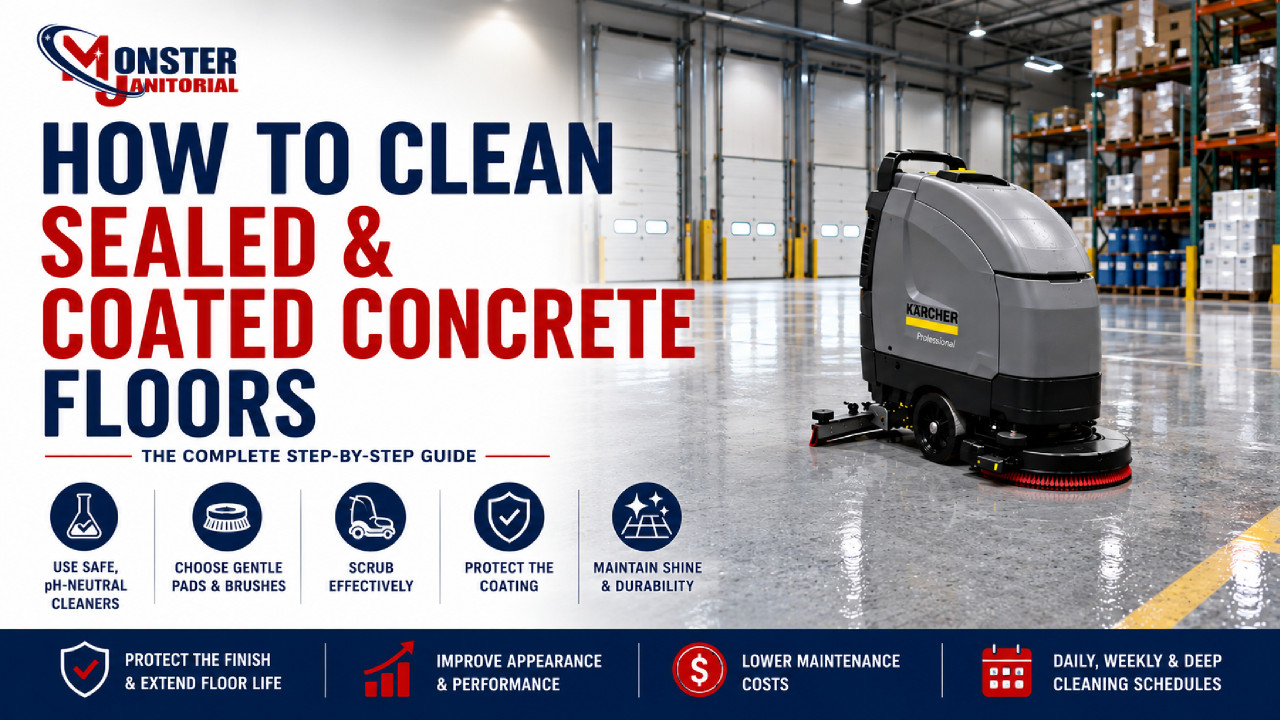
Protected Concrete Floor Care
How to Clean Sealed and Coated Concrete Floors
Learn how to clean sealed, epoxy-coated, urethane-coated, acrylic, polyaspartic, and painted concrete without dulling, softening, scratching, or damaging the protective finish.
Sealed and coated concrete is easier to maintain than bare concrete, but the protective layer can be damaged by the wrong chemical, pad, brush, or machine setting.
The safest cleaning process is to remove grit first, use a neutral low-residue cleaner, agitate with a non-aggressive pad or soft brush, control solution flow, and recover the dirty water before it dries.
Quick Answer
Sweep or vacuum first. Use a neutral, low-foam cleaner for routine maintenance. Start with a white or red pad on smooth coatings, or a soft nylon brush on textured surfaces. Avoid acids, strong solvents, abrasive powders, and aggressive stripping pads unless the coating manufacturer approves them.
Before Cleaning
Identify the Sealer or Coating
Different protective systems respond differently to chemistry, water, abrasion, heat, and solvents. When the coating type is unknown, test a small inconspicuous area before broad cleaning.
Clear Concrete Sealer
May be acrylic, urethane, epoxy, or another topical finish. Harsh cleaners can haze or soften it.
Epoxy Coating
Durable and chemical resistant, but aggressive solvents, abrasive pads, and poor recovery can still damage appearance.
Urethane or Polyaspartic
Often highly durable, but cleaning chemistry should still match the manufacturer’s maintenance instructions.
Painted Concrete
May scratch, soften, chip, or discolor more easily than industrial resin coatings.
Waxed Sealed Concrete
Requires chemistry and pads compatible with the wax or sacrificial finish program.
Textured Safety Coating
Usually needs soft brush agitation because a flat pad may not reach the texture.

Coating-Type Comparison: Clear sealed concrete, epoxy-coated concrete, textured safety coating, and worn or peeling coating require different cleaning methods.
Test Before Full Application
Check for Haze, Softening, Color Change, or Gloss Loss
Test the cleaner, dilution, dwell time, pad or brush, machine pressure, and recovery process in an inconspicuous area. Inspect the test after it dries completely.

Correct Cleaning Setup: Neutral cleaner, a gentle floor pad, controlled solution flow, and immediate water recovery help protect sealed and coated concrete.
Step-by-Step Cleaning
How to Clean Sealed and Coated Concrete
Start gently and increase aggressiveness only after the safer method has been tested.
1. Remove Loose Soil
Sweep, dust mop, or vacuum grit, sand, and debris before wet cleaning.
2. Spot-Clean Spills
Blot liquid spills and remove sticky contamination before spreading solution across the floor.
3. Apply Neutral Cleaner
Use the label-approved dilution and avoid excessive solution around cracks or damaged coating.
4. Allow Controlled Dwell
Keep the cleaner wet for the approved dwell time without letting it dry on the coating.
5. Agitate Gently
Use a white or red pad on smooth surfaces, or a soft brush on textured coatings.
6. Recover Immediately
Pick up dirty solution with an auto scrubber, wet vacuum, or clean recovery system.
7. Rinse When Needed
Use a clean-water pass when foam, residue, or streaking remains.
8. Inspect After Drying
Check gloss, color, traction, residue, scratches, peeling, and worn traffic lanes.
Recommended Chemistry
Use Neutral, Low-Foam Cleaning Chemicals
Neutral chemistry is generally the safest starting point for sealed concrete, epoxy, urethane, polyaspartic, and painted surfaces. Always confirm compatibility with the coating manufacturer.
Karcher Neutral Floor Cleaner
Part Number: 8.698-103.0
Monster SKU: MPK86981030
Low-foam neutral cleaner for compatible finished floors, polished surfaces, and sealed concrete maintenance.
Shop Neutral Floor CleanerConcrete and Terrazzo Floor Cleaners
Compare concrete-care products and verify that the selected chemical is approved for the floor coating or sealer.
Shop Concrete Floor CleanersPad and Brush Selection
Use the Least Aggressive Accessory That Works
White Pad
Best for very light cleaning or polishing on compatible smooth coatings.
Red Pad
A common starting choice for routine cleaning of smooth sealed or coated floors.
Soft Nylon Brush
Better for textured epoxy, anti-slip coatings, joints, grooves, and uneven surfaces.
Approved Specialty Pad
Use only when included in the coating manufacturer’s maintenance program.
Machine Cleaning
Can You Use an Auto Scrubber on Coated Concrete?
Yes. Auto scrubbers can clean sealed concrete, epoxy, and other compatible coated floors when the operator controls chemical strength, pad or brush aggressiveness, down pressure, solution flow, and recovery.
Excess pressure can dull soft coatings and accelerate finish wear.
Avoid flooding cracks, peeling edges, joints, and delaminated areas.
Clean blades and strong vacuum recovery help prevent streaks and standing water.
Targeted Soil Removal
How to Remove Common Soil Without Damaging the Coating
Start with neutral cleaner and red-pad or soft-brush agitation. Test specialty chemistry before use.
Absorb first, then use a coating-compatible degreaser at the correct dilution.
Use an approved spot cleaner and plastic tool instead of a metal scraper.
Use gentle agitation before increasing chemical strength or pad aggressiveness.
Damaged Areas
Clean Carefully Around Peeling, Cracked, or Delaminated Coatings
Reduce water flow and agitation around damaged sections. Do not scrub loose edges aggressively, because this may enlarge the failure. Photograph and mark damaged areas for repair instead of trying to remove the defect through cleaning.
Protect the Coating
What to Avoid
They may etch concrete or damage coating edges and exposed areas.
They may soften, swell, stain, or remove certain sealers and coatings.
They can scratch the surface and create permanent dull areas.
Aggressive pads may remove or deeply abrade the protective layer.
They may gouge, chip, or peel coatings.
Dried cleaner can leave haze, streaks, residue, or uneven gloss.
Troubleshooting
Why Coated Concrete Looks Cloudy, Sticky, Dull, or Discolored
May indicate trapped moisture, sealer failure, or incompatible chemistry.
May result from residue, softened coating, incorrect dilution, or solvent damage.
Often indicate abrasion or finish wear rather than removable soil.
May be staining, ultraviolet exposure, coating wear, or chemical attack.
Cleaning vs Repair
When the Floor Needs Recoating Instead of More Cleaning
Stronger cleaning will not repair peeling, delamination, exposed concrete, deep scratches, worn traffic lanes, moisture whitening, or chemically softened coating.
Contact the coating manufacturer or a qualified flooring contractor when the protective layer is failing or repair preparation is required.
Maintenance Planning
Suggested Cleaning Schedule
Daily or As Needed
Remove grit, clean spills, spot-clean tire marks, and inspect damaged sections.
Weekly
Damp mop or auto scrub with neutral cleaner, low pressure, and a non-aggressive pad or soft brush.
Monthly or Quarterly
Inspect gloss, traction, coating wear, joints, cracks, peeling edges, and chemical damage.
Related Concrete Floor Guides
Continue Learning
Common Questions
Sealed and Coated Concrete FAQs
What is the best cleaner for sealed concrete?
Start with a neutral, low-residue cleaner approved for the specific sealer or coating.
Can an auto scrubber clean epoxy floors?
Yes, using compatible chemistry, low down pressure, controlled water flow, and a non-aggressive pad or soft brush.
Can degreaser be used on coated concrete?
Only when the product is compatible with the coating and used at the correct dilution after testing.
Why is the coating peeling after cleaning?
Peeling may indicate adhesion failure, moisture, age, chemical damage, or aggressive scrubbing. Stop cleaning the area and arrange an inspection.
Final Recommendation
Protect the Coating Before Increasing Aggressiveness
Identify the floor system, remove grit, use neutral chemistry, select a gentle pad or soft brush, control machine pressure and water flow, and recover the cleaning solution completely. When peeling, exposed concrete, deep scratches, or cloudy failure remain, the floor needs repair or recoating rather than stronger cleaning.
- #Auto Scrubber for Epoxy Floors
- #Coated Concrete Floor Cleaning
- #Commercial Concrete Floor Care
- #Concrete Sealer Maintenance
- #Epoxy Floor Cleaning
- #Floor Pads for Coated Concrete
- #How to Clean Sealed Concrete Floors
- #Industrial Floor Coatings
- #Neutral Floor Cleaner
- #Painted Concrete Floors
- #Polyaspartic Floor Cleaning
- #Urethane Floor Care