
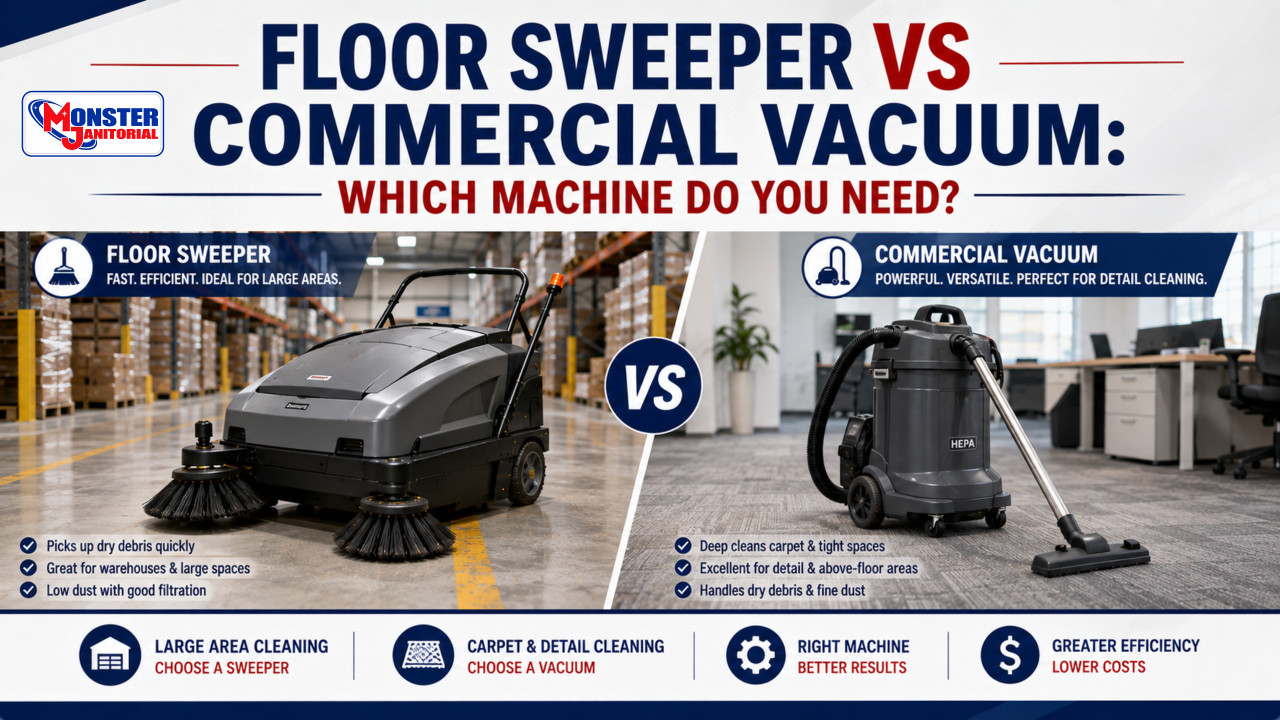
Floor Sweeper vs Commercial Vacuum: Which Machine Do You Need?
Floor sweepers and commercial vacuums both remove dry soil, but they are designed for different surfaces, debris types, cleaning areas, and levels of detail.
Sweepers are generally better for quickly collecting loose debris across larger hard-floor areas, while commercial vacuums use suction and are often better suited to carpet, edges, corners, offices, classrooms, and detailed cleaning.
Should You Choose a Floor Sweeper or Commercial Vacuum?
Choose a floor sweeper when you need fast dry-debris pickup across larger hard-floor areas such as warehouses, manufacturing facilities, parking structures, loading areas, and large corridors. Choose a commercial vacuum when you need suction-based cleaning on carpet, around edges, under furniture, along walls, in offices or classrooms, or in other detailed cleaning areas. Many facilities benefit from having both.
Floor Sweeper vs Commercial Vacuum at a Glance
The biggest differences are how the machines collect debris and where they work most efficiently.
- Best suited to hard floors
- Fast coverage of larger areas
- Handles loose dry debris
- Good for sand, grit, litter, and packaging debris
- Available as manual, walk-behind, and ride-on machines
- Uses rotating brooms and a debris hopper
- Excellent for carpet and detail cleaning
- Uses suction to collect soil
- Can reach edges and corners
- Useful around furniture and workstations
- Many configurations available for different applications
- Filtration options vary by vacuum type and model

Sweepers use rotating brooms to collect loose debris, while commercial vacuums use suction for carpet, detail work, and many smaller-area applications.
What Does a Commercial Floor Sweeper Do?
A commercial sweeper uses a main broom and, on many machines, one or more side brushes to move loose debris into a hopper.
Sweepers are particularly useful when a large amount of hard-floor area must be cleaned efficiently. Depending on the machine and broom configuration, they may collect dust, sand, grit, leaves, litter, cardboard fragments, labels, packaging debris, and other loose material.
What Does a Commercial Vacuum Do?
Commercial vacuums use airflow and suction to collect dry soil. Depending on the vacuum type, they may be designed primarily for carpet, hard floors, upholstery, stairs, edges, detail work, or a combination of surfaces.
Vacuum configurations include upright vacuums, backpack vacuums, canister vacuums, wide-area vacuums, and wet/dry machines. The right design depends on the surface, cleaning area, debris, filtration needs, and required attachments.
Hard Floors vs Carpet
Floor surface is one of the fastest ways to narrow down the machine choice.

Sweepers are commonly used for larger hard-floor areas, while commercial vacuums are generally the better choice for carpeted areas.
Large Debris vs Fine Dust
The type of material being collected is just as important as the size of the cleaning area.
Dust-control performance varies significantly by machine. Always evaluate the filtration system and manufacturer specifications for the actual debris being collected.
Large Open Areas vs Detail Cleaning
Floor sweepers are designed around area coverage. Commercial vacuums are often stronger when the cleaning task requires maneuvering around furniture, reaching edges, cleaning corners, or working in smaller occupied spaces.
A machine that is extremely productive in a warehouse aisle may be impractical inside a furnished office, while a small vacuum that works well around desks may be inefficient for sweeping thousands of square feet of loose warehouse debris.

Sweepers can cover large open hard-floor areas quickly, while vacuums provide greater access around desks, furniture, edges, corners, and narrow spaces.
Which Is Better for Warehouses & Manufacturing Facilities?
For large warehouse aisles and manufacturing floors with loose dry debris, a walk-behind or ride-on sweeper is often the more productive primary machine.
A commercial vacuum may still be useful for offices, carpeted areas, production equipment edges, corners, shelving areas, workstations, and other locations that the sweeper cannot access effectively.
Which Machine Is Better for Schools, Offices & Commercial Buildings?
Commercial vacuums are especially useful in classrooms, offices, conference rooms, carpeted corridors, stairs, and furnished spaces.
A compact manual or battery sweeper can complement the vacuum in larger hard-floor hallways, entry areas, maintenance areas, loading zones, exterior walkways, or other locations where loose dry debris must be collected quickly.
Which Machine Is Better for Parking Garages & Entry Areas?
Parking structures frequently collect sand, grit, litter, leaves, and other coarse dry debris. A walk-behind or ride-on sweeper is typically better suited to covering these larger hard-floor areas.
For entrance mats, carpeted vestibules, corners, stairs, and detailed interior entry cleaning, a commercial vacuum may still be necessary.
When Do You Need Both a Sweeper & Vacuum?
Many facilities have multiple surfaces and cleaning conditions, making a combination of equipment more practical than trying to force one machine to perform every task.
Cleaning Width, Noise & Operator Effort
- Cleaning width: larger sweepers can cover substantial hard-floor areas quickly.
- Maneuverability: compact vacuums generally provide better access around furniture and detailed spaces.
- Operator effort: ride-on sweepers reduce walking over very large areas, while backpack vacuums can improve mobility in furnished interiors.
- Noise: compare actual manufacturer sound ratings when noise-sensitive cleaning is important.
- Debris capacity: compare hopper or vacuum-container capacity based on the amount of soil being collected.
Which Machine Should You Choose?
Sweeper vs Vacuum Buying Mistakes to Avoid
- Choosing based only on machine size instead of floor surface.
- Using a sweeper where detailed suction cleaning is actually required.
- Trying to vacuum very large open areas with equipment that is too small.
- Ignoring the size and type of debris.
- Ignoring filtration requirements.
- Forgetting about edges, furniture, stairs, and tight spaces.
- Choosing one machine for a facility that really needs two different cleaning systems.
- Expecting either machine to replace wet floor scrubbing when the floor requires washing.
Compare Floor Sweepers & Commercial Vacuums
Related Floor Sweeper Guides
Floor Sweeper vs Commercial Vacuum
Current Guide
Best Commercial Floor Sweepers by Facility Type
Compare manual, battery walk-behind, and ride-on sweepers for different facilities and applications.
Read Buying Guide →Sweeper vs Scrubber: Which Floor Cleaning Machine Do You Need?
Learn when dry debris pickup is enough and when the floor needs wet scrubbing and water recovery.
Read Sweeper vs Scrubber →Floor Sweeper Main Brooms, Side Brushes & Filters Explained
Learn how broom wear, side brushes, contact patterns, filters, and replacement selection affect sweeper performance.
Read Brooms & Filters Guide →Commercial Floor Sweeper Maintenance Checklist
Follow daily, weekly, and monthly care for brooms, filters, hoppers, skirts, batteries, and other components.
Read Maintenance Guide →Commercial Floor Sweeper Troubleshooting Guide
Diagnose poor pickup, excessive dust, debris trails, worn brushes, filter problems, and vibration.
Read Troubleshooting Guide →Floor Sweeper vs Commercial Vacuum FAQs
Is a floor sweeper better than a vacuum?
Neither machine is universally better. Sweepers are generally more productive for collecting loose debris across large hard-floor areas, while vacuums are better suited to carpet, detailed cleaning, edges, corners, and many smaller interior spaces.
Can you use a commercial vacuum on hard floors?
Many commercial vacuums can clean hard floors when equipped with the proper floor tool or configuration. For very large areas with significant loose debris, however, a sweeper may provide greater productivity.
Can a floor sweeper clean carpet?
Commercial floor sweepers are primarily intended for suitable hard-floor surfaces. Carpet cleaning should generally be performed with equipment specifically designed for carpet.
Which machine is better for a warehouse?
A walk-behind or ride-on sweeper is often the more productive choice for large warehouse hard floors with loose debris. A commercial vacuum may still be needed for offices, carpet, workstations, corners, and detail areas.
Do schools need both sweepers and vacuums?
Many schools can benefit from both. Vacuums handle classrooms, carpet, offices, stairs, and detail cleaning, while compact sweepers can increase productivity on larger hard-floor corridors, entry areas, and other appropriate spaces.
Can a sweeper or vacuum replace an auto scrubber?
Not when the floor requires wet cleaning. Auto scrubbers apply cleaning solution, mechanically scrub the floor, and recover dirty solution. Sweepers and dry vacuums primarily remove loose dry soil.
Explore More Cleaning Equipment Guides
Floor Sweepers Learning Center
Explore sweeper buying guides, comparisons, maintenance, troubleshooting, brushes, filters, and machine-selection resources.
Visit Sweeper Learning Center →Commercial Vacuums Learning Center
Learn about commercial vacuum types, filtration, machine selection, maintenance, and cleaning applications.
Visit Vacuum Learning Center →Need Help Choosing Between a Sweeper & Commercial Vacuum?
Monster Janitorial can help compare equipment based on your floor surfaces, square footage, debris type, carpeted areas, dust-control needs, cleaning frequency, and facility layout.
Tax-exempt purchasing and purchase-order support are available for qualifying schools, universities, government agencies, healthcare facilities, municipalities, and other institutional customers.
- #Battery Walk-Behind Sweepers
- #Canister Vacuums
- #Carpet Cleaning Equipment
- #Commercial Cleaning Equipment
- #Commercial Floor Sweepers
- #Commercial Vacuum Comparison
- #Commercial Vacuums
- #Dry Debris Pickup
- #Dust Control
- #Facility Cleaning Equipment
- #Floor Sweeper Comparison
- #Floor Sweeper vs Vacuum
- #Hard Floor Cleaning
- #Manual Sweepers
- #MJ University
- #Ride-On Sweepers
- #School Cleaning Equipment
- #Sweeper vs Commercial Vacuum
- #Warehouse Cleaning Equipment
- #Wet Dry Vacuums