
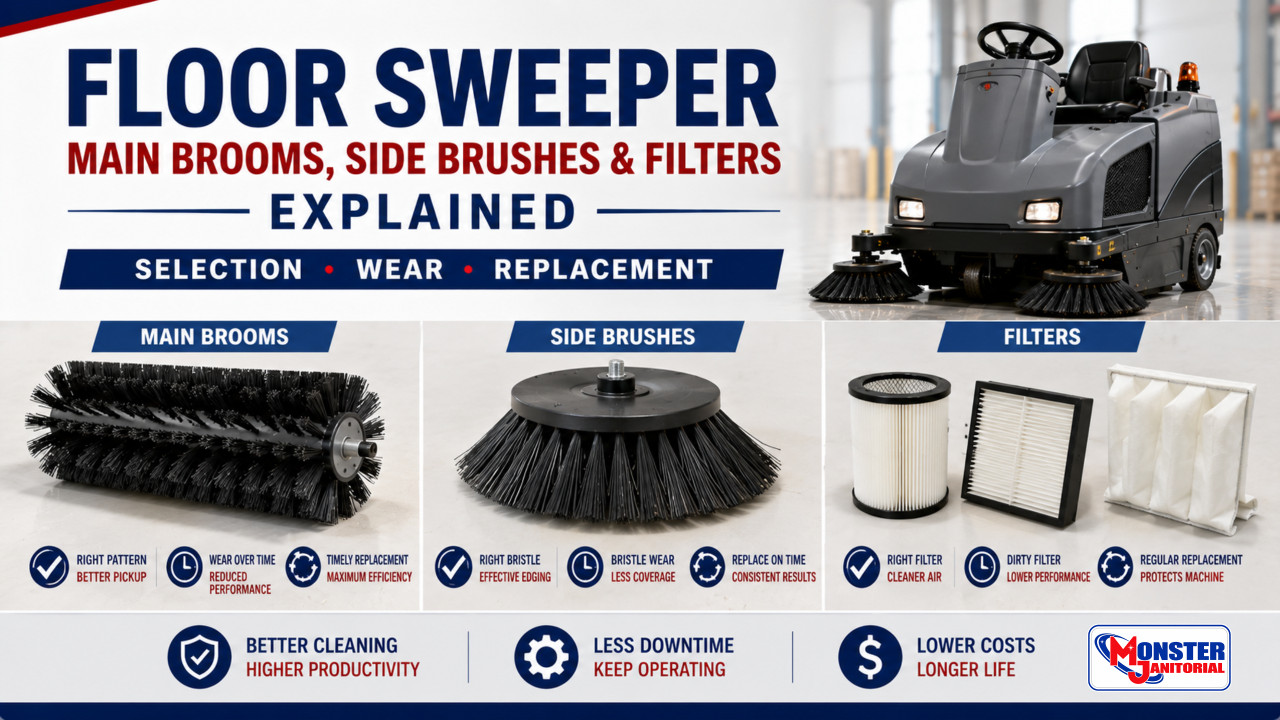
Floor Sweeper Main Brooms, Side Brushes & Filters Explained: Selection, Wear & Replacement
Main brooms, side brushes, and dust filters directly affect how well a commercial floor sweeper collects debris, cleans along edges, and controls airborne dust.
Understanding what each component does—and recognizing wear before performance drops—can help improve pickup, reduce dust, prevent unnecessary machine adjustments, and make replacement parts easier to select.
When Should Sweeper Brooms, Side Brushes & Filters Be Replaced?
Replace a main broom when bristles become excessively short, uneven, damaged, or can no longer maintain the manufacturer's recommended contact pattern. Replace a side brush when bristles become severely worn, bent, broken, or no longer sweep debris effectively toward the main broom. Clean or replace a dust filter according to the manufacturer's instructions when airflow decreases, dust escapes from the machine, or the filter becomes loaded or damaged.
Why Brooms, Brushes & Filters Matter
A commercial floor sweeper depends on several wear components working together. When one of these components becomes worn, dirty, damaged, or incorrectly adjusted, overall sweeping performance may decline.
What Does the Main Sweeper Broom Do?
The main broom is the primary debris-collection component on most commercial sweepers. As it rotates, it lifts loose material from the floor and directs it toward or into the hopper.
Main broom design varies by sweeper. Brush diameter, width, bristle material, bristle pattern, stiffness, rotation speed, and adjustment method may all differ between manufacturers and machine models.
Main Broom Bristle Types & Applications
Replacement broom selection should be based on the sweeper model, floor surface, debris type, and manufacturer recommendations.
Always use a replacement broom approved for the specific sweeper. Bristle materials and patterns are not universally interchangeable.
Signs a Main Broom Is Worn
- Bristles are noticeably shorter than when new.
- Bristles are bent, broken, missing, or uneven.
- The broom cannot maintain the manufacturer's recommended contact pattern.
- Debris remains behind even after broom adjustment.
- Pickup becomes inconsistent across the cleaning path.
- Excessive broom adjustment is required to maintain contact with the floor.

A worn main broom may have shortened, uneven, bent, or damaged bristles that reduce consistent debris pickup.
Why Main Broom Contact Pattern Matters
The main broom needs enough floor contact to lift debris effectively, but excessive pressure can increase broom wear and may reduce sweeping performance.
Follow the sweeper manufacturer's procedure for checking and adjusting the broom contact pattern. The correct contact width and adjustment method vary by machine.

An even broom contact pattern helps provide consistent pickup. Follow the manufacturer's specified adjustment procedure for the machine.
What Does a Floor Sweeper Side Brush Do?
The side brush extends beyond the main cleaning path to reach debris near walls, curbs, shelving, corners, equipment, and other edges.
Its job is generally to move debris inward toward the main broom so the primary sweeping system can collect it.
Signs a Side Brush Needs Attention
- Bristles are severely shortened or uneven.
- Bristles are permanently bent or flattened.
- Large sections of bristles are missing or broken.
- The machine leaves debris along walls or edges.
- The brush scatters debris instead of directing it inward.
- The brush can no longer be adjusted to the recommended working position.

A side brush with badly bent, shortened, or damaged bristles may no longer sweep edge debris effectively toward the main broom.
Do Not Compensate for Wear With Excessive Brush Pressure
As side-brush bristles wear, some machines allow the brush height or pressure to be adjusted. Adjustment can help maintain proper floor contact, but it cannot restore a brush that has reached the end of its usable life.
Excessive downward pressure may accelerate wear and can cause debris scattering. Follow the manufacturer's adjustment specifications rather than lowering the brush as far as possible.
What Does a Commercial Sweeper Dust Filter Do?
Powered commercial sweepers may use a filtration system to help capture fine particles carried by the machine's airflow.
Filter design varies significantly by machine. Depending on the sweeper, the filter may be a panel, cartridge, pleated element, or another manufacturer-specific design.
Loaded Filter vs Damaged Filter

A heavily loaded filter can restrict airflow and reduce dust-control performance even if the filter itself is not physically damaged.
When Should You Clean a Filter vs Replace It?
Filter maintenance should always follow the sweeper manufacturer's instructions because approved cleaning methods vary by filter media and machine design.
Do not wash, blow out, strike, or otherwise clean filter media unless that cleaning method is specifically approved by the manufacturer.
How Worn Brooms & Filters Affect Sweeper Performance
How to Choose the Correct Replacement Broom, Brush or Filter
Do not select sweeper wear parts by appearance alone. Similar-looking brooms and filters may use different dimensions, mounting systems, bristle materials, filtration specifications, or machine-specific designs.
- Identify the sweeper manufacturer.
- Find the exact machine model.
- Check the machine serial number when required.
- Verify the OEM or approved replacement part number.
- Confirm broom width, diameter, mounting design, and bristle configuration.
- Confirm filter dimensions and filter-media requirements.
- Use the manufacturer's parts manual when available.
Sweeper Brush & Filter Replacement Mistakes
- Using a broom simply because it has similar dimensions.
- Choosing the wrong bristle material for the floor or debris.
- Continuing to lower a badly worn broom instead of replacing it.
- Running a side brush with excessive floor pressure.
- Ignoring debris wrapped around broom shafts or brush hubs.
- Using unapproved cleaning methods on filter media.
- Reusing a torn or damaged filter.
- Ordering replacement parts without confirming the exact machine model or part number.
When the Problem May Be More Than a Wear Part
Replacing a broom or filter will not correct every sweeper problem. If the machine develops severe or sudden vibration, abnormal grinding or knocking, burning smells, unusual heat, damaged electrical wiring or battery components, steering or drive problems, or loose rotating components, remove it from service and inspect it before continued use.
Internal electrical or mechanical repairs should be performed by qualified service personnel when required.
Continue Learning About Commercial Floor Sweepers
Main Brooms, Side Brushes & Filters Explained
Current Guide
Commercial Floor Sweeper Maintenance Checklist
Follow daily, weekly, and monthly care for brushes, brooms, filters, hoppers, batteries, skirts, and other components.
Read Maintenance Guide →Commercial Floor Sweeper Troubleshooting Guide
Diagnose poor pickup, excessive dust, debris trails, worn brushes, filter problems, and vibration.
Read Troubleshooting Guide →Best Commercial Floor Sweepers by Facility Type
Compare manual, battery walk-behind, and ride-on sweepers by facility size, debris type, and application.
Read Buying Guide →Commercial Floor Sweepers
Compare manual push, battery walk-behind, and ride-on commercial sweepers for warehouses, schools, retail facilities, manufacturing plants, parking structures, and other commercial applications.
Sweeper Broom, Brush & Filter FAQs
How do I know when a floor sweeper main broom needs replacement?
Replacement may be needed when the bristles are excessively worn, uneven, damaged, or can no longer maintain the manufacturer's specified contact pattern even after proper adjustment.
Can I keep lowering the main broom as it wears?
Many sweepers allow broom adjustment as bristles wear, but there is a limit. Once the broom cannot maintain the correct contact pattern or performance remains poor after proper adjustment, replacement may be necessary.
Why is my side brush leaving debris along walls?
The side brush may be worn, damaged, incorrectly adjusted, rotating improperly, or unable to move debris effectively toward the main broom.
Can a dirty sweeper filter cause excessive dust?
Yes. A heavily loaded filter may restrict airflow and reduce dust-control performance. A torn or damaged filter may also allow dust to escape.
Can I wash a commercial sweeper filter?
Only if the manufacturer specifically approves washing for that filter type. Some filter media can be permanently damaged by water or other improper cleaning methods.
How do I order the correct sweeper replacement parts?
Start with the manufacturer, exact machine model, serial number when required, and the OEM or approved replacement part number. Do not rely only on the visual appearance of the old part.
Floor Sweepers Learning Center
Explore floor sweeper buying guides, machine comparisons, maintenance, troubleshooting, broom and filter guidance, and equipment-selection resources.
Visit Floor Sweepers Learning Center →Need Help Finding Sweeper Brushes, Brooms or Filters?
Monster Janitorial can help identify the correct replacement broom, side brush, filter, or other sweeper component. Have the manufacturer, machine model, serial number, and existing part number available when possible.
Tax-exempt purchasing and purchase-order support are available for qualifying schools, universities, government agencies, healthcare facilities, municipalities, and other institutional customers.
- #Broom Wear
- #Brush Wear
- #Commercial Floor Sweepers
- #Dust Filters
- #Floor Sweeper Maintenance
- #Floor Sweeper Parts
- #Floor Sweeper Troubleshooting
- #Industrial Floor Sweepers
- #Main Brooms
- #MJ University
- #Ride-On Sweepers
- #Side Brushes
- #Sweeper Broom Adjustment
- #Sweeper Contact Pattern
- #Sweeper Dust Control
- #Sweeper Filters
- #Sweeper Main Broom
- #Sweeper Replacement Parts
- #Sweeper Side Brush
- #Sweeper Wear Parts
- #Walk-Behind Sweepers