
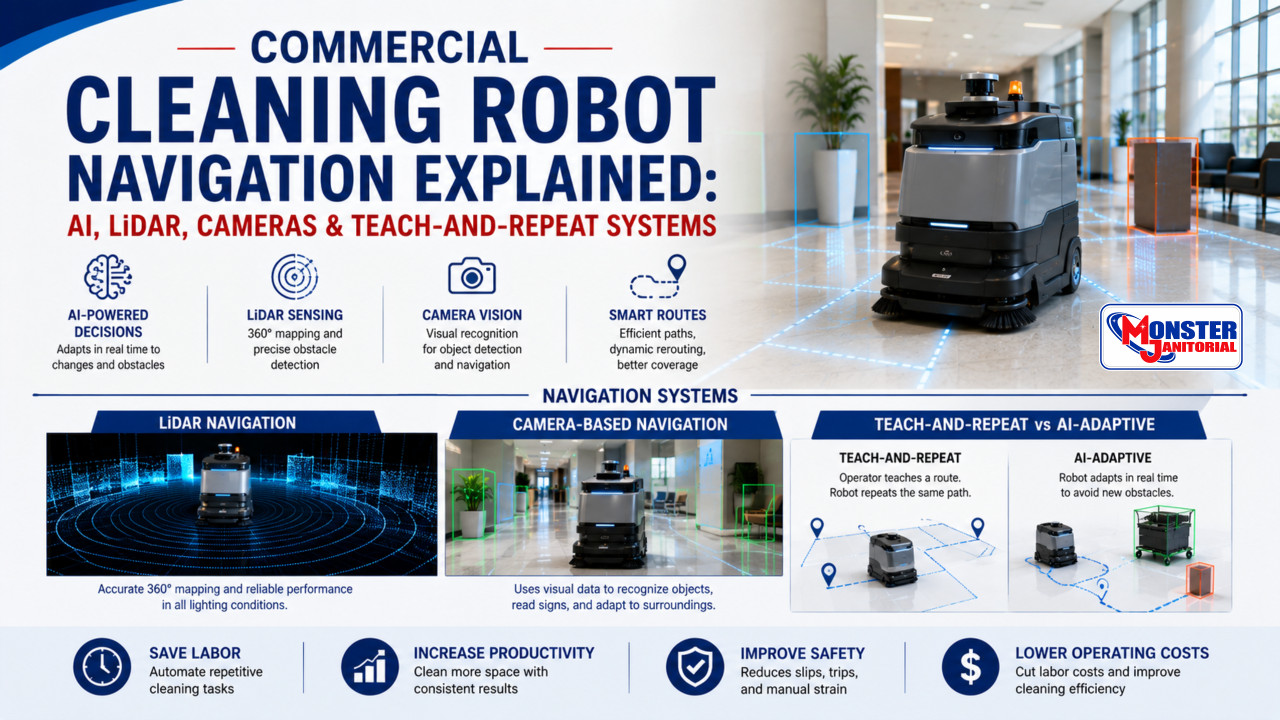
Commercial Cleaning Robot Navigation Explained: AI, LiDAR, Cameras & Teach-and-Repeat Systems
Commercial cleaning robots use combinations of mapping, sensors, cameras, LiDAR, software, and navigation logic to understand where they are, follow cleaning routes, detect obstacles, and adapt to changing environments.
Understanding how these technologies work can help facility managers compare robotic floor scrubbers more effectively and determine which navigation approach is best suited to their building.
How Do Commercial Cleaning Robots Navigate?
Most commercial cleaning robots combine multiple technologies rather than relying on one sensor alone. LiDAR can measure distances and map surrounding structures, cameras can provide visual information, proximity and safety sensors help detect nearby objects, and navigation software uses that information to determine the robot's location and route. Some systems follow routes taught by an operator, while more adaptive systems can respond dynamically when people, carts, furniture, or other obstacles change the environment.
How Commercial Cleaning Robot Navigation Works
A robotic scrubber needs to continuously answer several questions while it cleans: Where am I? Where should I go next? Is the planned route still clear? Is there an object or person in the way? Can I safely continue, reroute, pause, or return to another area?
Mapping
The robot creates or uses a digital representation of the facility so cleaning routes can be planned and repeated.
Localization
The robot estimates its current position within the mapped environment while it moves through the cleaning route.
Obstacle Response
Sensors and navigation software help the machine detect people, furniture, equipment, carts, and other objects that may affect its route.
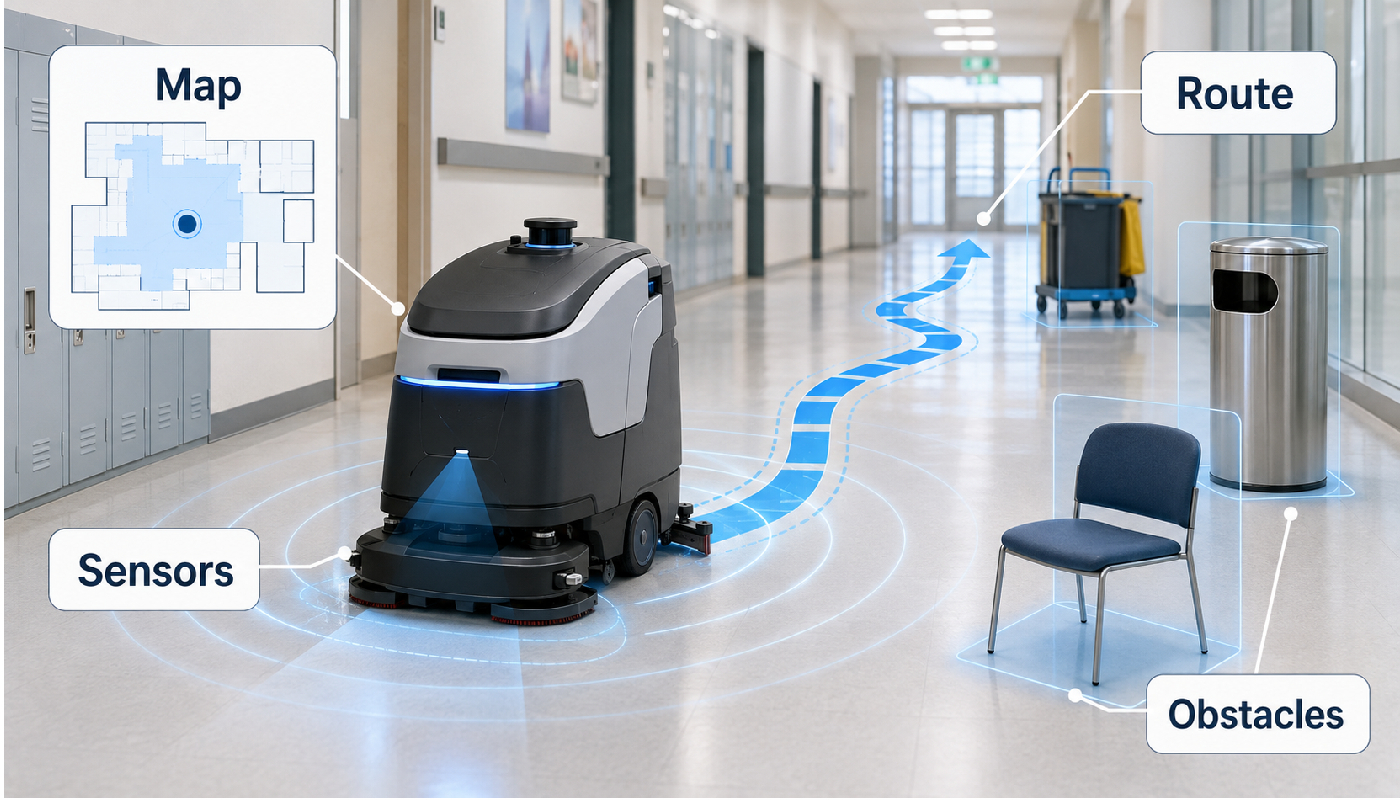
Robotic cleaning systems combine mapping, sensors, route planning, and obstacle detection to move through commercial facilities.
What Does AI Mean in Commercial Cleaning Robotics?
In commercial cleaning equipment, the term AI may refer to software that helps interpret sensor data, identify environmental changes, select routes, respond to obstacles, improve mapping, or make operational decisions while the machine is running.
The exact capabilities vary by manufacturer and platform. A machine described as AI-powered may still rely heavily on LiDAR, cameras, proximity sensors, predefined maps, or operator-created routes. Facility managers should compare the actual navigation functions instead of relying only on broad technology labels.
How LiDAR Navigation Works
LiDAR uses laser-based distance measurements to help a robot understand the shape and location of surrounding objects and building features. Repeated measurements can help the robot estimate its position and compare its surroundings with a stored map.
Mapping walls, corridors, fixtures, equipment, and other physical features within the robot's sensing range.
Distance measurements do not depend on visible surface color in the same way a conventional camera image does.
Navigation software, safety systems, mapping logic, and usually other sensors to create a complete autonomous system.
How Camera-Based Navigation Works
Camera systems capture visual information about the surrounding environment. Navigation software may use this information to recognize features, detect obstacles, estimate movement, interpret the facility layout, or supplement other navigation sensors.
Some robotic systems combine cameras with LiDAR and other sensors. This sensor-fusion approach allows the platform to use multiple sources of information instead of depending entirely on one technology.

LiDAR measures surrounding distances while cameras capture visual information. Many robotic platforms combine multiple sensing technologies.
LiDAR vs Camera Navigation
Neither technology should automatically be considered better in every facility. What matters is how the complete robotic platform combines sensing, software, mapping, safety systems, and route management.
LiDAR
- Measures distance using laser-based sensing
- Useful for geometric mapping and localization
- Can help identify walls and physical obstacles
- Usually works as part of a larger sensor system
Cameras
- Capture visual information about the environment
- May support feature recognition and obstacle interpretation
- Can supplement mapping and localization
- Often combined with additional sensors and software
How Sensors Help Robots Detect Obstacles
Commercial cleaning robots commonly use multiple sensors to detect objects and support safe movement. Depending on the platform, these may include LiDAR, cameras, proximity sensors, bump sensors, depth sensors, ultrasonic sensors, wheel encoders, or other safety and positioning technologies.
The robot's software interprets these inputs to determine whether it should continue, slow down, stop, wait, reroute, or mark an area as temporarily unavailable.
What Is Teach-and-Repeat Navigation?
Teach-and-repeat systems typically begin with an operator guiding the machine through a desired cleaning route. The robot records information about that route so it can later repeat the cleaning pattern autonomously.
This approach can work well in stable environments where routes remain predictable. If a facility changes substantially, the route may need to be adjusted, retrained, or remapped depending on the platform.
What Is AI-Adaptive Navigation?
More adaptive robotic systems may use maps, sensors, and navigation software to respond dynamically when conditions differ from the original route. Instead of simply stopping whenever something changes, the machine may be able to determine whether another safe path is available.
The amount of adaptation varies substantially between robotic platforms. Facility managers should ask manufacturers or dealers exactly how the machine responds to blocked routes, changing furniture, temporary barriers, crowds, or inaccessible areas.

Teach-and-repeat systems follow established cleaning routes, while more adaptive systems may adjust their path when conditions change.
Teach-and-Repeat vs AI-Adaptive Robotics
Teach-and-Repeat
Best suited to environments where an operator can establish a consistent cleaning route and the floor layout remains relatively predictable.
Good Fit:Long corridors, predictable open areas, stable warehouse aisles, and other repeatable routes.
AI-Adaptive Navigation
Designed to provide more flexibility when obstacles, traffic, or route conditions change during autonomous operation.
Good Fit:Facilities where temporary obstacles, changing traffic, or variable access frequently affect the cleaning route.
How Robots Know Where They Are
Autonomous navigation depends on localization: the robot must continuously estimate where it is within the facility. Depending on the system, localization may use LiDAR scans, camera features, wheel movement, stored maps, sensor landmarks, or combinations of these inputs.
If localization becomes unreliable, a robot may pause, stop the route, request operator assistance, or attempt to determine its position again. This is why facility layout, environmental changes, sensor cleanliness, and proper deployment are important.
How Robots Handle People, Carts & Changing Obstacles
Commercial environments rarely remain completely static. People walk through corridors, carts are parked temporarily, displays move, pallets enter warehouse aisles, and equipment may block previously open routes.
A robotic platform's response depends on its sensors and software. Some machines may wait for an obstacle to move, some may reroute around it, and others may skip the blocked area and continue elsewhere. These behaviors should be demonstrated during a facility evaluation rather than assumed from marketing terminology alone.
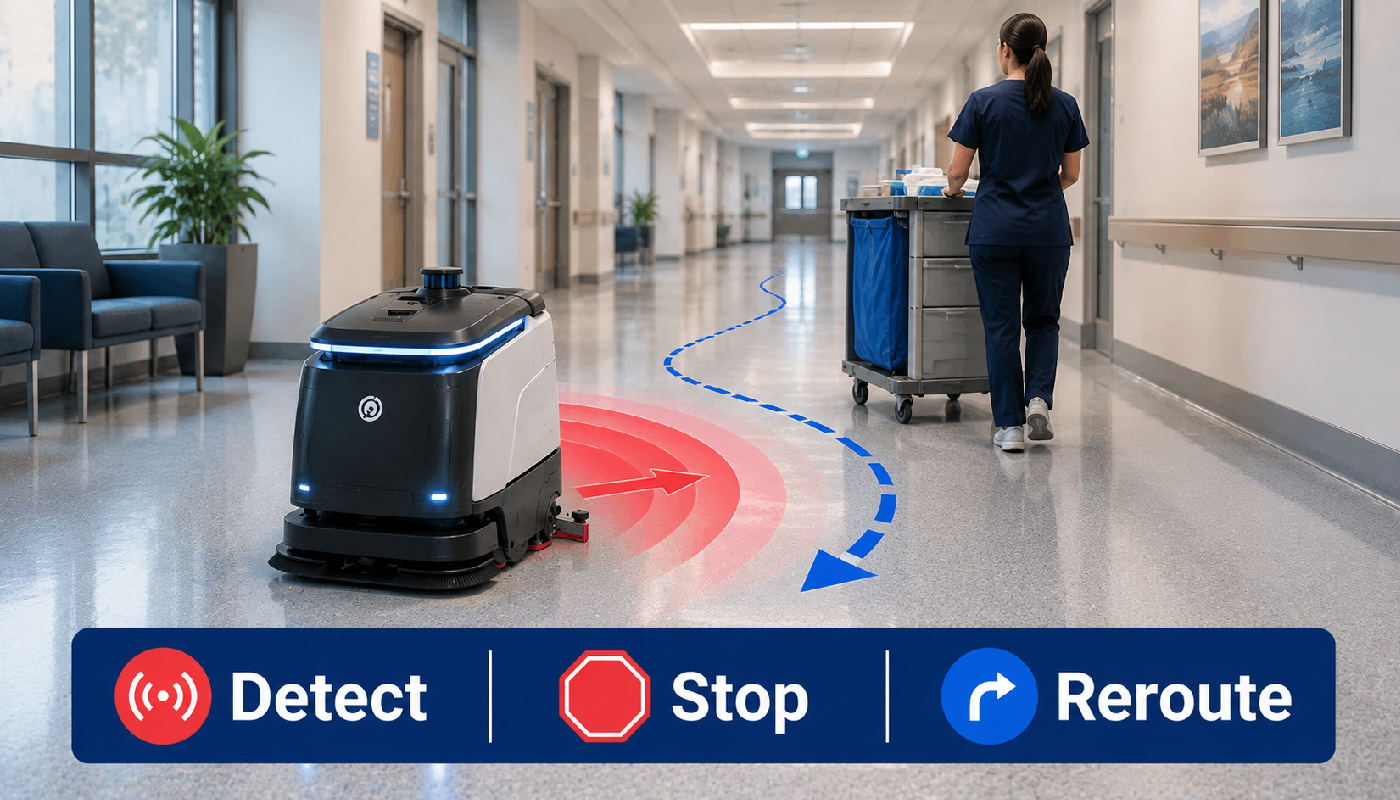
Depending on the robotic platform, the machine may detect an obstacle, stop or slow down, and then continue or reroute when a safe path is available.
Which Navigation Approach Is Best by Facility Type?
The facility layout matters more than the industry label alone, but different environments create different navigation priorities.
Schools & Universities
Prioritize obstacle response, simple remapping, quiet operation, and navigation that can handle chairs, backpacks, carts, and changing hallway traffic.
Healthcare
Prioritize reliable localization, conservative obstacle response, occupied-space navigation, and predictable operation around staff and equipment.
Airports
Look for robust obstacle detection, rerouting capability, large-area mapping, and route performance around passengers, luggage, queues, and carts.
Warehouses
Prioritize long-route localization, durable sensing systems, obstacle response, and navigation around pallets, forklifts, staging areas, and changing aisle access.
Retail
Look for maneuverability, easy route changes, strong obstacle detection, and navigation that can adapt to carts, displays, promotions, and customer traffic.
Large Commercial Buildings
Compare mapping capacity, route scheduling, fleet tools, elevator requirements, obstacle response, and the ease of redeploying machines across multiple zones.
What Happens When the Environment Changes?
One of the most important differences between robotic platforms is how they react when the real facility no longer matches the expected route.
- A chair or cart blocks a corridor
- A warehouse aisle is temporarily closed
- A retail display changes location
- A crowd forms in a previously open space
- A door that was normally open is closed
- Temporary barriers or equipment appear along the route
During a demo, ask the supplier to intentionally create realistic obstacles so you can see exactly how the machine responds.
Navigation Features to Compare Before Buying
Mapping Method
How is the facility mapped, and how difficult is it to create or modify routes?
Obstacle Avoidance
Does the machine stop, wait, reroute, skip the area, or require operator intervention?
Remapping
How easily can routes be updated when displays, walls, furniture, or operations change?
Localization Recovery
What happens if the robot becomes unsure of its position or loses confidence in the map?
Route Scheduling
Can routes be scheduled, prioritized, repeated, assigned to zones, or managed across multiple machines?
Reporting
Can the system show completed routes, skipped areas, interruptions, alerts, maps, or utilization data?
Common Navigation Limitations
Even advanced robotic scrubbers have operating limits. The exact limitations depend on the machine and manufacturer, but facility conditions can affect autonomous performance.
- Extremely cluttered environments
- Constantly changing floor layouts
- Routes frequently blocked by equipment or crowds
- Difficult transitions, ramps, thresholds, or access points
- Dirty, blocked, or damaged navigation sensors
- Areas requiring frequent manual repositioning
- Locations where the robot cannot reliably maintain localization
Questions to Ask During a Robotic Scrubber Demo
- Which sensors does this machine use for navigation?
- Does it use LiDAR, cameras, or both?
- How is the cleaning map created?
- How does the robot respond to a blocked route?
- Can it reroute around temporary obstacles?
- How difficult is it to change or retrain a route?
- What happens if the robot loses localization?
- What sensor maintenance is required?
- What navigation information appears in reports?
- Can the machine be tested in our actual facility before purchase?

A facility demo can reveal how the robot handles your actual corridors, carts, obstacles, traffic patterns, floor transitions, and changing routes.
Related Robotic Cleaning Guides
Continue learning about robotic scrubber selection, facility deployment, cleaning platforms, fleet management, and autonomous cleaning technology.
Commercial Cleaning Robot Navigation Explained
Understand AI, LiDAR, cameras, sensors, mapping, teach-and-repeat routes, and adaptive navigation.
Best Robotic Floor Scrubbers by Facility Type
Compare robotic cleaning applications for schools, healthcare facilities, airports, warehouses, retail, government buildings, and more.
Read Facility Guide →What Facility Managers Should Know Before Deploying Robotic Scrubbers
Review site readiness, floor plans, obstacles, training, staffing, docking, and operational planning.
Read Deployment Guide →Understanding Commercial Cleaning Robotics Platforms
Compare commercial robotics platforms, deployment philosophies, navigation approaches, and system priorities.
Read Platform Guide →Commercial Robotics Fleet Management Software Explained
Learn how robotics software can monitor routes, usage, performance, alerts, reporting, and multiple cleaning machines.
Read Fleet Guide →The Future of Autonomous Commercial Cleaning
Explore AI, autonomous fleets, cloud analytics, connected equipment, and the future of robotic cleaning.
Read Future Guide →Shop Robotic Cleaning Equipment
Explore autonomous floor scrubbers and robotic commercial cleaning equipment for schools, healthcare facilities, airports, warehouses, government buildings, campuses, and other large commercial facilities.
Shop Robotic Cleaning Equipment →Commercial Cleaning Robot Navigation FAQ
Do all commercial cleaning robots use LiDAR?
No. Navigation systems vary by manufacturer and model. Some use LiDAR, some use cameras, and many combine multiple sensors and navigation technologies.
Is LiDAR better than camera navigation?
Not automatically. The performance of the complete navigation system depends on how sensors, mapping, software, obstacle detection, and safety systems work together.
What is teach-and-repeat robotics?
Teach-and-repeat systems typically record a route demonstrated by an operator and later repeat that route autonomously.
Can a cleaning robot reroute around obstacles?
Some platforms can dynamically reroute around certain obstacles, while others may stop, wait, skip the area, or require operator assistance. The behavior varies by platform.
Do robotic scrubbers need to be remapped when a facility changes?
Sometimes. Minor temporary obstacles may be handled automatically, while major changes to walls, fixtures, routes, or room layouts may require route updates or remapping depending on the system.
What is the best way to compare robotic navigation systems?
Test the machines in the actual facility and create realistic obstacles, traffic, blocked routes, and layout changes. Comparing real behavior is more useful than comparing technology names alone.
Need Help Comparing Robotic Cleaning Navigation Systems?
Monster Janitorial can help evaluate robotic scrubbers based on your facility layout, cleaning routes, traffic, obstacles, navigation requirements, docking needs, staffing goals, and productivity expectations.
Tax-exempt purchasing and purchase-order support are available for qualifying schools, universities, government agencies, municipalities, healthcare facilities, and other institutional customers.
- #AI cleaning robots
- #AI-adaptive robotics
- #autonomous floor scrubbers
- #autonomous navigation
- #camera navigation
- #cleaning robot sensors
- #commercial cleaning robots
- #commercial floor cleaning
- #facility cleaning automation
- #LiDAR navigation
- #obstacle detection
- #robot navigation
- #robotic cleaning technology
- #robotic floor scrubbers
- #teach-and-repeat robotics