
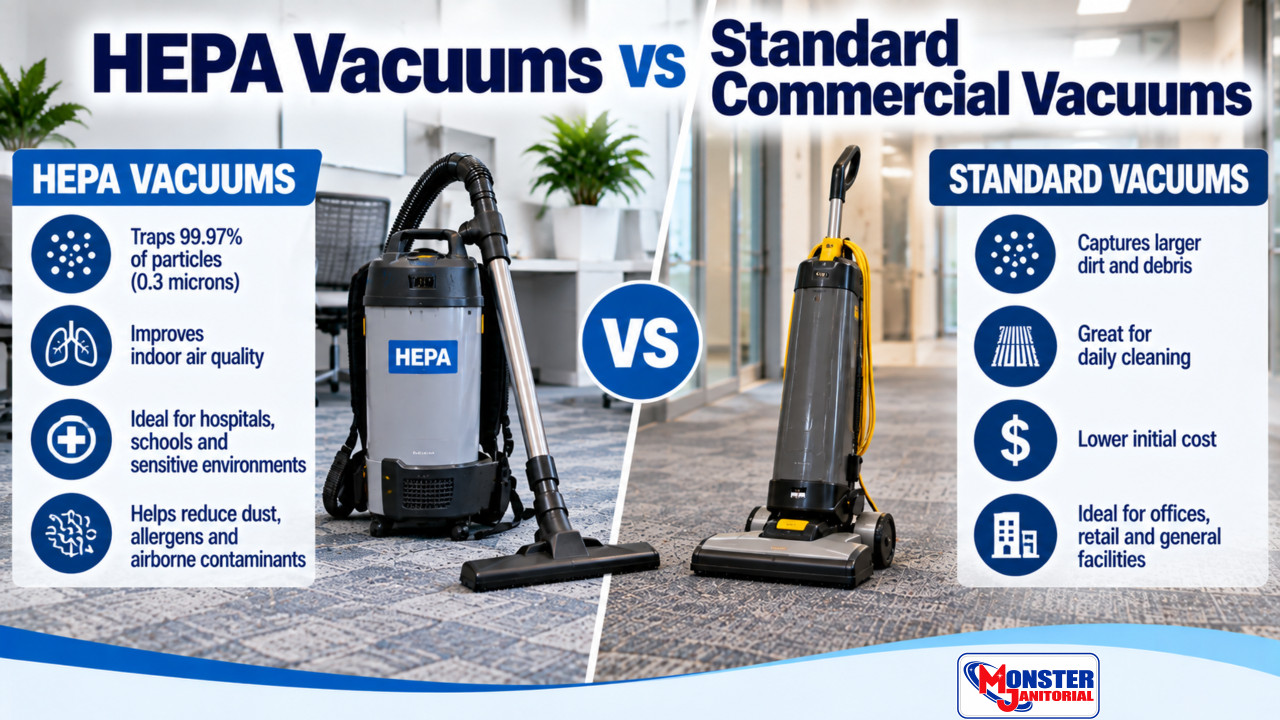
HEPA Vacuums vs Standard Commercial Vacuums
HEPA filtration can be valuable in schools, healthcare facilities, hotels, offices, government buildings, and other occupied commercial spaces. But a HEPA filter is only one part of a commercial vacuum. Cleaning performance also depends on airflow, suction, dust containment, bags, seals, floor tools, maintenance, and the overall filtration system.
HEPA Is About Fine-Particle Filtration — Not Just Suction
A HEPA-equipped commercial vacuum is designed to capture very fine particles at a specified filtration efficiency. A standard commercial vacuum may still provide excellent cleaning performance for routine soil and debris, but it may not provide the same fine-particle filtration level.
What Does HEPA Mean?
HEPA stands for High-Efficiency Particulate Air. HEPA filtration is designed to capture very small airborne particles that pass through the vacuum's filtration system.
Many commercial HEPA systems are rated to capture at least 99.97% of particles at 0.3 microns. Always verify the exact filtration specification of the machine you are considering.
A HEPA Filter Does Not Automatically Mean the Entire Vacuum Is Sealed
A vacuum can contain a HEPA filter without every part of the machine being designed as a sealed HEPA system. Dust can potentially escape through poorly fitted bags, seals, housings, connections, or other exhaust paths.
When filtration performance is a major purchasing requirement, review the complete vacuum design—not only the filter label.
What Makes a Good Commercial Filtration System?
The first stage of containment on many bagged commercial vacuums.
Helps protect the motor and capture material before it reaches later filtration stages.
Captures fine particulate that reaches the high-efficiency filtration stage.
Help reduce unfiltered air bypassing the intended filtration path.
Controls the air leaving the vacuum after collection.
Filters, bags, gaskets, and seals must be maintained correctly for the system to perform as intended.
HEPA Vacuum vs Standard Commercial Vacuum
Both can be effective cleaning tools. The main difference is the filtration requirement and the type of particles the facility wants to control.
Fine-Particle Filtration
- High-efficiency fine-particle filtration
- Useful in filtration-sensitive environments
- Often uses multi-stage filtration
- Requires proper filter maintenance
- May cost more to maintain
Routine Soil & Debris
- Effective routine vacuuming
- May use standard or high-efficiency filters
- Often lower filter replacement cost
- Good fit for many general cleaning programs
- Filtration level varies widely by model
HEPA vs Standard Vacuum Comparison
| Feature | HEPA Vacuum | Standard Commercial Vacuum |
|---|---|---|
| Fine-Particle Filtration | High-efficiency HEPA filtration | Varies by model |
| Routine Dirt & Debris | Yes | Yes |
| Filter Cost | Often higher | Often lower |
| Maintenance Importance | Very important | Very important |
| Schools & Healthcare | Often preferred where filtration is a priority | Application dependent |
| General Commercial Cleaning | Excellent option | Often sufficient depending on requirements |
When Is a HEPA Vacuum Worth Choosing?
HEPA filtration becomes especially useful when fine-particle containment is part of the facility's cleaning goals or operating requirements.
Classrooms, libraries, administrative offices, and carpeted common areas.
Facilities with stricter cleaning and filtration procedures.
Guest rooms, corridors, conference spaces, and occupied areas.
Carpeted workspaces and facilities focused on dust containment.
Buildings with specified cleaning or procurement requirements.
Applications where control of smaller particulate is important.
Not Every Commercial Cleaning Application Requires HEPA
A well-designed standard commercial vacuum can be perfectly appropriate for routine carpet cleaning and general dry-soil removal when HEPA filtration is not required by the facility.
The correct choice depends on facility policy, cleaning objectives, occupant needs, regulatory or contract requirements, flooring, soil type, maintenance budget, and the vacuum manufacturer's specifications.
Do Not Choose a Vacuum by Filtration Alone
A high-quality filter does not automatically make a vacuum better at removing soil from carpet. Cleaning performance depends on the entire machine.
Helps move air and collected soil through the vacuum system.
Important for soil pickup and recovery performance.
The correct cleaning head is essential for the flooring being vacuumed.
An overfilled bag can restrict airflow and reduce pickup.
A Dirty HEPA Filter Can Reduce Vacuum Performance
As vacuum bags and filters load with dust, airflow may decrease. That can reduce pickup performance and make the vacuum work harder.
What a HEPA Label Does Not Automatically Tell You
HEPA describes filtration, not overall cleaning power.
Confirm the complete filtration and sealing design.
Loaded or damaged filters still require service.
Floor tools, airflow, noise, weight, capacity, and design still matter.
HEPA Filtration Is Available on Different Vacuum Types
Common for routine commercial carpet maintenance.
Useful for high-mobility cleaning routes and stairs.
Useful for guest rooms, offices, detail cleaning, and quiet occupied areas.
Recommended Commercial HEPA Vacuums
HEPA Vacuums for Commercial Facilities
Compare upright, backpack, and canister vacuum configurations based on flooring, cleaning route, filtration requirements, capacity, and facility type.
TASKI AERO 8 PLUS
Compact commercial HEPA canister vacuum for hotels, offices, classrooms, healthcare facilities, guest rooms, and occupied-area cleaning.
View TASKI AERO 8 PLUS →TASKI AERO 15 PLUS
Larger-capacity commercial HEPA canister vacuum for extended routes, hospitality, offices, schools, convention facilities, and occupied buildings.
View TASKI AERO 15 PLUS →TASKI AERO BP E
Corded commercial backpack vacuum with available HEPA H13 filtration for stairs, hallways, offices, hospitality, and high-mobility cleaning routes.
View TASKI AERO BP E →NSS Pacer 12UE / 15UE
Commercial upright vacuum series with 3-stage HEPA filtration for daily carpet maintenance in schools, healthcare facilities, offices, hotels, retail, and public buildings.
View NSS Pacer 12UE / 15UE →HEPA Vacuum FAQ
HEPA refers to high-efficiency particulate filtration designed to capture very small particles. Confirm the exact efficiency rating for the vacuum you are considering.
Not necessarily. HEPA is valuable when fine-particle filtration matters, but suction, airflow, floor tools, ergonomics, noise, capacity, and maintenance also affect whether a vacuum is right for the facility.
No. A HEPA filter and a sealed filtration system are different concepts. Review the complete machine design and manufacturer specifications.
HEPA filtration can be useful in schools, especially where fine-dust containment is a priority, but actual requirements depend on facility policy and specifications.
Replacement intervals vary by model, hours of use, soil load, filter design, and manufacturer instructions. Inspect filters regularly and follow the specified maintenance schedule.
A heavily loaded filtration system can restrict airflow and reduce vacuum performance, which is why bags and filters should be maintained properly.
Continue Learning About Commercial Vacuums
Commercial HEPA & Standard Vacuums
Compare upright, backpack, canister, cordless, and other commercial vacuum options for carpet cleaning, dry-soil removal, occupied spaces, and facility maintenance.
Need Help Choosing a HEPA Commercial Vacuum?
Tell Monster Janitorial your facility type, flooring, cleaning route, filtration requirements, noise needs, and preferred vacuum style. We can help compare HEPA and standard commercial vacuum options.
Tax-exempt purchasing and purchase-order support are available for qualifying schools, universities, government agencies, municipalities, healthcare facilities, and other institutional customers.
- #airborne dust control
- #allergen control vacuum
- #backpack HEPA vacuum
- #commercial carpet vacuum
- #commercial cleaning equipment
- #commercial cleaning vacuum
- #commercial vacuum cleaner
- #commercial vacuum filtration
- #healthcare vacuum cleaner
- #HEPA commercial vacuum
- #HEPA filtration system
- #HEPA vacuum cleaner
- #HEPA vacuum vs standard vacuum
- #hotel vacuum cleaner
- #indoor air quality vacuum
- #office building vacuum
- #quiet commercial vacuum
- #school HEPA vacuum
- #TASKI AERO vacuum
- #vacuum for healthcare facilities