null
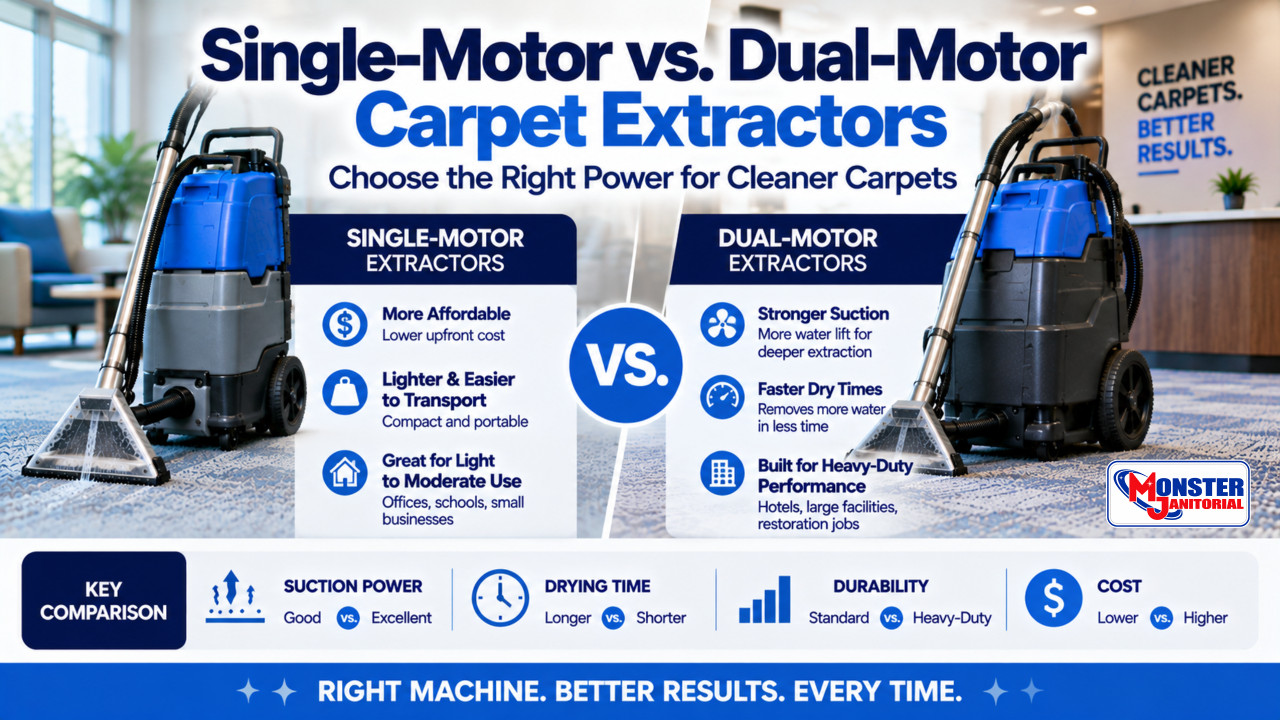
Single-Motor vs. Dual-Motor Carpet Extractors

Single-Motor vs. Dual-Motor Carpet Extractors

Posted by Monster Janitorial Tech Team on Aug 03, 2026

MJ University Carpet-Equipment Guide

Single-Motor vs. Dual-Motor Carpet Extractors

Compare vacuum recovery, airflow, water lift, hose length, drying performance, electrical demand, portability, and maintenance before choosing a commercial carpet extractor.

Quick Answer

Dual motors can provide stronger recovery, but motor count is only one factor.

Airflow, water lift, hose diameter, hose length, tank seals, tool design, electrical supply, and operator technique all affect how much dirty solution the extractor actually recovers.

Main Selection Principle

Compare the complete vacuum-recovery system.

A well-designed single-motor extractor can outperform a poorly designed dual-motor machine. Evaluate actual recovery performance instead of relying only on the number of vacuum motors.

2

What Does Single-Motor or Dual-Motor Mean?

The terms usually describe the number of vacuum motors used to recover dirty cleaning solution from the carpet. They do not normally refer to the solution pump that creates spray pressure.

A complete carpet extractor may include a solution pump, one or more vacuum motors, solution and recovery tanks, hoses, filters, seals, a carpet wand or cleaning head, and an optional heater.

Quick Comparison

Single-Motor vs. Dual-Motor Extractors

Both designs can clean commercial carpet effectively when properly matched to the job.

Single-Motor Extractor

Usually lower electrical demand
Often lighter and easier to transport
Usually lower purchase cost
Well suited to short hose runs
Good for routine maintenance
May leave more residual moisture

Dual-Motor Extractor

Stronger recovery potential
Often heavier and larger
Usually higher purchase cost
Better suited to longer hose runs
Useful for restorative work
Can improve moisture recovery

Dual Motors Do Not Automatically Mean Twice the Performance

Motor design, airflow, water lift, hose diameter, system restrictions, tank seals, filters, cuffs, wand design, and electrical supply all affect actual vacuum recovery. Compare published machine specifications and operating requirements rather than motor count alone.

Recovery System

What Carpet-Extractor Vacuum Motors Do

The vacuum system removes suspended soil, wastewater, foam, and residual moisture after cleaning solution is applied.

Recovers Cleaning Solution Pulls applied solution away from the carpet fibers and into the recovery tank.
Removes Suspended Soil Carries loosened dirt, detergent, and contamination through the hose.
Controls Residual Moisture Helps reduce the amount of solution left behind after wet passes.
Supports Faster Drying Strong recovery can shorten drying time when solution application is properly controlled.
Vacuum Performance

Airflow and Water Lift Work Together

Neither specification should be evaluated by itself.

AIRFLOW

Moves Air and Moisture

Airflow describes how much air moves through the wand, hose, vacuum system, and recovery tank.

Helps transport recovered moisture
Affected by hose diameter
Reduced by restrictions and clogs
Important for efficient recovery
WATER LIFT

Pulls Against Resistance

Water lift describes the vacuum system’s ability to pull against resistance inside the tool and hose.

Important with longer hose runs
Helps overcome restrictive tools
Affected by motor configuration
Supports moisture recovery under load
Dual-Motor Design

How Dual Vacuum Motors May Be Configured

Dual-motor machines do not all use the same internal arrangement. The configuration affects how the motors contribute to airflow and water lift.

Series Configuration Can increase water lift and help pull against greater resistance. This may be useful with longer hoses, restrictive tools, or demanding recovery conditions.
Parallel Configuration Can increase airflow and move a greater volume of air through the recovery system. Actual performance still depends on the complete machine design.
Lighter-Duty Applications

When a Single-Motor Extractor May Be Enough

Single-motor machines can be an effective and practical choice for routine carpet care and smaller cleaning jobs.

Small Offices Suitable for compact carpeted areas and regular maintenance schedules.
Spot Cleaning Useful for localized spills, stains, and small corrective-cleaning jobs.
Short Hose Runs Performs best when the wand remains relatively close to the extractor.
Upholstery Work Lower electrical demand and compact size can suit controlled detail cleaning.
Routine Extraction Appropriate for facilities cleaned before heavy soil and residue develop.
Limited Electrical Capacity May be easier to operate where electrical circuits cannot support multiple motors and heaters.
Higher-Recovery Applications

When a Dual-Motor Extractor May Be Better

Dual motors may provide an advantage when moisture recovery, hose length, or production demands increase.

Large Commercial Areas Stronger recovery can support higher-production cleaning across larger spaces.
Heavy Soil Conditions Useful when more solution and agitation are required to release accumulated soil.
Restorative Extraction Better suited to deep cleaning and corrective maintenance programs.
Longer Hose Runs Additional recovery capacity may help overcome hose resistance.
Faster Drying Requirements Improved moisture recovery can help reduce residual water when technique is controlled.
Contractor and Restoration Work Suitable for professionals who encounter varied soil levels and demanding applications.
Recovery Loss

Hose Length Can Reduce Vacuum Recovery

Recovery performance can decrease as the hose run becomes longer or more restrictive. A dual-motor system may help, but proper hose condition and setup remain essential.

Air Resistance Longer hose runs create more resistance inside the recovery path.
Air Leaks Cracks, loose cuffs, and damaged seals reduce vacuum performance.
Hose Kinks Kinks and sharp bends restrict airflow and slow moisture movement.
Narrow Hose Diameter Smaller hoses may create more restriction during high-volume recovery.
Dirty Filters Blocked filters can reduce airflow and strain the vacuum system.
Restrictive Tools Some upholstery tools, rotary tools, and narrow vacuum slots create more resistance.
Electrical Planning

Dual-Motor Machines May Require More Electrical Capacity

Vacuum motors, solution pumps, and heaters may create a high combined electrical load. Review the machine’s voltage, amperage, cord configuration, and circuit requirements before operation.

Higher amperage draw
Possible two-cord design
Separate circuits may be required
Heaters increase electrical demand
Breaker trips can interrupt cleaning
Cord placement must be controlled
Never assume two nearby outlets are connected to separate electrical circuits. Follow the extractor manufacturer’s electrical instructions.
Moisture Management

Do Dual Motors Always Dry Carpet Faster?

Stronger recovery can reduce residual moisture, but drying time depends on the entire cleaning process.

Number of wet passes
Number of dry passes
Pump pressure and jet size
Wand speed and technique
Carpet construction
Humidity and room temperature
Air movement
Condition of hoses and seals
Extractor recovery efficiency
WEIGHT & TRANSPORT

Portability Matters

Single motor: Usually lighter and easier to carry
Single motor: Better for stairs and compact vehicles
Dual motor: Often heavier with larger tanks
Dual motor: Better suited to high-production work
NOISE LEVEL

Consider Occupied Facilities

Two vacuum motors can increase sound, although insulation, motor design, airflow path, and enclosure construction affect the actual noise level.

Office buildings
Hotels
Schools
Healthcare facilities
Machine Care

Maintenance Requirements

Both single- and dual-motor extractors require regular maintenance. A dual-motor machine may contain more components and can have a higher repair cost if a vacuum motor fails.

Rinse the recovery tank
Inspect the float shutoff
Clean filters and screens
Check hoses and cuffs
Inspect tank gaskets and seals
Keep motor cooling vents clear
Buying Mistakes

Common Carpet-Extractor Selection Errors

Choosing only by motor count
Ignoring airflow specifications
Ignoring water-lift performance
Using unnecessarily long hoses
Overlooking electrical requirements
Applying too much cleaning solution
Ignoring machine weight and transport
Assuming dual motors always dry faster
Buying Checklist

How to Choose the Right Extractor

01
Determine Facility Size Estimate the amount of carpet cleaned during a normal shift.
02
Estimate Hose Length Identify the normal distance between the extractor and cleaning tool.
03
Identify Carpet Type Consider pile height, density, backing, and installation.
04
Define the Cleaning Level Separate routine maintenance from restorative extraction needs.
05
Compare Airflow Review how efficiently the machine moves air and recovered moisture.
06
Compare Water Lift Evaluate performance against hose and tool resistance.
07
Review Electrical Demand Confirm voltage, amperage, cord count, and circuit needs.
08
Check Weight and Size Confirm that the machine can be transported and stored safely.
09
Compare Tank Capacity Match tank size to productivity and refill requirements.
10
Confirm Tool Compatibility Review wand, upholstery tool, hose, and accessory options.
11
Consider Drying Expectations Determine how quickly the area must reopen after cleaning.
12
Review Parts and Service Confirm replacement motors, pumps, hoses, seals, and technical support.
Final Recommendation

Match the recovery system to the cleaning workload.

Choose a single-motor extractor for lighter routine work, short hose runs, compact storage, lower electrical demand, and easier transport. Choose a dual-motor extractor when stronger recovery, longer hose runs, heavier soil, restorative cleaning, and faster moisture removal are priorities. Compare the complete vacuum system rather than relying on motor count alone.

Need Help Choosing a Commercial Carpet Extractor?

Monster Janitorial can help compare vacuum motors, airflow, water lift, pump pressure, tank capacity, hose length, heaters, electrical requirements, machine weight, wands, upholstery tools, and replacement parts.

Commercial Cleaning Education

MJ University Learning Center

Explore carpet-care guidance, extractor comparisons, maintenance procedures, chemical-selection resources, and commercial cleaning education from Monster Janitorial.