null
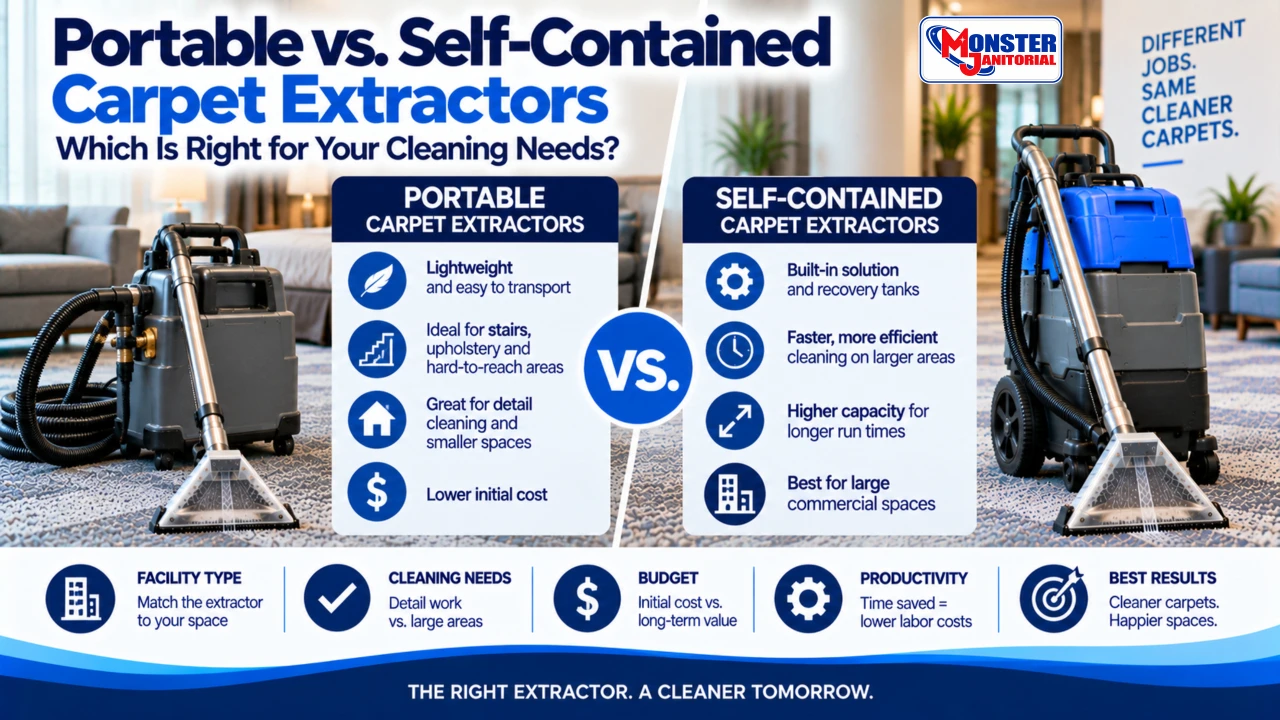
Portable vs. Self-Contained Carpet Extractors

Portable vs. Self-Contained Carpet Extractors

Posted by Monster Janitorial Tech Team on Aug 03, 2026

MJ University Carpet-Equipment Guide

Portable vs. Self-Contained Carpet Extractors

Compare flexibility, productivity, agitation, recovery, stair access, upholstery capability, operator training, and maintenance before choosing a commercial carpet extractor.

Portable Extractor

Best for flexibility and detail work.

Choose a portable extractor when stairs, upholstery, furnished rooms, edges, multiple tools, or restorative cleaning are important.

Self-Contained Extractor

Best for open carpeted areas.

Choose a self-contained extractor when consistent cleaning width, built-in agitation, simpler training, and faster open-area productivity are priorities.

PORTABLE DESIGN

What Is a Portable Carpet Extractor?

A portable extractor stays in one location while the operator cleans with separate vacuum and solution hoses connected to a carpet wand or specialty tool.

Separate carpet wand and hoses
Manual wet and dry passes
Multiple accessory options
Available in varied pressure and recovery configurations
SELF-CONTAINED DESIGN

What Is a Self-Contained Carpet Extractor?

A self-contained extractor combines solution delivery, powered agitation, and vacuum recovery into one walk-behind cleaning head.

Integrated solution delivery
Built-in powered brush
Integrated vacuum shoe
Consistent cleaning path
Quick Comparison

Portable vs. Self-Contained Extractors

The right machine depends more on the building layout and cleaning workload than the machine style alone.

Portable Extractor

Separate carpet wand
Better access around obstacles
Works with stairs and upholstery
More specialty-tool options
Requires hose management and wand technique

Self-Contained Extractor

Integrated cleaning head
Better for open carpeted areas
Built-in powered agitation
Less normal hose handling
Simpler operator workflow
Facility Application Guide

Match the Extractor to the Cleaning Area

Furnished Offices Portable wands can reach around desks, cubicles, chairs, and partitions.
Stairs and Upholstery Portable hoses and specialty tools provide access that walk-behind heads cannot.
Edges and Detail Work A wand can clean closer to walls, furniture legs, corners, and doorway edges.
Hotel Corridors Self-contained machines can follow long, consistent cleaning paths.
Schools and Meeting Rooms Integrated agitation and recovery suit scheduled open-area maintenance.
Large Open Offices A defined cleaning width supports steady productivity across unobstructed carpet.
Productivity and Operation

Which Design Is More Productive?

A self-contained extractor is usually more productive in open areas. A portable extractor may be more efficient when the job includes furniture, stairs, upholstery, edges, or multiple cleaning tools.

Open-Area Speed Self-contained machines reduce hose repositioning and maintain a consistent cleaning width.
Simpler Training Built-in solution delivery, agitation, and recovery create a more predictable workflow.
Flexible Cleaning Access Portable machines adapt better to mixed spaces and changing tool requirements.
More Operator Control Wand speed, wet passes, dry passes, and trigger use can be adjusted for each area.
Soil Release

Agitation Differences

PORTABLE EXTRACTOR

Agitation May Be Separate

A portable wand mainly applies and recovers solution. Additional agitation may require another tool.

Manual carpet brush
Counter-rotating brush machine
Rotary floor machine
Rotary extraction tool
SELF-CONTAINED EXTRACTOR

Agitation Is Built In

The powered cleaning head agitates the carpet while solution is applied and recovered.

Rotating carpet brushes
Cylindrical brush systems
Powered cleaning heads
Consistent brush contact

Pump Pressure and Recovery Still Matter

Portable extractors often offer more pump-pressure choices and tool configurations. Self-contained machines commonly use moderate pressure because agitation and recovery occur through the integrated cleaning head.

Neither style always leaves carpet drier. Compare vacuum motors, airflow, water lift, solution flow, jet design, wet passes, dry passes, and air movement.

PORTABLE OPERATION

More Tools and Storage

May offer larger tank options
Requires hose and wand storage
May need more vehicle space
Requires greater wand-technique training
SELF-CONTAINED OPERATION

Simpler Daily Workflow

Less hose handling during normal use
Compact models may refill more often
Often easier to store between rooms
Typically easier for new operators
Machine Care

Maintenance Differences

Both styles require tank rinsing, filter cleaning, solution-line flushing, jet inspection, seal checks, and vacuum-system maintenance.

Portable Hoses and Cuffs Inspect vacuum hoses, solution lines, quick connects, cuffs, and leaks.
Portable Wands and Tools Clean jets, vacuum slots, upholstery tools, and specialty attachments.
Self-Contained Brushes Inspect brushes, bearings, brush drives, and carpet compatibility.
Vacuum Shoes and Channels Clean recovery channels and inspect vacuum shoes for wear or blockage.
Buying Checklist

How to Choose the Right Extractor

01
Review the Layout Separate open carpet from furnished rooms and tight spaces.
02
Identify Specialty Work Determine whether stairs, upholstery, edges, or multiple tools are required.
03
Define the Cleaning Level Compare routine maintenance with restorative extraction needs.
04
Compare Agitation Decide whether built-in brush action or a separate agitation step is preferred.
05
Compare Recovery Review vacuum motors, airflow, water lift, hoses, and vacuum shoes.
06
Check Tanks and Transport Compare capacity, refill frequency, weight, storage, and loading needs.
07
Consider Operator Skill Match the machine to the cleaning team’s training and workflow.
08
Confirm Parts and Tools Review hoses, wands, brushes, filters, accessories, and service support.
Final Recommendation

Match the extractor to the facility layout and cleaning workload.

Choose a portable extractor when flexibility, stairs, upholstery, detail cleaning, adjustable pressure, and multiple tools are priorities. Choose a self-contained extractor when the facility has larger open carpeted areas and needs a simpler, productive walk-behind process with built-in agitation.

Need Help Choosing a Carpet Extractor?

Monster Janitorial can help compare portable and self-contained machines, pump pressure, vacuum recovery, agitation, tank capacity, hoses, wands, upholstery tools, machine weight, and replacement parts.

Commercial Cleaning Education

MJ University Learning Center

Explore carpet-care guidance, extractor comparisons, maintenance procedures, chemical-selection resources, and commercial cleaning education from Monster Janitorial.