
Commercial Concrete Floor Care
Polished Concrete vs Sealed Concrete
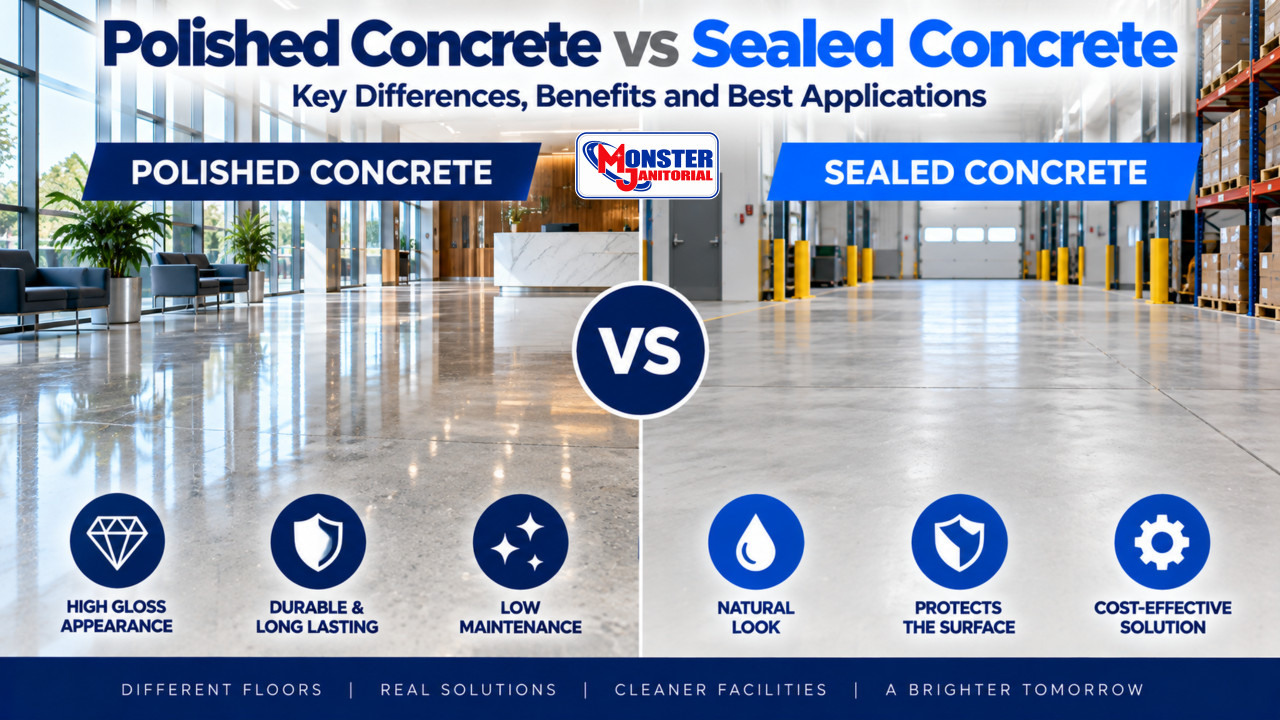
Compare appearance, durability, cleaning requirements, long-term maintenance, and the facilities where each concrete floor system works best.
Polished concrete and sealed concrete may look similar, but they are created and maintained differently.
Polished concrete is mechanically ground, honed, densified, and polished. Sealed concrete relies on a penetrating or topical protective product applied to the surface.
 Concrete Floor Comparison
This side-by-side example shows how polished concrete typically has a smoother, more reflective appearance, while sealed concrete depends more on the type of protective sealer or coating applied to the surface.
Quick Answer
Choose polished concrete for long-term durability and a refined appearance. Choose sealed concrete when you need topical protection, color enhancement, or a simpler coating system.
Know the Difference
Two Different Concrete Floor Systems
The right choice depends on traffic, appearance goals, moisture conditions, maintenance resources, and budget.
Mechanically Refined Surface
Polished Concrete
The concrete itself is progressively refined with diamond tooling and usually treated with a densifier.
Protective Sealer or Coating
Sealed Concrete
A penetrating or topical sealer helps resist staining, moisture, chemicals, or wear.
Appearance & Finish
How the Floors Look Different
Polished Concrete
Reflectivity comes from mechanically refining the slab. Aggregate exposure and gloss can be selected during installation.
Sealed Concrete
Appearance comes from the sealer or coating, which may deepen color, add gloss, or create a more uniform surface film.

Concrete Floor Maintenance
Polished concrete is commonly maintained with routine machine cleaning and periodic polishing, while sealed concrete may require careful cleaning and scheduled resealing or recoating as the protective layer wears.
Maintenance Requirements
How Cleaning and Restoration Differ
Polished Concrete Maintenance
- Frequent dust mopping or sweeping
- Routine auto scrubbing with a neutral cleaner
- Diamond-impregnated pads when appropriate
- Immediate spill removal
- Periodic polishing in worn traffic lanes
Sealed Concrete Maintenance
- Frequent dry soil removal
- Neutral cleaning compatible with the sealer
- Avoiding aggressive pads
- Monitoring traffic lanes for wear-through
- Periodic resealing or recoating
Protect the Floor
Common Cleaning Mistakes
Strong products may damage concrete or coatings.
Aggressive pads can scratch or wear through sealer.
Abrasive soil reduces clarity and accelerates wear.
Delayed maintenance can cause uneven gloss or coating failure.
Safety & Traction
Which Concrete Floor Is More Slippery?
Neither polished nor sealed concrete is automatically more slip-resistant. The final texture, coating, cleaning residue, moisture, oil, and maintenance condition all affect traction.
Polished Concrete
A polished floor may look slippery because of its gloss, but properly finished and maintained polished concrete can provide suitable traction. Water, dust, oil, and cleaning residue can still make it hazardous.
Sealed Concrete
Smooth, glossy topical sealers may become slippery when wet. Textured coatings or approved traction additives can help improve slip resistance in areas exposed to moisture.
Best practice: Keep either surface clean and dry, remove spills quickly, use compatible cleaners, and specify traction treatments where wet conditions are expected.
Decision Guide
Which Concrete Floor Is Better?
Choose Polished Concrete When
- Long-term durability is the priority
- A refined or reflective appearance is desired
- The area receives medium to heavy traffic
- You want to avoid a topical coating layer
- Routine mechanized cleaning is available
Choose Sealed Concrete When
- A protective surface is needed quickly
- Color enhancement or a coating appearance is desired
- The area has lighter or moderate traffic
- Stain or chemical resistance is important
- Periodic resealing fits the maintenance plan
Recommended Floor-Care Equipment
Machines, Pads & Cleaning Products for Concrete Floors
Common Questions
Frequently Asked Questions
Is polished concrete sealed?
It may receive a densifier or stain guard, but it is not the same as relying on a conventional topical sealer.
Which is easier to maintain?
Polished concrete often has lower long-term coating maintenance. Sealed concrete may be simpler initially but requires periodic resealing.
Can both floors be auto scrubbed?
Yes, when the machine, pad or brush, solution flow, and chemical are appropriate for the surface.
Final Recommendation
Choose Based on the Full Maintenance Plan
Polished concrete is often the better long-term choice for high-traffic facilities that want durability and a refined appearance. Sealed concrete can be practical when surface protection, color enhancement, or simpler installation is the priority.