
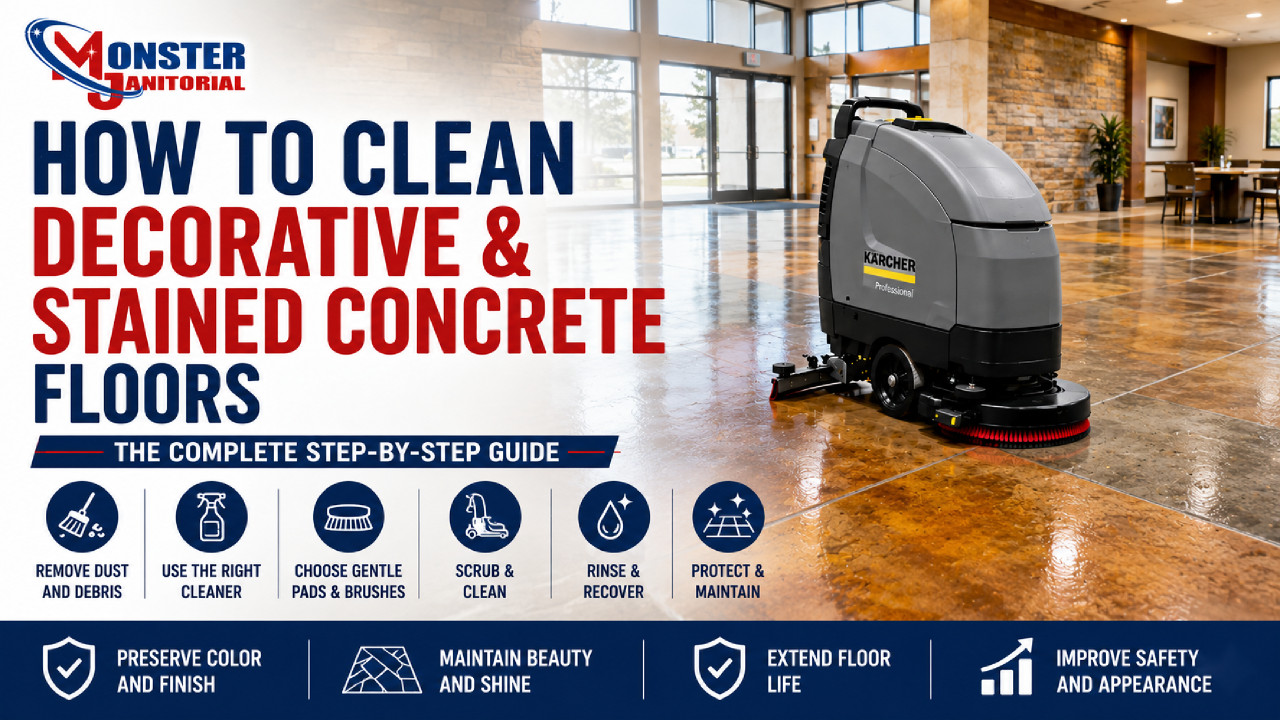
Decorative Concrete Floor Care
How to Clean Decorative and Stained Concrete Floors
A practical guide to protecting color, sheen, texture, sealers, waxes, and decorative finishes while removing routine soil, spills, scuffs, and buildup.
Decorative concrete should be cleaned more gently than unfinished industrial concrete. Many decorative floors contain stains, dyes, sealers, waxes, polished surfaces, or textured finishes that can be dulled, discolored, softened, or scratched by aggressive chemistry and pads.
The safest process is to remove dry soil first, use a neutral low-residue cleaner, scrub with a non-aggressive pad or soft brush, and recover the solution before it dries.
Quick Answer
Dust mop or vacuum first. Clean with a neutral, low-foam floor cleaner. Use a white or red pad on smooth sealed floors, or a soft brush on stamped and textured concrete. Avoid acids, strong solvents, harsh degreasers, and aggressive stripping pads unless the floor-system manufacturer specifically approves them.
Before You Clean
Identify the Decorative Concrete System
The visible color may come from stain, dye, integral pigment, a topical coating, or a polished finish. The maintenance method depends on what protects the surface.
Acid-Stained Concrete
Usually protected with a clear sealer and sometimes wax. Strong chemistry may haze or damage the protective layer.
Dyed or Water-Based Stained Concrete
Color may be sensitive to chemical attack, ultraviolet exposure, moisture, and worn sealer.
Polished Decorative Concrete
Needs low-residue chemistry and non-aggressive pads to preserve gloss and clarity.
Stamped or Textured Concrete
Often requires soft brushes that reach grooves, joints, edges, and low areas.
Waxed Decorative Concrete
Use products compatible with the wax program. Aggressive cleaners may strip, soften, or unevenly dull the finish.
Exposed Aggregate
The irregular texture may require brush agitation and careful recovery around low spots.
Important Test
Test Before Cleaning the Entire Floor
Choose a small inconspicuous area and test the cleaner, dilution, dwell time, pad or brush, and recovery process. Check the area after it dries for color change, haze, gloss loss, softening, whitening, or residue.
Step-by-Step Process
How to Clean Decorative and Stained Concrete
Use the least aggressive process that removes the soil while preserving the floor’s color and protective finish.
1. Remove Dry Soil
Dust mop, sweep, or vacuum grit and debris so they do not scratch the decorative surface during wet cleaning.
2. Clean Spills First
Blot liquid spills and remove sticky contamination before spreading cleaning solution across the floor.
3. Apply Neutral Cleaner
Use the label-approved dilution and apply enough solution to loosen soil without flooding the floor.
4. Allow Limited Dwell Time
Keep the solution wet and follow the cleaner manufacturer’s directions. Do not let chemistry dry on the surface.
5. Agitate Gently
Use a white or red pad on smooth surfaces, or a soft brush on stamped, textured, and exposed-aggregate concrete.
6. Recover the Solution
Use an auto scrubber, wet vacuum, or clean mop system to remove suspended soil and cleaner completely.
7. Rinse When Needed
Make a clean-water recovery pass when residue, foam, or streaking remains after cleaning.
8. Inspect After Drying
Evaluate color, gloss, slip resistance, residue, and worn areas before repeating or increasing aggressiveness.
Recommended Chemistry
Use a Neutral, Low-Residue Floor Cleaner
Neutral chemistry is generally the safest starting point for sealed, stained, polished, and decorative concrete. Confirm compatibility with the sealer, coating, wax, or polishing system before use.
Routine Maintenance
Karcher Neutral Floor Cleaner
Part Number: 8.698-103.0
Monster SKU: MPK86981030
A low-foam neutral cleaner for routine maintenance of compatible finished, polished, and decorative floors.
Shop Neutral Floor CleanerBrowse Compatible Products
Concrete and Terrazzo Floor Cleaners
Compare concrete-care products, then verify that the selected cleaner is approved for the floor’s sealer, finish, or coating.
Shop Concrete Floor CleanersFloor Contact Selection
Which Pad or Brush Should You Use?
The correct accessory should contact the floor without scratching, stripping, or dulling the protective finish.
White Polishing Pad
Use for very light cleaning or polishing when approved for the floor system.
Red Cleaning Pad
A common starting choice for routine machine cleaning on compatible smooth sealed floors.
Soft Nylon Brush
Useful for stamped, textured, scored, and exposed-aggregate surfaces.
Approved Diamond Pad
Use only as part of a compatible polished-concrete maintenance program.
Machine Cleaning
Can You Use an Auto Scrubber on Decorative Concrete?
Yes, when the machine, chemistry, pad or brush, down pressure, and water flow are appropriate for the floor system. A compact auto scrubber can provide consistent solution control and immediate recovery without over-wetting the floor.
Start with the lightest effective setting to protect sealer, wax, and gloss.
Avoid flooding joints, low areas, edges, and damaged sections.
Clean squeegees and strong vacuum recovery help prevent streaks and standing water.
Spot Cleaning
How to Handle Spills and Scuffs
Blot promptly, clean with neutral solution, and dry the area completely.
Absorb first and use only a sealer-compatible cleaner or degreaser after testing.
Use neutral cleaner and gentle agitation before trying stronger specialty chemistry.
Use a manufacturer-approved spot cleaner and avoid metal scrapers or untested solvents.
Protect the Finish
What to Avoid on Decorative Concrete
They may etch concrete, alter color, or damage the protective system.
They may soften, haze, discolor, or remove sealers and coatings.
High alkalinity may damage wax, sealer, color, or gloss.
They may strip the protective finish or permanently dull the surface.
They can scratch, gouge, or chip decorative coatings and sealers.
Dried chemistry may leave haze, streaks, residue, or uneven appearance.
Troubleshooting
Why Decorative Concrete Looks Hazy, Dull, or Streaky
The dilution may be too strong or the floor may need a clean-water recovery pass.
Traffic lanes may need recoating or refinishing instead of stronger cleaning.
Whitening or cloudiness may indicate trapped moisture or sealer failure.
Dull spots may be abrasion rather than removable soil.
Cleaning vs Restoration
When the Floor Needs Resealing or Recoating
More aggressive cleaning will not repair worn sealer, peeling coating, exposed stain, deep scratches, moisture whitening, or traffic-lane erosion.
Contact the floor-system manufacturer or a qualified decorative-concrete contractor when the finish is failing, color is exposed, moisture is trapped, or recoating is required.
Location Matters
Indoor vs Outdoor Decorative Concrete
Indoor Decorative Concrete
Prioritize low residue, controlled water use, fast recovery, gloss protection, and compatibility with wax or sealer.
Outdoor Stamped Concrete
Account for soil, algae, weathering, drainage, overspray, surrounding landscaping, and wastewater control. Confirm sealer compatibility before pressure washing.
Maintenance Planning
Suggested Decorative Concrete Cleaning Schedule
Daily or As Needed
Remove dry soil, clean spills promptly, and spot-clean scuffs before they build up.
Weekly
Damp mop or auto scrub with neutral cleaner using a non-aggressive pad or soft brush.
Monthly or Quarterly
Inspect traffic lanes, gloss, sealer wear, wax condition, joints, edges, and moisture-related discoloration.
Related Concrete Floor Guides
Continue Learning
Common Questions
Decorative and Stained Concrete FAQs
What is the best cleaner for stained concrete floors?
Start with a neutral, low-residue cleaner that is compatible with the stain, sealer, wax, or polished-concrete system.
Can an auto scrubber be used on stained concrete?
Yes, with controlled water flow, low down pressure, compatible chemistry, and a non-aggressive pad or soft brush.
Can vinegar be used on decorative concrete?
Acidic products may etch concrete or damage sealers. Use only products approved by the floor-system manufacturer.
Why did the floor become dull after cleaning?
The cleaner or pad may have been too aggressive, residue may remain, or the sealer or wax may be worn and require restoration.
Final Recommendation
Protect the Finish Before Increasing Cleaning Aggressiveness
Identify the decorative system, remove dry soil, use neutral chemistry, choose a gentle pad or soft brush, and recover the cleaning solution completely. When haze, peeling, exposed color, or worn traffic lanes remain, the floor may need resealing or refinishing rather than stronger cleaning.
- #Acid-Stained Concrete
- #Auto Scrubber for Decorative Concrete
- #Commercial Concrete Floor Maintenance
- #Concrete Floor Sealer Care
- #Decorative Concrete Care
- #Floor Pads for Concrete
- #How to Clean Decorative Concrete Floors
- #Neutral Floor Cleaner
- #Polished Decorative Concrete
- #Sealed Concrete Cleaning
- #Stained Concrete Floor Cleaning
- #Stamped Concrete Cleaning