null
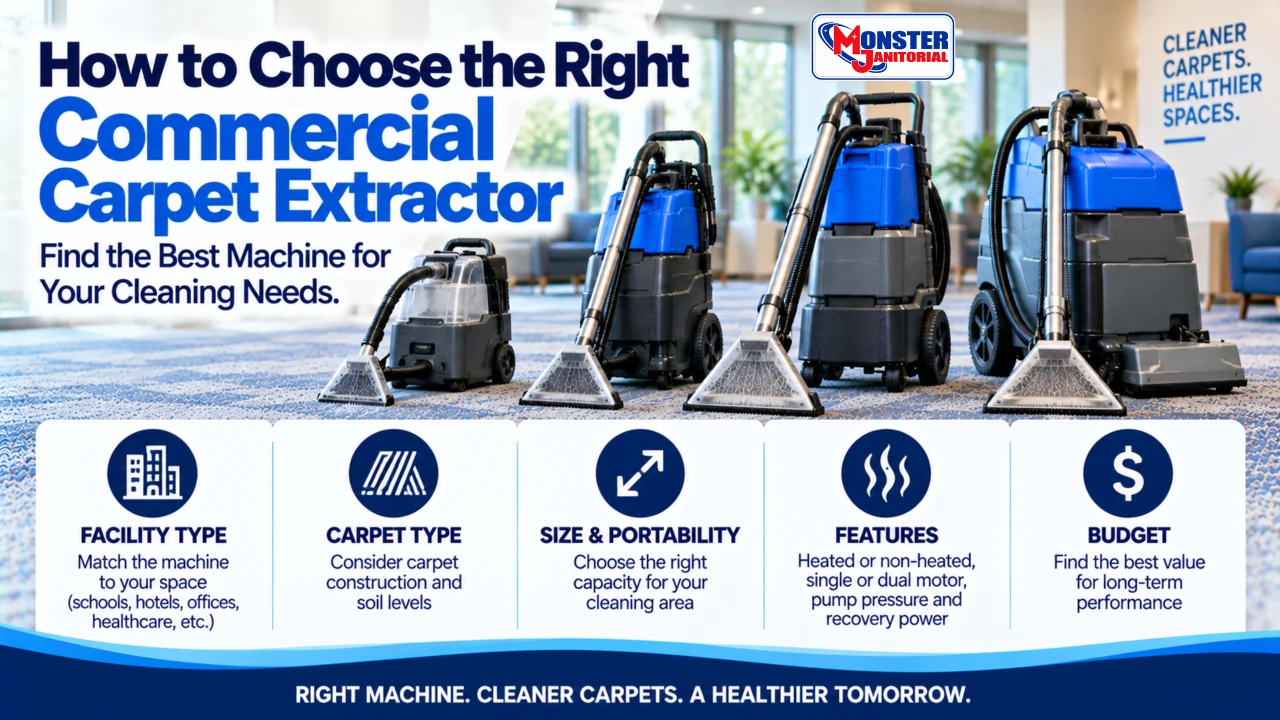
How to Choose the Right Commercial Carpet Extractor

How to Choose the Right Commercial Carpet Extractor

Posted by Monster Janitorial Sales Team on Aug 03, 2026

MJ University Carpet-Equipment Buying Guide

How to Choose the Right Commercial Carpet Extractor

Compare machine type, cleaning width, tank capacity, pump pressure, vacuum recovery, heat, electrical requirements, tools, weight, and facility needs before choosing a commercial carpet extractor.

Quick Answer

Match the extractor to the facility instead of choosing only by PSI, tank size, or motor count.

Start with the building layout, carpet type, cleaning frequency, stairs, upholstery needs, transportation limits, and available electrical capacity. Then compare solution delivery, agitation, vacuum recovery, tools, and service support.

Step One

Start with the Facility and Cleaning Workload

The machine should fit the areas, obstacles, transportation requirements, and cleaning frequency it will actually encounter.

Carpeted Square Footage Estimate how much carpet must be cleaned during each shift.
Open Areas and Obstacles Separate corridors and large rooms from furniture-heavy offices and tight spaces.
Carpet Construction Identify carpet tile, low-pile commercial carpet, broadloom, and sensitive materials.
Stairs and Upholstery Decide whether the extractor must operate with stair, upholstery, or detail-cleaning tools.
Cleaning Frequency Compare occasional spot work with scheduled daily, weekly, or restorative cleaning.
Storage Space Confirm that the machine, hoses, wands, and accessories fit the available storage area.
Transportation Review doorways, elevators, stairs, vehicle access, ramps, and loading height.
Electrical Capacity Identify available outlets, circuits, voltage, and amperage before selecting heated or dual-cord equipment.
Machine Type

Portable vs. Self-Contained Carpet Extractors

Portable machines emphasize flexibility, while self-contained machines emphasize open-area productivity.

PORTABLE EXTRACTOR

Best for Flexible Cleaning

Furnished offices and cubicles
Stairs and landings
Upholstery and detail work
Multiple wand and tool options
Spot and restorative cleaning
SELF-CONTAINED EXTRACTOR

Best for Open-Area Productivity

Hotel corridors
Schools and conference rooms
Large open offices
Built-in brush agitation
Simpler walk-behind operation
Size and Productivity

Compare Cleaning Width and Tank Capacity Together

Wider cleaning paths and larger tanks can improve productivity in open spaces, but they also increase machine size, weight, storage requirements, and transportation difficulty.

Compact Machines

Easier around furniture
Better for narrow hallways
Lighter for transport
Require more frequent refilling

Larger Machines

Cover more carpet per pass
Reduce refill interruptions
Better for long open areas
May require ramps or loading assistance
Cleaning Performance

Pump Pressure Must Be Balanced with Vacuum Recovery

Higher PSI can increase solution delivery, but it does not guarantee better cleaning or faster drying.

Pump Pressure and Solution Flow

Match pressure to the carpet, soil, tool, jet size, hose length, and cleaning method.

Routine commercial carpet cleaning
Carpet tile and upholstery
Restorative cleaning
Rotary extraction and specialty tools

Vacuum Recovery

Strong recovery removes dirty solution and helps control residual moisture.

Vacuum-motor configuration
Airflow and water lift
Hose length and diameter
Wand, vacuum shoe, seals, and gaskets
Vacuum-Motor Configuration

Single-Motor vs. Dual-Motor Extractors

Motor count can affect recovery and electrical demand, but the complete vacuum system determines actual performance.

Single-Motor Extractors Lower electrical demand, lower weight, easier transportation, and practical performance for many routine applications.
Dual-Motor Extractors May provide stronger recovery for longer hose runs, heavier cleaning, and applications requiring improved water removal.
Solution Temperature

Heated vs. Non-Heated Extractors

HEATED EXTRACTOR

Useful for Compatible Oily Soil

Greasy traffic lanes
Food-service and automotive soil
Restorative cleaning
Higher electrical demand
Added heater maintenance and warm-up time
NON-HEATED EXTRACTOR

Practical for Routine Cleaning

Office and carpet-tile maintenance
Spot cleaning
Lower electrical demand
Easier transport
Simpler maintenance

Check Electrical Requirements Before Purchasing

Heated and dual-motor extractors may require more amperage, multiple power cords, or separate electrical circuits.

Voltage
Total amperage
Number of power cords
Separate circuit requirements
Outlet availability
Extension-cord restrictions
Cleaning Accessories

Review Hose Length, Tools, and Agitation

Hose Reach Choose enough hose to reach normal work areas without adding unnecessary length.
Carpet Wand Match wand width, jets, vacuum slot, fittings, and handle design to the machine.
Upholstery and Stair Tools Confirm solution pressure, hose size, fittings, and moisture control.
Built-In Brushes Self-contained extractors may simplify cleaning with integrated agitation.
Separate Agitation Portable systems may require a manual brush, CRB, rotary machine, or specialty tool.
Tool Compatibility Verify pressure, flow, vacuum capacity, fittings, and hose diameter before adding tools.
Daily Usability

Consider Weight, Noise, Draining, and Refilling

Features that make the extractor easier to move, fill, drain, and operate can improve real productivity more than a small difference in technical specifications.

Empty and Filled Weight Confirm that the machine remains manageable when its solution tank is full.
Wheels and Handles Larger wheels and practical handles can improve movement across thresholds and loading ramps.
Operating Noise Review sound levels for hotels, offices, schools, healthcare facilities, and occupied buildings.
Recovery-Tank Drain Drain hoses or large openings can speed disposal and tank rinsing.
Fill Access Bucket-fill access, front-fill ports, and removable tanks simplify daily setup.
Tank Visibility Clear lids, solution indicators, and automatic floats help operators monitor the machine.
Long-Term Ownership

Review Maintenance Access and Replacement-Part Support

A commercial extractor should be easy to clean, inspect, and service. Confirm that common wear parts and technical information are available.

Hoses and cuffs
Wands and tools
Jets and filters
Pumps and motors
Brushes and vacuum shoes
Manuals and service support
Facility Recommendations

Match the Extractor to the Application

Offices Consider portable extractors or compact self-contained machines for furniture and smaller rooms.
Hotels Use self-contained units for corridors and portable machines for rooms, stairs, and upholstery.
Schools Productive self-contained extractors can support scheduled cleaning of classrooms and common areas.
Restaurants A heated portable extractor may help with compatible greasy soil and detailed cleaning.
Healthcare Facilities Prioritize controlled moisture recovery, practical noise levels, and easy machine sanitation.
Restoration Work Consider high-recovery portable systems with flexible hose lengths and specialty tools.
Recommended Equipment

Commercial Carpet Extractors by Application

These recommended machines cover compact spot cleaning, portable extraction, heated cleaning, open-area extraction, and dual-method carpet maintenance.

Best Compact Spot Extractor

NSS Rally 55 / 55H

A compact 2.9-gallon spot extractor available in cold-water and heated configurations for quick-response carpet, stair, upholstery, and detail cleaning.

Compact and easy to transport
Cold-water or heated options
Best for smaller targeted areas
Best for Upholstery and Detail Work

EDIC Bravo 300MH

A compact 3-gallon commercial spotter suited to upholstery, vehicle interiors, isolated stains, stairs, and smaller carpeted areas.

Compact 3-gallon design
Useful for upholstery and stairs
Practical for mobile spot cleaning
Best General-Purpose Portable

Karcher Puzzi 30/4

A commercial portable extractor with a floor tool and 13-foot hose for offices, schools, hospitality properties, and routine carpet-cleaning programs.

Portable floor-cleaning system
Includes hose and floor tool
Versatile for routine commercial use
Best Large-Capacity Portable

Karcher Puzzi Large-Capacity Series

A larger commercial portable-extractor platform with heated and non-heated options for extended cleaning, heavier workloads, and facilities that need greater tank capacity.

Heated and non-heated options
Designed for extended cleaning
Suitable for heavier commercial workloads
Best Self-Contained Extractor

NSS Stallion 818 SC

An 18-inch self-contained carpet extractor with an 8-gallon tank for open carpeted areas in schools, hotels, offices, healthcare facilities, and institutional buildings.

18-inch cleaning path
8-gallon tank capacity
Built for open-area productivity
Best Dual-Method Carpet System

TASKI Procarpet 45

An 18-inch walk-behind carpet-cleaning system designed to support both deep extraction and interim encapsulation programs in larger commercial facilities.

Extraction and encapsulation capability
18-inch walk-behind design
Useful for planned carpet-care programs
Choosing Between These Machines

Choose a compact spotter for isolated spills, upholstery, and stairs; a portable extractor for flexible room-to-room cleaning; a self-contained machine for open carpeted areas; or the TASKI Procarpet 45 when both extraction and encapsulation are part of the facility’s carpet-maintenance program.

Buying Checklist

Eight Steps for Choosing the Right Extractor

01
Measure the Carpeted Area Estimate the square footage normally cleaned per shift.
02
Review the Layout Identify open areas, narrow spaces, furniture, stairs, and access limitations.
03
Choose the Machine Type Compare portable flexibility with self-contained productivity.
04
Match Width and Tank Size Balance area productivity with weight, storage, refilling, and transport.
05
Compare Solution Delivery Review PSI, flow, jets, agitation, heat, and tool requirements.
06
Evaluate Recovery Compare motors, airflow, water lift, hoses, seals, wands, and pickup design.
07
Confirm Electrical Capacity Check voltage, amperage, cord count, circuits, and outlet availability.
08
Verify Ownership Support Confirm tools, parts, manuals, warranty coverage, and service availability.
Final Recommendation

Choose the machine that fits the real cleaning environment.

Do not select a commercial carpet extractor only because it has the highest PSI, largest tanks, onboard heat, or the most vacuum motors. A properly matched machine will be easier to move, easier to power, more productive in the intended space, and better suited to the carpet, soil, tools, and operators.

Need Help Choosing a Commercial Carpet Extractor?

Monster Janitorial can help compare machine type, cleaning width, tank capacity, PSI, vacuum recovery, heat, electrical demand, hoses, wands, upholstery tools, machine weight, and replacement parts.

Commercial Cleaning Education

MJ University Learning Center

Explore carpet-care guidance, extractor comparisons, maintenance procedures, chemical-selection resources, and commercial cleaning education from Monster Janitorial.