
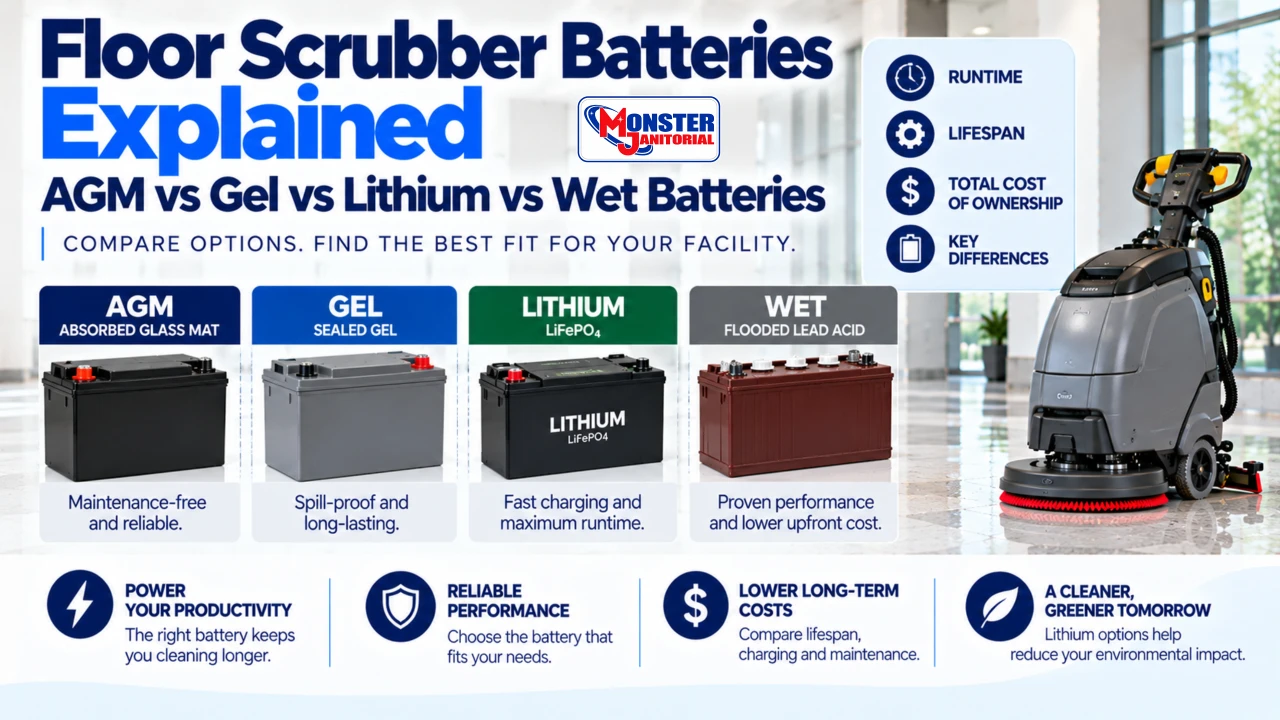
Floor Scrubber Battery Guide: AGM vs Gel vs Wet vs Lithium
Compare AGM, Gel, wet flooded and lithium batteries for commercial floor scrubbers.
Learn how battery chemistry, voltage, amp hours, charging time, maintenance, runtime and facility schedule affect scrubber performance and long-term ownership cost.
Match the Battery to the Cleaning Schedule
Choose AGM for sealed, low-maintenance single-shift use; Gel for compatible sealed deep-cycle systems; wet flooded batteries where trained staff can handle watering and maintenance; and lithium when fast charging, opportunity charging, low maintenance and high machine availability are priorities.
Battery Choice Affects More Than Runtime
Route Completion
The battery must support the real cleaning route without leaving work unfinished.
Charging Downtime
Charging time affects how quickly the machine can return to service.
Maintenance
Some batteries require watering, ventilation and more routine inspection.
Ownership Cost
Replacement batteries, charger requirements, labor and downtime all affect total cost.
Voltage & Amp Hours
Voltage
Voltage must match the machine's electrical system. Commercial scrubbers commonly use 24V, 36V or 48V battery systems depending on model.
Amp Hours
Amp hours describe battery capacity. More amp hours can provide more available energy, but actual runtime still depends on machine load and operating conditions.
Do Not Choose a Battery by Voltage Alone
The correct battery must match the machine's approved voltage, chemistry, charger profile, physical dimensions, weight, capacity, cables, connectors and battery-management requirements. Use the scrubber manufacturer's approved battery specifications.
What Reduces Floor Scrubber Battery Runtime?
Increases motor load.
Vacuum motors draw power during cleaning.
Can require slower speed and extra passes.
Can increase machine load.
Older batteries may provide less usable capacity.
Extreme temperatures can affect charging and capacity.
AGM vs Gel vs Wet vs Lithium
Each battery type has different maintenance, charging and operating characteristics.
AGM
AGM batteries are sealed lead-acid batteries that do not require routine watering.
Good fit for: single-shift facilities, overnight charging and lower-maintenance fleets.Gel
Gel batteries use a gelled electrolyte and require a charging profile specifically approved for Gel batteries.
Good fit for: approved sealed deep-cycle applications.Wet Flooded
Wet batteries can be economical but require regular inspection, watering, terminal care and an appropriate charging area.
Good fit for: trained maintenance teams with established battery-care procedures.Lithium
Lithium systems can support faster charging, opportunity charging and lower routine maintenance when approved for the machine.
Good fit for: long routes, multi-shift use and facilities where downtime matters.Battery Type Comparison
| Feature | AGM | Gel | Wet Flooded | Lithium |
|---|---|---|---|---|
| Routine Maintenance | Low | Low | High | Very low |
| Watering | No | No | Yes | No |
| Upfront Cost | Moderate | Moderate | Often lower | Higher |
| Charging Flexibility | Limited | Limited | Limited | High when approved |
| Opportunity Charging | Usually not preferred | Usually not preferred | Usually not preferred | Common in compatible systems |
| Typical Fit | Single-shift cleaning | Approved deep-cycle use | Maintained industrial fleets | Long-route or multi-shift use |
Charging Practices by Battery Type
Charging During Breaks or Between Routes
Opportunity charging means adding charge during shorter breaks rather than waiting for a battery to become nearly empty. Many commercial lithium systems are designed to support this, but the exact battery, charger and machine instructions must allow it.
Common Floor Scrubber Battery Killers
Repeatedly running lead-acid batteries extremely low.
Incorrect charging voltage or profile.
High operating or charging temperature.
Repeatedly interrupting lead-acid charging.
Low water, corrosion, loose cables or damaged connectors.
Leaving batteries discharged or outside approved storage conditions.
Possible Battery Choices by Facility Type
| Facility | Possible Starting Choice | Why |
|---|---|---|
| Small Offices | AGM or Gel | Short routes and dependable overnight charging. |
| K-12 Schools | AGM, Gel or Lithium | Depends on route length, charging window and budget. |
| Universities & Campuses | Lithium | Long routes and frequent machine use. |
| Healthcare | Lithium or approved sealed battery system | Machine availability and low routine maintenance may be priorities. |
| Warehouses | Lithium or maintained wet batteries | Large areas and long operating routes. |
| Multi-Shift Operations | Lithium | Fast and opportunity charging can support higher machine utilization. |
When Lithium May Be Worth the Higher Price
Lithium often costs more initially, so compare the full ownership picture rather than purchase price alone.
Match Battery Runtime to the Real Cleaning Route
Can You Convert a Floor Scrubber to Lithium?
Sometimes, but not every scrubber is designed for a lithium conversion.
A conversion may require manufacturer approval, correct voltage, an approved charger, battery-management compatibility, correct physical dimensions, compatible connectors, machine programming and weight or ballast verification.
Common Floor Scrubber Battery Mistakes
Battery Inspection Checklist
Before Use
- Check charge level
- Inspect cables and connectors
- Check for swelling, leaks or damage
- Verify no battery warnings
After Use
- Park in approved charging area
- Connect the correct charger
- Follow approved watering procedures if applicable
- Record charger or battery faults
Scheduled Inspection
- Inspect terminals and cables
- Review runtime changes
- Inspect charger condition
- Confirm battery settings match chemistry
Commercial Battery-Powered Floor Scrubbers
Compare compact walk-behind, larger walk-behind, stand-on and ride-on scrubbers based on route length, battery configuration, charging schedule and facility size.
TASKI swingo 455B
Compact battery scrubber for classrooms, offices, healthcare spaces and smaller routes.
View Scrubber →TASKI ULTIMAXX 1900
Commercial walk-behind scrubber for schools, retail, healthcare and institutional routes.
View Scrubber →TASKI swingo XP-R
Stand-on scrubber for corridors, campuses and higher-productivity cleaning routes.
View Scrubber →TASKI swingo 4000B
Ride-on battery scrubber for large schools, universities, warehouses and public facilities.
View Scrubber →Floor Scrubber Battery FAQ
Schools, Government & Institutional Buyers
Monster Janitorial supports qualifying schools, universities, municipalities, government agencies, healthcare facilities and institutional buyers with quotes, equipment selection and purchase-order support.
Tax-exempt organizations can create an account and email their exemption certificate to sales@monsterjanitorial.com.
Related MJ University Resources
Need Help Choosing a Battery-Powered Floor Scrubber?
Monster Janitorial can help compare AGM, Gel, wet flooded and lithium scrubber configurations based on your cleaning route, charging schedule, facility size, maintenance program and budget.