null
Complete Commercial Epoxy Floor Cleaning Guide

Complete Commercial Epoxy Floor Cleaning Guide

Posted by Monster Janitorial Tech Team on Aug 04, 2026

MJ University Floor Care

Complete Commercial Epoxy Floor Cleaning Guide

Learn how to clean, auto scrub, deep clean, and maintain commercial epoxy and resin floors without leaving residue, dulling the coating, or damaging the surface.

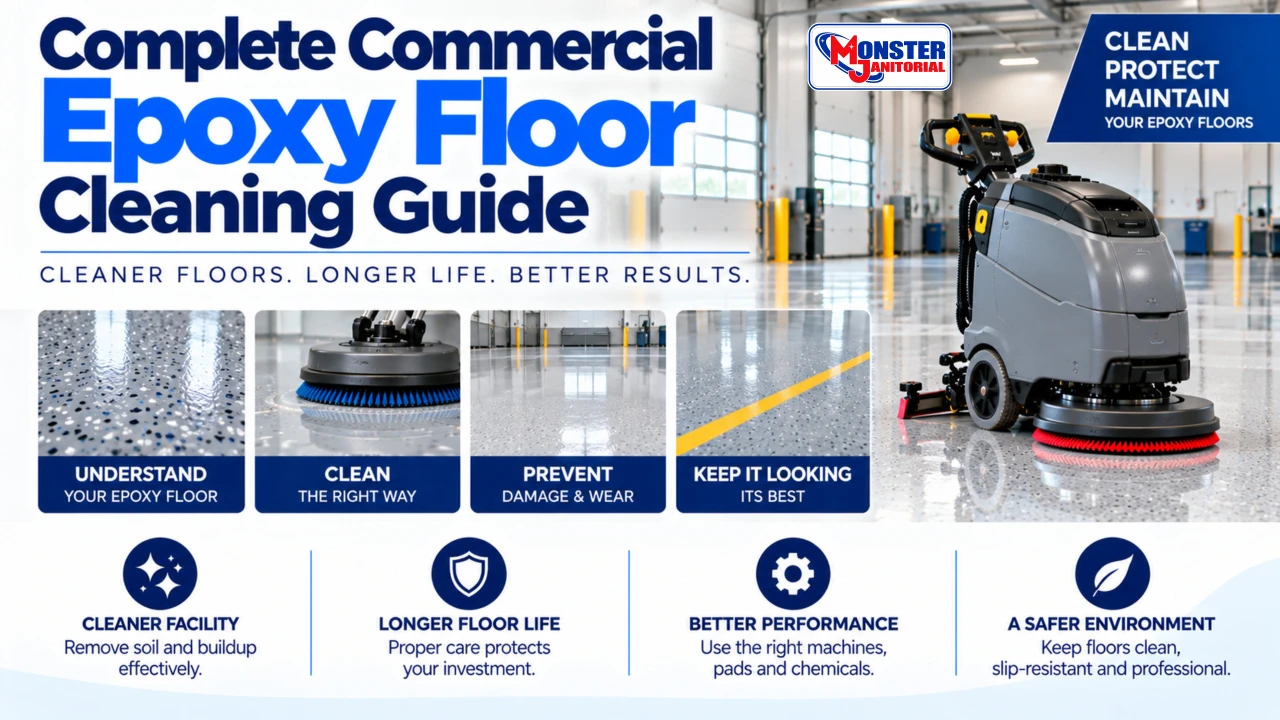
Commercial epoxy and resin floor cleaning with an automatic floor scrubber
Quick Answer

Most commercial epoxy floors can be cleaned with dry-soil removal, properly diluted neutral chemistry, controlled agitation, and complete recovery of the dirty solution.

Auto scrubbers are commonly used, but the chemical, pad, brush, water flow, and cleaning pressure must match the coating texture and condition.

Floor Identification

What Are Epoxy and Resin Floors?

Epoxy and resinous flooring systems are protective coatings installed over concrete to create a durable, cleanable surface.

Epoxy Coatings Common in warehouses, factories, garages, service areas, mechanical rooms, and commercial buildings.
Polyurethane Systems Often used as a protective topcoat where abrasion resistance, appearance, or chemical resistance is important.
Polyaspartic Coatings Fast-curing systems frequently installed in garages, showrooms, industrial spaces, and commercial facilities.
Quartz and Flake Systems Decorative or slip-resistant coatings containing aggregate, colored flakes, or textured material.
Urethane Cement Heavy-duty resin flooring used in food processing, kitchens, manufacturing, and harsh industrial environments.
Textured Resin Flooring Slip-resistant systems that may require soft brushes to reach soil trapped around aggregate and surface texture.

Identify the Coating Before Cleaning

Not every coated concrete floor is maintained the same way. Before selecting a chemical, pad, brush, or machine setting, confirm as much information as possible about the floor.

Coating or resin type
Smooth or textured surface
Coating manufacturer
Age and condition
Existing scratches or peeling
Type of soil or contamination
Routine Maintenance

How to Clean Commercial Epoxy Floors

A consistent cleaning process helps reduce scratching, residue, staining, dull traffic lanes, and premature coating wear.

01
Remove Loose Soil Sweep, dust mop, or vacuum grit, dust, metal particles, packaging debris, and loose contamination.
02
Clean Spills Promptly Remove oils, chemicals, food, beverages, and industrial spills before they spread or become difficult to remove.
03
Select Compatible Chemistry Use a properly diluted neutral or coating-approved cleaner for routine maintenance.
04
Agitate the Surface Use a suitable pad, microfiber pad, or soft brush based on texture and soil level.
05
Recover Dirty Solution Remove suspended soil and cleaning solution completely with an auto scrubber or wet vacuum.
06
Inspect After Drying Check for haze, streaks, sticky residue, missed soil, scratches, peeling, and worn traffic lanes.
Chemical Selection

Recommended Cleaning Chemistry

Always follow the coating manufacturer’s maintenance instructions. Neutral and low-foaming cleaners are commonly used for routine maintenance, while stronger chemistry should be reserved for compatible coatings and specific soil conditions.

Neutral Cleaners Best starting point for routine cleaning of compatible epoxy and resin floors.
Low-Foaming Scrubber Detergents Designed for automatic floor scrubbers and easier solution recovery.
Compatible Degreasers May be needed for oil, grease, rubber marks, and industrial soil when approved for the coating.

Browse Commercial Floor Cleaning Chemicals →

Chemicals to Avoid Unless Approved

Aggressive floor strippers
Strong solvents
Highly acidic cleaners
Highly alkaline degreasers
Abrasive cleaning powders
Undiluted concentrated chemicals
Machine Cleaning

Can You Use an Auto Scrubber on Epoxy Floors?

Yes. Auto scrubbers are commonly used on commercial epoxy and resin floors. The machine setup must match the coating, floor texture, contamination, and facility layout.

Disc Scrubbers Effective on many smooth and lightly textured epoxy floors using compatible pads.
Cylindrical Scrubbers Helpful where loose debris and textured surfaces are common.
Orbital Scrubbers Useful for controlled agitation and detailed scrubbing when the pad is approved for the coating.
Controlled Solution Flow Use enough solution to clean without flooding joints, drains, edges, or damaged areas.
Strong Recovery Good squeegee contact and vacuum recovery help prevent residue and slip concerns.
Test First Test the cleaner, pad, brush, pressure, and machine setting in an inconspicuous area.

Shop Commercial Auto Scrubbers →

Agitation Selection

Best Pads and Brushes for Epoxy Floors

Start with the least aggressive option capable of removing the soil.

White Pads For light cleaning, polishing, and sensitive coating surfaces when approved.
Red Pads Common for routine scrubbing and light soil on many smooth coated floors.
Microfiber Pads Useful for light cleaning and residue control on compatible smooth coatings.
Soft Nylon Brushes Often more effective than flat pads on textured or aggregate-filled surfaces.
Blue Pads May be used for heavier scrubbing only when the coating manufacturer approves the level of abrasion.
Aggressive Pads Black stripping pads and highly abrasive tools may scratch or permanently dull the coating.

Browse Floor Pads, Brushes and Pad Drivers →

Surface Texture

Smooth vs. Textured Epoxy Floors

Smooth Epoxy Floors

Smooth coatings are easier to mop, pad scrub, and recover. Use soft or moderate pads and avoid excessive abrasion that can reduce gloss or create visible scratches.

Textured Epoxy Floors

Slip-resistant aggregate can trap grease, soil, and dirty solution. Soft nylon brushes and multiple scrub-and-recovery passes may clean texture more effectively than flat pads.

Problem Soil

Removing Oil, Grease, Tire Marks, and Industrial Soil

Identify the soil before selecting stronger chemistry or agitation.

Oil and Grease Absorb fresh spills first, then use a compatible degreaser at the approved dilution.
Tire and Rubber Marks Use approved chemistry, controlled dwell time, and non-damaging agitation.
Food and Beverage Soil Remove spills promptly and clean residue completely to prevent stickiness.
Metal and Pallet Debris Sweep or vacuum abrasive particles before wet cleaning.
Adhesive and Paint Avoid scraping or solvent use until compatibility with the coating is confirmed.
Unknown Chemicals Follow the facility’s spill-response plan and coating-manufacturer guidance.
Periodic Maintenance

How to Deep Clean Epoxy and Resin Floors

1. Inspect the Floor Identify damaged areas, exposed concrete, failed coating, drains, seams, and heavy contamination.
2. Remove Loose Debris Sweep or vacuum thoroughly before applying cleaning solution.
3. Apply Approved Cleaner Mix at the recommended dilution and apply only to a manageable area.
4. Allow Controlled Dwell Time Keep the solution wet without allowing it to dry on the surface.
5. Scrub and Recover Agitate with the least aggressive effective pad or brush and recover the solution completely.
6. Rinse if Needed Use a clean-water pass when residue remains or the product instructions require rinsing.

Why Epoxy Floors Look Dull, Hazy, Sticky, or Streaky

Dull appearance: Abrasive soil, aggressive pads, scratches, chemical damage, or coating wear.
Hazy surface: Cleaner residue, hard-water deposits, dirty solution, or incomplete rinsing.
Sticky floor: Excess chemical, incorrect dilution, grease, food residue, or poor recovery.
Streaking: Dirty pads, worn squeegees, uneven chemical application, or solution drying too quickly.
Slippery surface: Residue, grease, contamination, poor rinsing, or coating failure.
Dark traffic lanes: Embedded soil, tire residue, coating wear, or inadequate agitation.
Avoid These Problems

Common Epoxy-Floor Cleaning Mistakes

Using stronger chemical than necessary
Applying undiluted cleaner directly to the coating
Scrubbing with highly abrasive pads
Failing to sweep abrasive debris first
Allowing cleaning solution to dry on the floor
Leaving dirty solution in textured areas
Ignoring worn squeegees and dirty recovery tanks
Cleaning damaged coating as though it were intact
Using solvents without written compatibility guidance
Maintenance Planning

Suggested Epoxy-Floor Maintenance Schedule

Daily Sweep or vacuum loose soil, clean spills, and scrub high-traffic areas as needed.
Weekly Auto scrub based on soil levels, traffic, facility use, and appearance standards.
Monthly Inspect traffic lanes, drains, edges, residue, tire marks, scratches, and worn areas.
As Needed Deep clean areas with heavy grease, embedded soil, or textured buildup.
Periodic Evaluate coating condition and schedule repairs or recoating when cleaning no longer restores the surface.
Document Results Record chemistry, dilution, machine settings, pads, brushes, and recurring floor problems.

When Cleaning Is No Longer Enough

Cleaning can remove soil and residue, but it cannot repair a failed coating.

Peeling or flaking coating
Exposed concrete
Deep scratches or gouges
Bubbling or delamination
Permanent chemical damage
Worn slip-resistant texture

Contact the coating installer or manufacturer before applying a sealer, finish, repair compound, or replacement coating.

Commercial Epoxy Floor Cleaning FAQs

Can epoxy floors be auto scrubbed? Yes. Use an approved cleaner, compatible pad or brush, controlled water flow, and effective recovery.
What cleaner should be used on epoxy floors? Start with a properly diluted neutral or coating-approved cleaner. Use stronger chemistry only when compatibility is confirmed.
What pad should be used? White, red, and microfiber pads are common starting options. Select the least aggressive pad capable of removing the soil.
Should textured epoxy be cleaned with a brush? A soft nylon brush may reach recessed soil and aggregate more effectively than a flat pad.
Why does epoxy look hazy after cleaning? Haze may come from chemical residue, hard water, dirty solution, incomplete recovery, or insufficient rinsing.
Can epoxy floors be waxed or sealed? Do not add finish, wax, or sealer unless the coating manufacturer provides an approved maintenance system.

Need Help Choosing Epoxy-Floor Equipment or Chemicals?

Monster Janitorial can help compare auto scrubbers, sweepers, floor machines, wet/dry vacuums, chemicals, pads, and brushes for warehouses, garages, manufacturing plants, kitchens, healthcare facilities, and commercial buildings.