null
Carpet Extractor Pump Pressure vs. Vacuum Recovery Explained

Carpet Extractor Pump Pressure vs. Vacuum Recovery Explained

Posted by Monster Janitorial Tech Team on Aug 03, 2026

MJ University Carpet-Extractor Guide

Carpet Extractor Pump Pressure vs. Vacuum Recovery Explained

Learn how PSI, solution flow, spray jets, airflow, water lift, hose length, tool design, and operator technique affect commercial carpet-extraction performance.

Quick Comparison

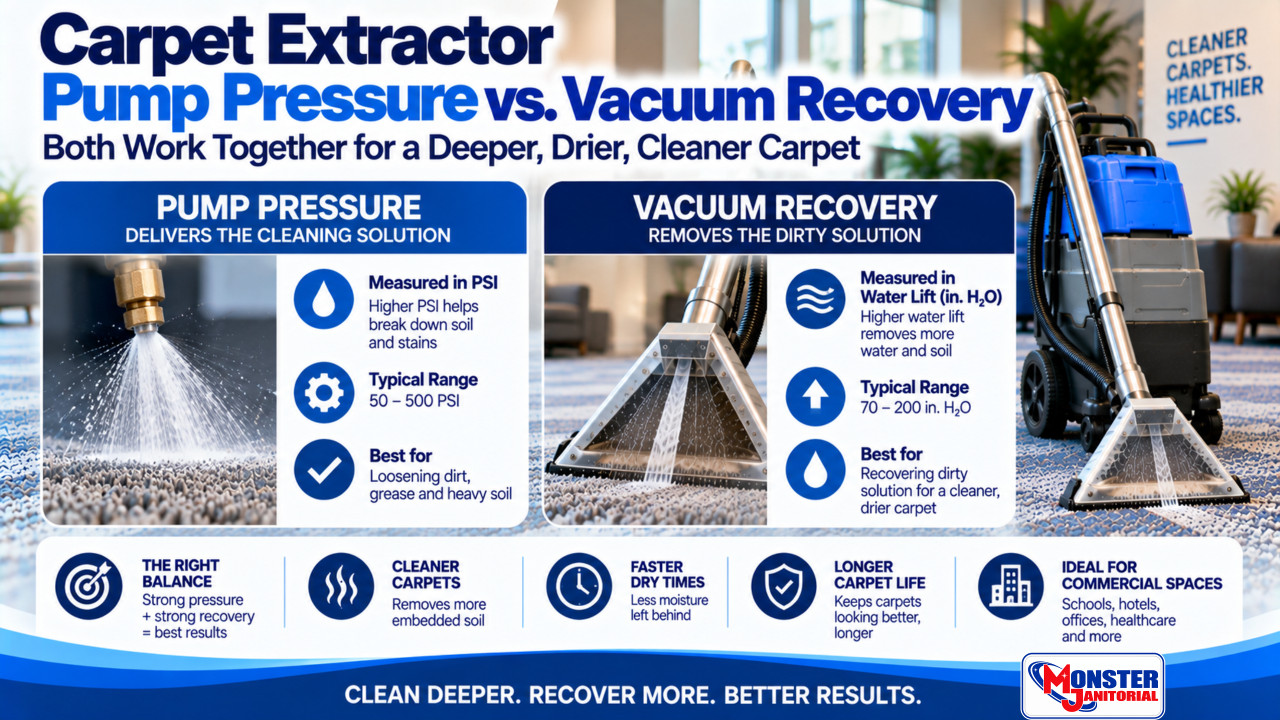
Pump Pressure Applies Solution; Vacuum Recovery Removes It

Carpet extraction works best when solution delivery and moisture recovery are matched to the carpet, cleaning tool, hose setup, and operator.

Pump Pressure

Pushes solution through the spray system
Commonly measured in PSI
Works with flow rate and jet size
Influences rinsing and soil release
Can introduce excess moisture when overused

Vacuum Recovery

Removes dirty solution and suspended soil
Depends on airflow and water lift
Works through the wand and vacuum hose
Helps control residual moisture
Declines when seals, hoses, or filters leak
Solution-System Design

Pressure, Flow, and Spray Jets Work Together

PSI describes pressure, but it does not show exactly how much solution reaches the carpet. Actual delivery changes with the pump, jets, tool width, hose, and operator trigger time.

Pump Pressure Provides the force needed to move solution through the system.
Solution Flow Determines how much liquid is delivered during a cleaning pass.
Jet Orifice Size Larger openings can increase flow at the same pressure.
Jet Angle and Placement Affect spray coverage, overlap, and contact with the carpet.
Cleaning-Tool Width Wider tools may require additional jets or adjusted flow.
Trigger Time Longer trigger use introduces more solution during each wet pass.
Vacuum-System Design

Recovery Depends on the Complete Airflow Path

Vacuum motors create suction, but recovery at the carpet also depends on hoses, seals, filters, tanks, and the cleaning tool.

Airflow Moves recovered moisture and suspended soil through the hose.
Water Lift Represents suction strength against resistance in the system.
Vacuum Hose Diameter, length, blockage, and leaks influence performance.
Tank Seals Loose lids and damaged gaskets allow vacuum loss.
Filters and Floats Restrictions or activated shutoffs can reduce recovery.
Wand or Vacuum Shoe Carpet contact and vacuum-slot condition affect moisture pickup.
Vacuum-Motor Configuration

Single-Motor vs. Dual-Motor Extractors

Motor count can influence recovery and electrical demand, but the entire vacuum design determines performance.

SINGLE MOTOR

Practical for Routine Applications

Lower electrical demand
Lower machine weight
Easier transportation
Well suited to shorter hose runs
DUAL MOTOR

Useful for Heavier Recovery Needs

May improve moisture removal
Better suited to longer hoses
Useful for restorative cleaning
May require additional electrical capacity
Hose and Tool Setup

Reach, Resistance, and Carpet Contact Matter

Use enough hose to reach the normal cleaning area without adding unnecessary resistance, storage bulk, fittings, or leak points.

Solution-Hose Length Longer runs can delay or reduce pressure at the cleaning tool.
Vacuum-Hose Length Added resistance can reduce airflow available at the wand.
Hose Diameter Diameter affects airflow capacity and compatibility with tools.
Wand Width Wider tools must be matched to solution flow and vacuum capacity.
Vacuum-Slot Condition Debris, wear, or damage can reduce pickup across the tool.
Tool Angle and Contact Poor carpet contact can allow air leakage and weaker recovery.
Operator Technique

Control Moisture During Every Cleaning Pass

The operator controls how much solution enters the carpet and how much time the vacuum system has to recover it.

Control Trigger Time Release the trigger when additional solution is not required.
Maintain Steady Wand Speed Avoid moving so slowly that one area receives excessive solution.
Limit Wet Passes Apply only the amount of solution required for the soil level.
Add Dry Passes Pass over the area without spraying to remove additional moisture.
Use Correct Overlap Overlap paths enough for consistent cleaning without repeatedly soaking sections.
Support Drying Use HVAC, ventilation, and air movement when conditions require them.
Troubleshooting

Identify Whether the Problem Is Delivery or Recovery

Pressure or Spray Problems

Weak, missing, or pulsing spray
Uneven spray pattern
Delayed pressure at the tool
Pump runs without solution delivery
Check the tank filter, jets, valve, hose, fittings, and pump inlet

Recovery Problems

Weak suction at the tool
Carpet remains excessively wet
Recovery tank fills unusually slowly
Dry passes produce little improvement
Check the float, filter, lid seal, hose, cuffs, tool, and vacuum motors
Buying Checklist

How to Compare Extractor Performance

01
Identify the Carpet and Soil Match the machine to the fiber, construction, soil, and cleaning frequency.
02
Compare PSI and Flow Review pressure, flow rate, jet count, and jet size together.
03
Review Recovery Specifications Compare airflow, water lift, motor configuration, and system design.
04
Check Hose Requirements Select the shortest practical hose setup for the facility.
05
Match the Cleaning Tool Confirm wand width, jets, fittings, hose size, and vacuum capacity.
06
Review Electrical Demand Compare amperage, cord count, circuits, and outlet availability.
07
Consider Operator Workflow Evaluate trigger control, wet passes, dry passes, and hose handling.
08
Confirm Parts and Service Review jets, hoses, filters, pumps, motors, tools, manuals, and support.
Final Recommendation

Choose a balanced solution-and-recovery system.

Select enough pump pressure and solution flow to clean the carpet effectively, then confirm that the vacuum system, hoses, seals, and cleaning tool can recover the applied moisture. The best extractor is the one matched to the facility, carpet, hose length, electrical supply, cleaning tool, and operator.

Need Help Comparing Carpet Extractor Performance?

Monster Janitorial can help compare PSI, solution flow, spray jets, airflow, water lift, vacuum motors, hose length, carpet wands, electrical requirements, and replacement parts.

Commercial Cleaning Education

MJ University Learning Center

Explore carpet-care guidance, extractor comparisons, maintenance procedures, chemical-selection resources, and commercial cleaning education from Monster Janitorial.