
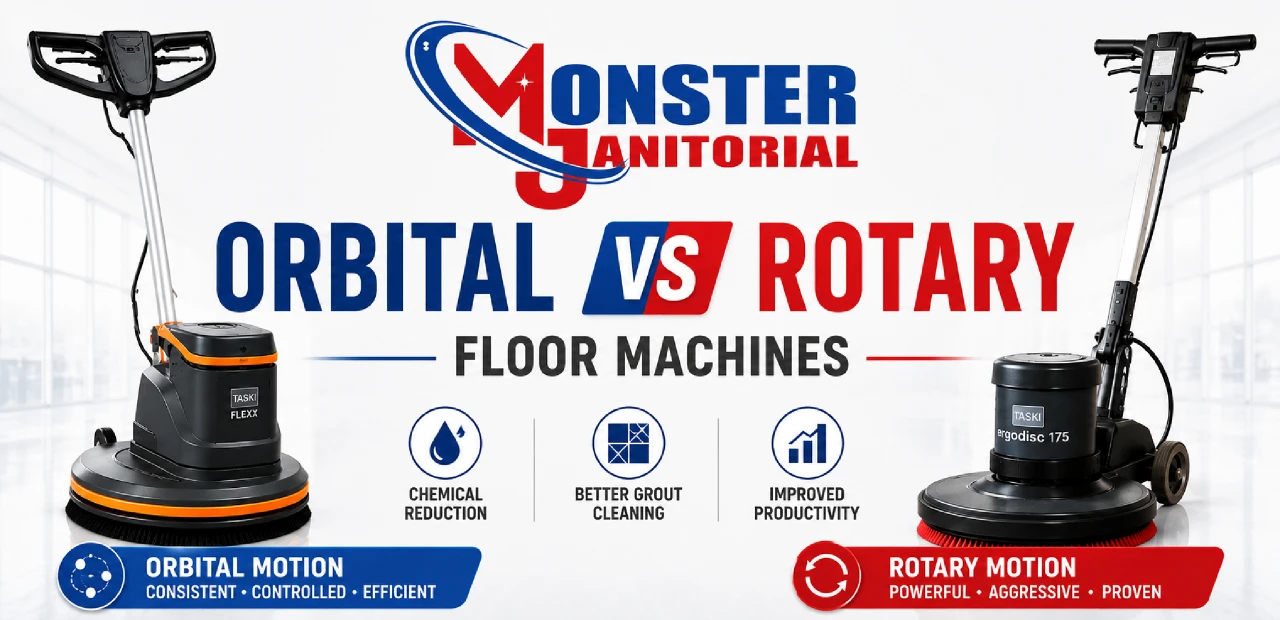
Orbital and rotary floor machines are used throughout schools, healthcare facilities, retail stores, airports, government buildings, warehouses, offices, and commercial cleaning operations for stripping, scrubbing, floor preparation, grout cleaning, polishing, and restoration.
Although both machine types can perform many of the same floor-care tasks, they operate very differently. A traditional rotary floor machine spins a round pad or brush in a continuous circular motion. An orbital floor machine moves a square or rectangular pad in rapid, small oscillating patterns.
Understanding these differences can help facility managers choose the right machine for the floor surface, cleaning task, operator experience, maintenance program, and desired results.
Quick Answer: Choose a rotary floor machine for traditional stripping, scrubbing, spray buffing, bonnet cleaning, and general floor maintenance. Choose an orbital floor machine for controlled floor preparation, grout cleaning, edge work, reduced operator fatigue, and chemical-reduction stripping programs.
Rotary, Disc, Swing Machine & Side-by-Side: What Do These Terms Mean?
The terms rotary floor machine, disc floor machine, swing machine, side-by-side machine, and low-speed buffer are often used to describe the same general machine category.
These machines use a round brush, pad driver, or floor pad that spins in a continuous circular motion. Most traditional commercial rotary machines operate between approximately 175 and 300 RPM, although speed varies by model.
Common Rotary Floor Machine Names
- Rotary floor machine
- Disc floor machine
- Low-speed floor machine
- Swing machine
- Side-by-side floor machine
- Rotary buffer
What Is a Rotary Floor Machine?
A rotary floor machine uses a circular spinning pad or brush to agitate the floor surface. The operator controls the machine by slightly raising or lowering the handle, causing the machine to move from side to side.
Rotary machines are widely used because they are durable, versatile, compatible with many pads and brushes, and capable of performing multiple floor-care tasks.
Floor Stripping
Removes worn floor finish and buildup before recoating.
Deep Scrubbing
Provides strong agitation for tile, VCT, concrete, terrazzo, and other hard floors.
Bonnet Cleaning
Supports interim carpet maintenance when paired with a compatible bonnet pad.
Spray Buffing
Removes light scuffs and improves finished-floor appearance.
Stone Restoration
Can support specialty stone-care procedures with approved pads and chemicals.
Surface Preparation
Prepares floors for finish, coatings, restoration, or refinishing.
What Is an Orbital Floor Machine?
An orbital floor machine uses rapid oscillating or micro-orbital motion instead of one large circular rotation. Many orbital machines use square or rectangular pads that maintain more consistent contact with the floor surface.
The controlled movement can reduce side pull, improve edge access, limit splash, and make the machine easier for many operators to control.
Common Orbital Floor Machine Applications
- Chemical-reduction floor stripping
- Tile and grout cleaning
- Wood floor preparation
- Floor finish removal
- Surface restoration
- Edge and corner cleaning
- Interim floor maintenance
- Reduced-fatigue cleaning programs
Orbital vs Rotary Floor Machines at a Glance
Key Differences Between Orbital and Rotary Machines
| Feature | Rotary Floor Machine | Orbital Floor Machine |
|---|---|---|
| Movement | Continuous circular rotation | Rapid oscillating or micro-orbital motion |
| Pad Shape | Round pads, brushes, and pad drivers | Square or rectangular pads |
| Operator Control | Requires control of side-to-side rotary torque | Typically more stable with less side pull |
| Edge Cleaning | Round pad leaves some distance from walls and corners | Rectangular deck can clean closer to edges and corners |
| Stripping | Strong traditional wet-stripping performance | Strong surface contact for floor prep and chemical-reduction stripping |
| Scrubbing | Versatile with pads and brushes | Consistent agitation across the pad surface |
| Splash | Can create more solution sling during stripping | Typically provides more controlled solution movement |
| Equipment Cost | Often lower initial cost | Often higher initial cost |
| Best General Use | General floor care and traditional maintenance | Floor preparation, restoration, grout cleaning, and controlled stripping |
Rotary Floor Machine Advantages
Versatile Accessory Selection
Rotary machines can use stripping pads, scrubbing pads, polishing pads, bonnet pads, brushes, pad drivers, and solution tanks.
Strong Traditional Performance
Rotary machines remain a dependable option for VCT stripping, deep scrubbing, and general restoration.
Lower Initial Cost
A standard rotary machine often costs less than a comparable orbital system.
Widely Understood Technology
Pads, brushes, parts, and operator training are widely available for traditional rotary machines.
Potential Rotary Machine Drawbacks
- Requires practice to control side-to-side movement
- May cause more operator fatigue during long cleaning routes
- Round pads cannot reach fully into corners
- Can produce more splash during wet stripping
- Incorrect technique may create swirl marks
Orbital Floor Machine Advantages
Consistent Pad Contact
The oscillating motion keeps more of the pad in contact with the floor during preparation and restoration work.
Reduced Operator Fatigue
Orbital machines generally have less side-to-side pull than traditional swing machines.
Better Edge Access
Square and rectangular pads can clean closer to walls, corners, baseboards, and edges.
Chemical-Reduction Programs
Some orbital systems can reduce the amount of stripper or cleaning chemical required when paired with the correct pads and process.
Reduced Splash
Controlled oscillating motion may reduce solution sling compared with traditional rotary stripping.
Grout & Floor Prep
Orbital action can be especially useful for grout cleaning, finish removal, wood preparation, and restoration.
Potential Orbital Machine Drawbacks
- Higher initial equipment cost on many models
- Requires orbital-specific pads and accessories
- Pad availability may be more limited than standard round pads
- Some traditional heavy stripping jobs may still favor a rotary machine
- Replacement pads may cost more depending on the system
Which Machine Is Better for Floor Stripping?
Both rotary and orbital machines can strip finished floors, but they approach the job differently.
Traditional Rotary Stripping
A rotary machine with a stripping pad provides aggressive circular action and remains a dependable choice for traditional wet-stripping programs.
Orbital Floor Preparation
An orbital machine provides consistent pad contact and can support chemical-reduction stripping, edge work, and controlled floor preparation.
Choose rotary stripping when you want a familiar, aggressive wet-stripping process with widely available round pads.
Choose orbital stripping when consistent contact, edge access, controlled movement, reduced splash, or chemical reduction are priorities.
Which Machine Is Better for Scrubbing?
A rotary machine is highly versatile for general scrubbing because it can use both pads and brushes. This makes it suitable for smooth floors, textured floors, tile, concrete, and many commercial surfaces.
An orbital machine provides consistent pad contact and can be especially effective for flat surfaces, grout cleaning, finish preparation, and restorative work.
Important: On heavily textured or non-slip flooring, a rotary machine with the correct scrubbing brush may clean recessed texture better than a flat orbital pad.
Which Machine Is Easier to Operate?
Traditional rotary machines require the operator to control the machine’s side-to-side movement by adjusting handle height. Experienced operators often appreciate this control, but new users may need practice.
Orbital machines generally move in a more stable forward-and-back pattern with less side pull. This can make them easier for new operators to control and may reduce fatigue during longer cleaning routes.
| Operator Consideration | Rotary | Orbital |
|---|---|---|
| Side Pull | Noticeable side-to-side torque | Typically reduced |
| Training | Usually requires more practice | Often easier for new operators |
| Long Routes | May create more fatigue | More stable handling may reduce fatigue |
Pad Shape & Edge Cleaning
Traditional rotary machines use round pads and brushes. This design is effective across open floor areas but cannot reach completely into square corners or directly against every wall.
Orbital machines often use square or rectangular pads. The pad shape allows the machine to work closer to edges, walls, baseboards, and corners.
Round Rotary Pads
Widely available and compatible with stripping, scrubbing, polishing, and bonnet-cleaning applications.
Rectangular Orbital Pads
Provide improved edge contact and can reduce the amount of hand detailing required near walls and corners.
Choosing by Floor Type
The best machine also depends on the floor surface, coating, soil level, and maintenance objective.
VCT & Finished Resilient Floors
Both machines can strip and scrub VCT.
Rotary: traditional stripping and scrubbing.
Orbital: controlled floor prep, edge work, and chemical-reduction stripping.
Ceramic Tile & Grout
Orbital machines provide strong flat-surface and edge contact.
Rotary: use a compatible brush for textured tile and recessed grout.
Orbital: useful for flat tile, grout lines, and perimeter cleaning.
Concrete
Both systems can clean sealed or finished concrete.
Rotary: good for scrubbing with brushes or pads.
Orbital: useful for floor prep and restoration.
Wood Floor Preparation
Wood requires manufacturer-approved processes and minimal moisture.
Orbital: often preferred for controlled screening and preparation.
Rotary: may be used by trained professionals with approved accessories.
Natural Stone
Stone requires surface-specific pads and chemicals.
Rotary: commonly used for traditional stone-care processes.
Orbital: can support controlled preparation and restoration.
Textured & Non-Slip Floors
Texture can prevent a flat pad from contacting recessed areas.
Rotary: usually preferred with a compatible scrubbing brush.
Orbital: useful on flatter sections and perimeter areas.
Important: Flooring of the same material may require different equipment depending on whether it is uncoated, sealed, finished, polished, worn, or damaged. Always verify the flooring manufacturer’s maintenance instructions.
Best Applications by Machine Type
| Cleaning Need | Recommended Machine | Reason |
|---|---|---|
| Traditional wet stripping | Rotary | Aggressive circular action and widely available stripping pads |
| Chemical-reduction stripping | Orbital | Consistent pad contact and controlled floor preparation |
| General floor scrubbing | Rotary | Versatility with pads and brushes |
| Tile and grout cleaning | Orbital or rotary brush | Choice depends on tile texture and grout depth |
| Edge and corner cleaning | Orbital | Square or rectangular pad reaches closer to walls |
| Bonnet carpet cleaning | Rotary | Compatible with traditional bonnet pads |
| Wood floor preparation | Orbital | Controlled movement and consistent pad contact |
| Lower equipment cost | Rotary | Traditional machines are often less expensive initially |
| Reduced operator fatigue | Orbital | Less side pull and more stable handling |
Which Machine Should You Choose?
Choose Rotary
Choose a rotary floor machine when you need traditional stripping, deep scrubbing, bonnet cleaning, spray buffing, broad accessory compatibility, or a lower initial equipment cost.
Choose Orbital
Choose an orbital floor machine when you need controlled floor preparation, edge cleaning, grout cleaning, reduced side pull, reduced splash, or chemical-reduction stripping.
Best practice: Many commercial floor-care programs use both machine types. Rotary machines handle versatile general maintenance, while orbital machines support controlled restoration, edge work, and floor preparation.
Where Orbital & Rotary Machines Work Best
Schools
VCT stripping, hallway scrubbing, gym-floor preparation, classrooms, cafeterias, and entryways.
Healthcare
Controlled floor preparation, grout cleaning, reduced splash, and occupied-building maintenance.
Retail
Floor restoration, entrance cleaning, aisle maintenance, and customer-facing floor care.
Government Buildings
Routine floor maintenance, restoration projects, hallways, offices, and public areas.
Hospitality
Lobby floor care, stone maintenance, carpet bonnet cleaning, and appearance restoration.
Commercial Contractors
Versatile equipment options for stripping, scrubbing, floor prep, restoration, and specialty work.
Recommended Orbital & Rotary Floor Machines
Recommended Commercial Floor Care Equipment
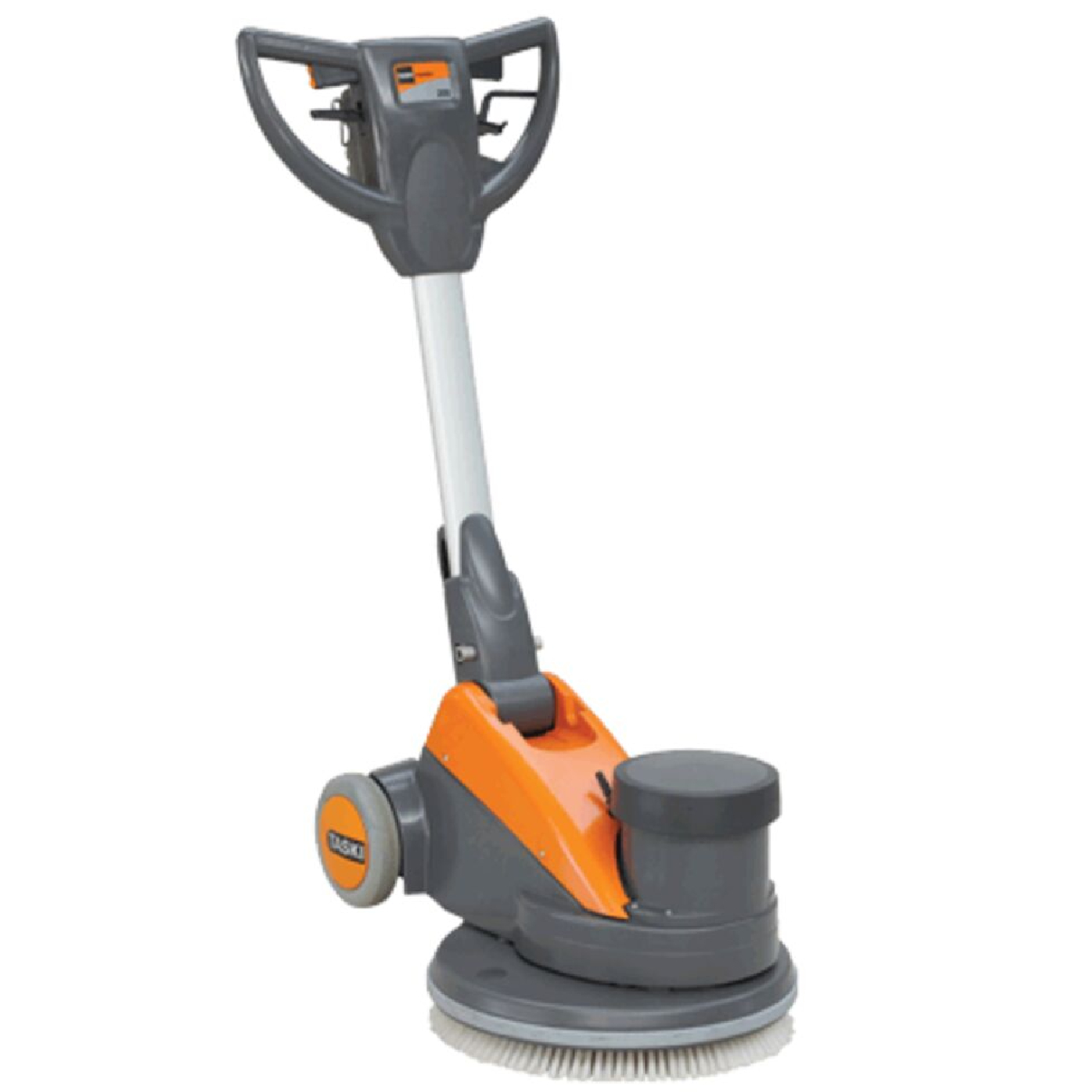
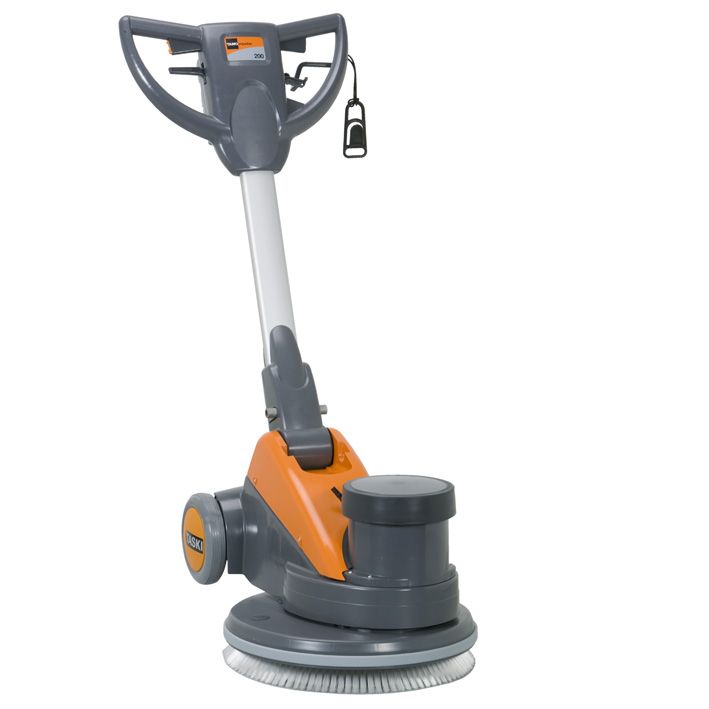
TASKI Rotary & Orbital Floor Machines
Compare traditional rotary floor machines with orbital equipment designed for stripping, scrubbing, grout cleaning, restoration, and floor preparation.
Frequently Asked Questions
Is a disc floor machine the same as a rotary floor machine?
In most commercial floor-care discussions, yes. Disc floor machine, rotary machine, swing machine, and side-by-side machine usually refer to a machine using a round pad or brush with circular rotation.
Which is better for floor stripping: orbital or rotary?
Rotary machines are a dependable choice for traditional wet stripping. Orbital machines are often preferred for controlled floor preparation, edge access, reduced splash, and chemical-reduction stripping. The best choice depends on the finish buildup, pad system, chemical process, and floor condition.
Are orbital machines easier to operate?
Many operators find orbital machines easier to control because they typically produce less side-to-side pull than traditional rotary swing machines.
Can an orbital machine clean grout?
Yes. Orbital movement and rectangular pad contact can help clean tile and grout, especially near walls and edges. Deep or textured grout may still require a specialty brush or grout-cleaning accessory.
Do orbital machines use less chemical?
Some orbital floor-preparation systems can reduce chemical use when paired with the correct pads and maintenance process. Results depend on the floor finish, buildup, pad, machine, and operating procedure.
Can a rotary machine polish floors?
Yes. Rotary machines can spray buff and polish finished floors with the correct pad. A dedicated high-speed burnisher is generally better for maintaining a high-gloss finish.
Can one facility use both machines?
Yes. Many facilities use rotary machines for general maintenance, traditional stripping, bonnet cleaning, and scrubbing, while orbital machines are used for restoration, edge work, grout cleaning, and floor preparation.
Shop Orbital & Rotary Floor Machines
Need Help Choosing the Right Floor Machine?
Monster Janitorial can help compare orbital floor machines, rotary machines, pads, brushes, pad drivers, floor-care chemicals, and restoration accessories based on your floor type, facility layout, and maintenance goals.
Email sales@monsterjanitorial.com or call 956-772-4842 for equipment recommendations.
Institutional Purchasing Support
D-U-N-S Number: 080901706
UEI Number: U4TYL7A5LEN9
Purchase orders accepted
Bid and specification support available
Why Choose Monster Janitorial?
- Commercial floor-care equipment for schools, healthcare, government, retail, hospitality, warehouses, and cleaning contractors
- Help matching equipment to floor type, cleaning task, and facility size
- Rotary machines, orbital equipment, pads, brushes, chemicals, and replacement parts
- Fast order processing
- 30-Day Returns
Tax-Exempt Purchasing
Schools, government agencies, and tax-exempt organizations can create an account and submit their exemption certificate for tax-free purchasing.
Create an Account and email your exemption certificate to sales@monsterjanitorial.com for review.
MJ University Learning Center
Explore equipment guidance, floor-care tips, maintenance advice, and commercial cleaning resources from Monster Janitorial.
Visit MJ University