
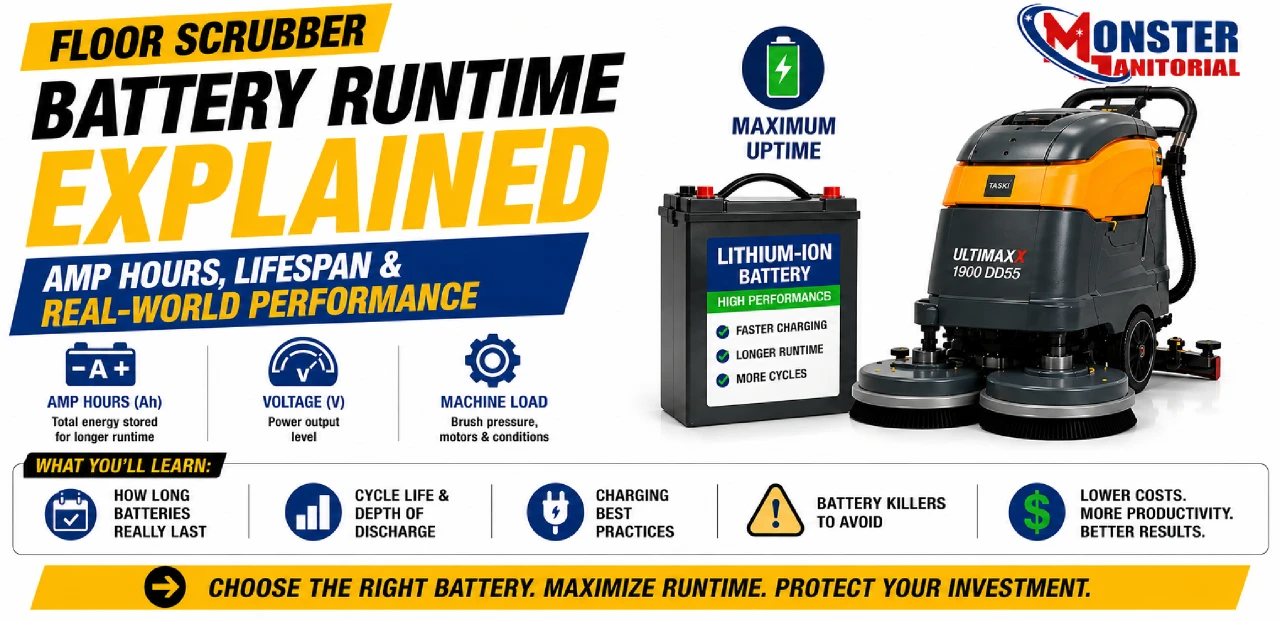
Battery type directly affects floor scrubber runtime, charging time, maintenance, productivity, and long-term ownership cost.
AGM, Gel, wet flooded, and lithium batteries can all power commercial floor scrubbers, but they are designed for different operating schedules and maintenance programs. A battery that performs well in a small single-shift building may not be the best choice for a large campus, warehouse, airport, healthcare facility, or multi-shift cleaning operation.
This guide explains how floor scrubber batteries work, what determines real-world runtime, how charging practices affect battery life, and which battery type is best for different facilities.
Quick Answer: Choose AGM for sealed, low-maintenance operation and lower upfront cost; Gel for sealed construction and improved deep-cycle performance in compatible systems; wet flooded batteries when trained staff can perform watering and maintenance; and lithium when fast charging, opportunity charging, longer service life, consistent runtime, and minimal maintenance are priorities.
Why Floor Scrubber Battery Type Matters
The battery determines whether the scrubber can complete its cleaning route, how long it must remain on the charger, and how much maintenance the facility must perform.
Cleaning productivity
Route Completion
Insufficient battery capacity can leave hallways, classrooms, warehouses, or public areas unfinished.
Charging availability
Downtime
Charging time determines how quickly the machine can return to service between routes or shifts.
Maintenance burden
Staff Requirements
Some batteries require watering, inspection, ventilation, terminal cleaning, and strict charging procedures.
Lifecycle planning
Ownership Cost
Replacement batteries, labor interruptions, maintenance, and downtime affect total cost beyond the initial purchase price.
Understanding Voltage and Amp Hours
Two specifications commonly appear in floor scrubber battery configurations: voltage and amp hours.
Voltage
Voltage describes the electrical system the machine is designed to use. Common floor scrubber systems include 24-volt, 36-volt, and 48-volt configurations.
The battery pack must match the machine’s required voltage. Installing an incompatible battery configuration can damage the machine, charger, battery-management system, or electrical components.
Amp Hours
Amp hours, commonly shown as Ah, describe the battery’s storage capacity. A higher amp-hour rating generally means more available energy, but it does not automatically guarantee a specific runtime.
Think of amp hours like fuel-tank capacity. A larger tank can support a longer route, but actual consumption still depends on the machine, floor conditions, brush pressure, operator habits, and cleaning speed.
What Determines Real-World Battery Runtime?
Rated runtime is usually based on controlled testing. Actual runtime may be lower because commercial cleaning routes include turns, obstacles, varying soil levels, and changing machine settings.
Brush Pressure
Higher down pressure increases the load on brush motors and may reduce runtime.
Vacuum Load
Vacuum motors continuously consume battery power while recovering water.
Floor Condition
Heavy soil, textured flooring, slopes, and repeated passes increase energy use.
Operator Speed
Frequent stopping, turning, reversing, and changing settings can affect runtime.
Battery Condition
Older or poorly maintained batteries may provide less usable capacity than new batteries.
Temperature
Extreme heat or cold can affect charging, capacity, and battery service life.
Floor Scrubber Battery Types at a Glance
Sealed lead-acid
AGM
Low-maintenance, sealed, widely available, and commonly used for single-shift cleaning programs.
Sealed deep-cycle
Gel
Sealed and low-maintenance, with charging requirements that must match the Gel battery profile.
Traditional lead-acid
Wet Flooded
Potentially cost-effective but requires watering, inspection, ventilation, and trained maintenance staff.
High-productivity option
Lithium
Fast charging, opportunity charging, low maintenance, and strong long-term value for demanding cleaning schedules.
AGM Floor Scrubber Batteries
AGM stands for absorbed glass mat. AGM batteries are sealed lead-acid batteries that do not require routine watering.
AGM Advantages
- No battery watering
- Sealed construction
- Lower maintenance than wet flooded batteries
- Widely available in commercial cleaning equipment
- Often lower upfront cost than lithium
- Suitable for overnight charging programs
- Common in walk-behind and ride-on scrubbers
AGM Considerations
- Charging generally takes longer than many lithium systems
- Frequent deep discharge can shorten service life
- Partial charging may reduce long-term performance
- The charger must use the correct AGM profile
- Battery capacity may decline as the battery ages
Best for: schools, offices, retail stores, municipal buildings, and single-shift facilities with dependable overnight charging.
Gel Floor Scrubber Batteries
Gel batteries are sealed lead-acid batteries that use a gelled electrolyte. Like AGM batteries, they do not require routine watering.
Gel Advantages
- Sealed and low-maintenance
- No watering required
- Designed for deep-cycle applications
- Can provide good service life when charged correctly
- Useful where a sealed lead-acid option is preferred
Gel Considerations
- Requires a Gel-compatible charging profile
- Incorrect charging voltage can damage the battery
- May cost more than AGM
- Replacement availability can vary by machine
- Must be approved for the specific scrubber configuration
Best for: facilities that want sealed, low-maintenance batteries and have equipment and chargers specifically approved for Gel batteries.
Wet Flooded Floor Scrubber Batteries
Wet flooded batteries are traditional lead-acid batteries containing liquid electrolyte. They can provide dependable performance, but only when maintained correctly.
Wet Battery Advantages
- Often lower upfront purchase cost
- Widely used in industrial cleaning equipment
- Can provide strong service life with proper maintenance
- Suitable for facilities with experienced battery-maintenance programs
Wet Battery Maintenance Requirements
- Inspect electrolyte levels
- Add approved water when required
- Keep battery terminals clean
- Use appropriate personal protective equipment
- Provide suitable charging ventilation
- Follow proper charging procedures
- Inspect cables, connectors, and battery trays
Best for: facilities with trained maintenance personnel, established watering schedules, proper charging areas, and a strong focus on lower initial equipment cost.
Lithium Floor Scrubber Batteries
Lithium battery systems are increasingly used in commercial floor scrubbers because they support demanding schedules, faster charging, and reduced routine maintenance.
Lithium Advantages
- Faster charging in many compatible systems
- Opportunity charging between routes or shifts
- No battery watering
- Very low routine maintenance
- Consistent power delivery through much of the cleaning route
- Potentially longer usable service life
- Reduced downtime for multi-shift operations
- Can reduce the number of battery replacements over the machine’s working life
Lithium Considerations
- Higher upfront purchase cost
- Must use the approved charger
- Battery-management-system compatibility is critical
- Not every scrubber can be converted from lead-acid to lithium
- Replacement batteries may be manufacturer-specific
- Cold-temperature charging limits may apply
Best for: large campuses, healthcare facilities, airports, warehouses, universities, municipal complexes, multi-shift operations, and facilities that cannot afford long charging delays.
AGM vs Gel vs Wet vs Lithium Comparison
| Feature | AGM | Gel | Wet Flooded | Lithium |
|---|---|---|---|---|
| Routine Maintenance | Low | Low | High | Very low |
| Watering Required | No | No | Yes | No |
| Upfront Cost | Moderate | Moderate | Often lower | Higher |
| Charging Flexibility | Limited | Limited | Limited | High when approved |
| Opportunity Charging | Usually not preferred | Usually not preferred | Usually not preferred | Common in compatible systems |
| Best Application | Single-shift cleaning | Sealed deep-cycle applications | Maintained industrial fleets | Daily, long-route, and multi-shift use |
Battery Cycle Life Explained
A battery cycle generally represents one discharge-and-recharge sequence. The number of usable cycles depends on battery design, depth of discharge, temperature, charging practices, maintenance, and operating conditions.
Published cycle-life figures should be treated as estimates rather than guarantees. Two identical batteries can have very different service lives if one is repeatedly discharged too deeply, exposed to heat, charged incorrectly, or left partially charged.
Important: Always use the cycle-life information supplied by the battery and equipment manufacturer for the exact battery model, charger, depth of discharge, and operating temperature.
What Is Opportunity Charging?
Opportunity charging means charging the battery during short breaks, route changes, meal periods, or gaps between shifts instead of waiting for the battery to become nearly empty.
Many lithium systems are designed to support opportunity charging. Traditional lead-acid batteries generally perform best when they complete a proper charging cycle instead of receiving frequent short charges.
Opportunity charging can be useful for:
- Multiple cleaning shifts
- Large campuses
- Airports and transportation facilities
- Healthcare facilities
- Warehouses and manufacturing operations
- Shared equipment fleets
- Facilities with limited overnight charging time
Best Charging Practices by Battery Type
| Battery Type | Recommended Practice | Avoid |
|---|---|---|
| Wet Flooded | Charge fully, inspect water levels, maintain terminals, and follow approved watering procedures. | Skipping watering, running completely dead, poor ventilation, or using the wrong charger. |
| AGM | Recharge after use and allow a complete charge whenever possible. | Repeated deep discharge, incorrect charger profiles, and routine partial charging. |
| Gel | Use an approved Gel charger profile and recharge before severe discharge. | High charging voltage or AGM and wet-battery charger settings. |
| Lithium | Use the approved lithium charger and opportunity-charge only when allowed. | Lead-acid chargers, incompatible battery-management systems, or unapproved conversions. |
The Biggest Floor Scrubber Battery Killers
Deep Discharge
Repeatedly running lead-acid batteries extremely low can shorten service life and reduce capacity.
Heat
High temperature during charging or heavy use can accelerate battery wear.
Wrong Charger
Incorrect charging voltage or profile can damage AGM, Gel, wet, or lithium batteries.
Incomplete Charging
Repeatedly interrupting lead-acid charging can reduce performance and usable battery life.
Poor Maintenance
Low water levels, dirty terminals, loose cables, and damaged connectors can create premature failure.
Long-Term Storage
Leaving batteries discharged or improperly stored can permanently reduce capacity.
Battery Recommendations by Facility Type
| Facility Type | Possible Battery Choice | Why |
|---|---|---|
| Small Offices | AGM or Gel | Shorter routes, low maintenance, and reliable overnight charging. |
| K-12 Schools | AGM, Gel, or Lithium | Choice depends on route length, available charging time, and budget. |
| Universities & Campuses | Lithium | Long routes, multiple buildings, and opportunity charging needs. |
| Healthcare Facilities | Lithium | High machine availability and reduced downtime are important. |
| Warehouses | Lithium or maintained wet batteries | Large floor areas and long operating routes require capacity and durability. |
| Municipal Buildings | AGM or Lithium | AGM fits single-shift budgets; lithium supports larger or shared fleets. |
| Multi-Shift Operations | Lithium | Fast charging and opportunity charging support high utilization. |
When AGM Makes the Most Sense
- The scrubber is used for one primary cleaning shift
- Reliable overnight charging is available
- The facility wants sealed batteries without watering
- Upfront budget is a major consideration
- The cleaning route can be completed on one charge
- The machine does not need to return to service quickly
When Gel Makes the Most Sense
- The machine is designed and approved for Gel batteries
- The facility wants sealed, maintenance-free lead-acid batteries
- A Gel-compatible charger is available
- The application requires regular deep-cycle use
- The facility wants an alternative to AGM or wet batteries
When Wet Batteries May Still Make Sense
- Trained battery-maintenance staff are available
- Watering and inspection are already part of the maintenance program
- Proper charging ventilation is available
- Lower upfront cost is the priority
- The facility has a disciplined charging and maintenance process
When Lithium Is Worth the Higher Cost
- The scrubber is used daily for long routes
- Multiple shifts are required
- The facility needs opportunity charging
- Cleaning downtime causes labor or scheduling problems
- The machine serves multiple buildings
- Maintenance staff cannot support wet-battery watering
- The facility wants fewer battery replacements
- Consistent runtime is more important than the lowest purchase price
Understanding Lithium Return on Investment
Lithium batteries generally cost more at the time of purchase, but the initial price does not represent the complete ownership cost.
Potential Lithium Savings
- Fewer battery replacements
- Reduced battery maintenance labor
- Less machine downtime
- Faster charging between routes
- Improved machine availability
- Fewer incomplete cleaning routes
- Less need for backup equipment
ROI takeaway: Lithium is most likely to provide long-term value when the scrubber is used frequently, supports large cleaning routes, or operates in a facility where downtime has a measurable labor cost.
Three-to-Five-Year Cost Planning
Schools, government agencies, universities, and institutional buyers often plan equipment purchases over multi-year budget cycles. Battery comparisons should include more than the machine’s purchase price.
Include these costs:
- Initial battery price
- Expected replacement timing
- Battery-maintenance labor
- Watering equipment and safety supplies
- Charging electricity
- Downtime and incomplete routes
- Replacement charger costs
- Backup machine requirements
- Battery disposal or recycling
How to Match Battery Runtime to Your Cleaning Route
Before choosing a battery configuration, document the actual cleaning route.
Ask These Questions
- How many square feet are cleaned per shift?
- How many hours does the scrubber run?
- Does the route include ramps or textured floors?
- Is heavy brush pressure required?
- How many buildings use the same machine?
- Can the machine charge between routes?
- Is overnight charging guaranteed?
- Does the facility operate multiple cleaning shifts?
- Is a backup scrubber available?
Can You Convert a Floor Scrubber to Lithium?
Not every floor scrubber can be safely converted from AGM, Gel, or wet batteries to lithium.
A conversion may require:
- Manufacturer approval
- Correct system voltage
- Battery-management-system compatibility
- Approved lithium charger
- Correct battery compartment dimensions
- Compatible cables and connectors
- Proper machine programming
- Weight and ballast verification
Do not install lithium batteries solely because the voltage appears to match. Contact the machine manufacturer or an authorized equipment specialist before changing battery chemistry.
Common Floor Scrubber Battery Mistakes
- Choosing batteries only by upfront price
- Ignoring real cleaning-route length
- Using the wrong charger profile
- Running lead-acid batteries completely dead
- Skipping wet-battery watering
- Charging in an unsuitable location
- Leaving batteries discharged during storage
- Mixing old and new batteries in the same pack
- Installing batteries with the wrong voltage or capacity
- Attempting an unapproved lithium conversion
- Ignoring cable, terminal, and connector condition
Battery Inspection Checklist
Before Use
- Check the battery charge level
- Inspect cables and connectors
- Look for corrosion, swelling, leaks, or damage
- Confirm the charger was disconnected correctly
- Verify that the machine starts without battery warnings
After Use
- Park the machine in the approved charging area
- Inspect wet-battery water levels according to manufacturer instructions
- Connect the correct charger
- Allow the charging cycle to complete when required
- Record battery or charger fault codes
Monthly or Scheduled Inspection
- Inspect terminals and cables
- Clean corrosion using approved procedures
- Inspect the battery tray
- Review runtime changes
- Check charger condition
- Confirm battery settings match the installed chemistry
Recommended Battery-Powered Floor Scrubbers
Recommended Battery Scrubbers
Automatic Floor Scrubbers for Commercial Facilities
Compare compact walk-behind, stand-on, ride-on, and robotic scrubbers for different cleaning routes, runtime requirements, charging schedules, and facility sizes.
Compact Walk-Behind
TASKI swingo 455B
Compact battery scrubber for classrooms, restrooms, offices, healthcare spaces, and smaller cleaning routes.
View Scrubber →Walk-Behind Scrubber
TASKI ULTIMAXX 1900
Commercial walk-behind scrubber for schools, retail, healthcare, offices, and institutional cleaning programs.
View Scrubber →Stand-On Scrubber
TASKI swingo XP-R
Stand-on battery scrubber for long corridors, campuses, public buildings, and high-productivity routes.
View Scrubber →Ride-On Scrubber
TASKI swingo 4000B
Ride-on battery scrubber for universities, airports, warehouses, large schools, and government facilities.
View Scrubber →Frequently Asked Questions
What is the best battery for a commercial floor scrubber?
The best battery depends on the cleaning route, charging window, maintenance capability, and budget. AGM is common for single-shift programs, while lithium is often better for long routes, opportunity charging, and multi-shift use.
Are AGM batteries maintenance-free?
AGM batteries do not require watering, but they still require correct charging, cable inspection, clean terminals, and proper storage.
Are Gel batteries better than AGM?
Gel batteries may provide advantages in some deep-cycle applications, but they require an approved Gel charging profile. The correct choice depends on the machine and manufacturer specifications.
How long do floor scrubber batteries last?
Battery life varies by chemistry, depth of discharge, charging practices, operating temperature, maintenance, machine load, and frequency of use. Manufacturer cycle-life estimates should be used as guidance rather than guarantees.
Can I charge an AGM battery with a wet-battery charger?
Only when the charger is specifically approved and programmed for AGM batteries. Using the wrong charger profile can shorten battery life or damage the battery.
Can lithium batteries be partially charged?
Many commercial lithium systems support opportunity charging, but the battery and machine manufacturer’s instructions must be followed.
Why is my floor scrubber losing runtime?
Possible causes include aging batteries, deep discharge, incomplete charging, heat, damaged cables, high brush pressure, heavy floor conditions, charger problems, or an electrical issue with the machine.
Should I replace all batteries in the pack together?
Battery packs are generally replaced as a matched set. Mixing batteries of different ages, capacities, or conditions can cause uneven charging and poor performance.
Is lithium always the best choice?
No. Lithium provides strong advantages for demanding applications, but AGM, Gel, or wet batteries may be more economical for light-duty or single-shift facilities.
How do I choose the correct amp-hour rating?
Use the machine manufacturer’s approved battery specifications and match the capacity to the real cleaning route. Physical size, weight, voltage, charger compatibility, and battery chemistry must also be considered.
Institutional Purchasing Support
Monster Janitorial supports schools, universities, government agencies, municipalities, healthcare facilities, and institutional buyers.
- Purchase-order support for approved organizations
- Tax-exempt account setup
- Equipment and battery configuration quotes
- Bid and specification assistance
- Replacement battery and charger support
D-U-N-S Number: 080901706
UEI Number: U4TYL7A5LEN9
Need Help Choosing a Battery-Powered Scrubber?
Monster Janitorial can help compare AGM, Gel, wet flooded, and lithium scrubber configurations based on your facility size, cleaning route, available charging time, maintenance program, and budget.
Email: sales@monsterjanitorial.com
Phone: 956-772-4842
Tax-Exempt Purchasing
Schools, government agencies, and qualifying tax-exempt organizations can create an account and submit an exemption certificate for review.
Create an Account and email the tax exemption certificate to sales@monsterjanitorial.com.
MJ University Learning Center
Explore equipment guidance, battery information, maintenance tips and commercial cleaning resources from Monster Janitorial.
Visit MJ University