
Choosing the right commercial floor scrubber requires more than matching a machine to the total square footage of a building.
The best automatic floor scrubber must fit the actual cleaning route, including hallways, classrooms, aisles, restrooms, elevators, doorways, ramps, storage rooms, furniture, and open floor areas. It must also provide enough cleaning productivity, tank capacity, battery runtime, maneuverability, and water recovery to complete the job during the facility’s available cleaning window.
A scrubber that is too small may require excessive refill cycles, repeated passes, and unnecessary labor. A machine that is too large may not fit through doorways, turn inside narrow corridors, enter elevators, or clean around furniture and fixtures.
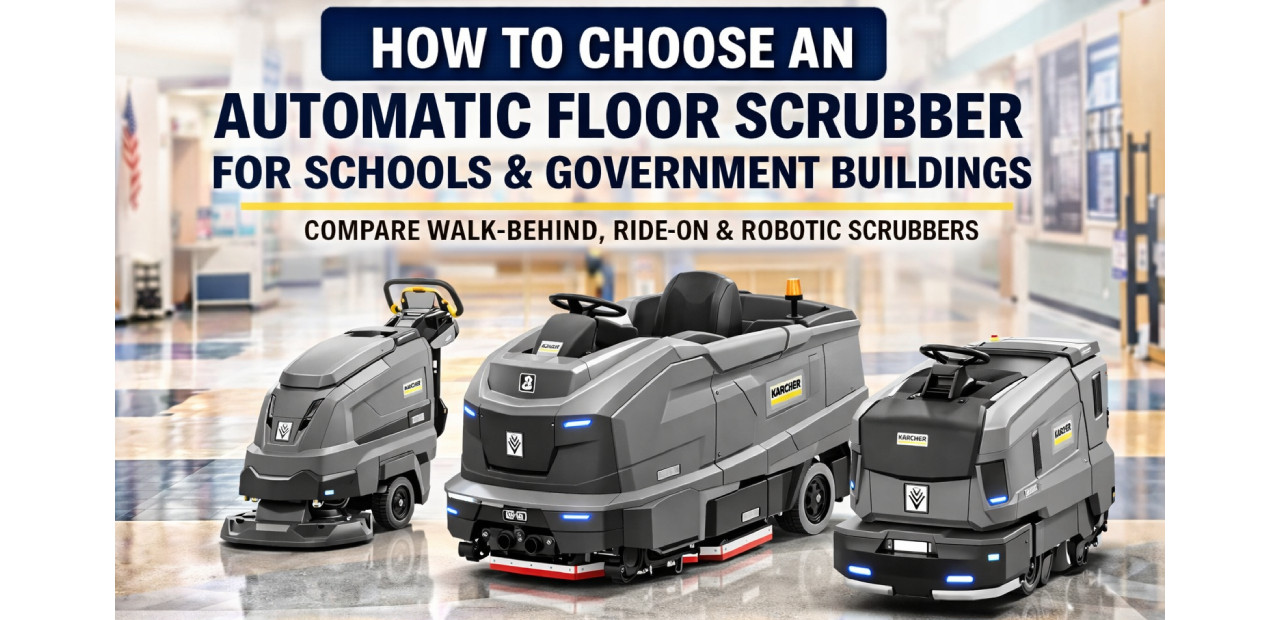
This guide explains how to choose between compact walk-behind, large walk-behind, stand-on, ride-on, and robotic scrubbers. It also covers cleaning-path width, theoretical versus real-world productivity, tank size, battery options, deck systems, floor types, operator considerations, and facility-specific recommendations.
Quick Answer: Choose a compact walk-behind scrubber for small rooms and tight spaces, a mid-size or large walk-behind for mixed commercial routes, a stand-on scrubber for long corridors and medium-to-large facilities, and a ride-on scrubber for large open areas where labor savings and productivity are the main priorities. Choose a robotic scrubber when repeatable routes, reporting, and labor support are important.
What Is an Automatic Floor Scrubber?
An automatic floor scrubber, also called an auto scrubber, is a commercial cleaning machine that applies cleaning solution, agitates the floor with brushes or pads, and recovers dirty water with a vacuum and squeegee system.
This allows the machine to scrub and dry the floor in one pass.
Most auto scrubbers include:
- A clean-solution tank
- A recovery tank
- A scrub deck with brushes, pads, or orbital technology
- A solution-control system
- A vacuum motor
- A rear squeegee assembly
- Drive and steering controls
- A battery, charger, engine, or cord-electric power system
Auto scrubbers are designed primarily for routine and restorative hard-floor cleaning in schools, healthcare facilities, retail stores, warehouses, airports, government buildings, offices, grocery stores, manufacturing facilities, and commercial cleaning operations.
Auto, Automatic & Autonomous Scrubbers
- Auto scrubber and automatic floor scrubber usually mean the same thing. Both describe an operator-controlled machine that dispenses solution, scrubs, and recovers dirty water.
- Autonomous floor scrubber or robotic scrubber describes a machine that can follow mapped cleaning routes with sensors, safety systems, reporting, and operator supervision.
Start with the Actual Cleaning Route
Total building square footage is not the same as cleanable floor area.
A 100,000-square-foot building may include carpet, offices filled with furniture, mechanical rooms, stairways, storage areas, and spaces that are not cleaned with an auto scrubber. The actual hard-floor route may be much smaller.
Before comparing machines, map the areas the scrubber must clean.
Measure
Cleanable Square Footage
Calculate the hard-floor area that will actually be scrubbed during each route.
Inspect
Doorways & Elevators
Confirm the machine, squeegee, and turning radius fit through the narrowest route.
Time
Available Cleaning Window
Determine how many minutes or hours operators have to complete the route.
Identify
Obstacles & Tight Areas
Include furniture, displays, columns, ramps, turns, narrow aisles, and congested corridors.
Questions to Answer Before Choosing a Scrubber
- How many square feet of hard floor must be cleaned?
- How often is the route cleaned?
- How much time is available?
- What is the narrowest doorway?
- Does the machine need to enter an elevator?
- How much turning space is available?
- Are there classrooms, exam rooms, aisles, offices, or furniture?
- Are the floors smooth, textured, grouted, coated, or uneven?
- How heavily soiled are the floors?
- Where will the machine be filled, emptied, stored, and charged?
- Will one operator use the machine, or will multiple employees share it?
- Does the facility need daytime or quiet cleaning?
Why Scrubber Size Matters
The size of an automatic floor scrubber affects cleaning speed, maneuverability, tank capacity, battery requirements, storage, transportation, and operator comfort.
A Machine That Is Too Small
- Requires more passes
- Increases cleaning time
- Needs more refill and dump cycles
- May not complete the route on one charge
- Can increase operator fatigue
- May require multiple machines or shifts
A Machine That Is Too Large
- May not fit through doors
- May be difficult to turn
- Cannot reach tight rooms or aisles
- Requires more storage space
- May be harder to transport
- Can leave detail areas for manual cleaning
Floor Scrubber Size Guide
The following table is a starting point. It should not replace a review of the actual layout, route, tank requirements, battery runtime, and cleaning window.
| Cleanable Floor Area | Common Cleaning Path | Possible Machine Type |
|---|---|---|
| Under 10,000 sq. ft. | Approximately 12–17 in | Micro or compact walk-behind scrubber |
| 10,000–30,000 sq. ft. | Approximately 17–22 in | Mid-size walk-behind scrubber |
| 30,000–75,000 sq. ft. | Approximately 20–28 in | Large walk-behind, stand-on, or compact rider |
| 75,000+ sq. ft. | Approximately 26 in and wider | Stand-on, ride-on, or robotic scrubber |
Important: A large building does not automatically require one large rider. A facility with classrooms, narrow corridors, elevators, and many separate wings may be better served by multiple compact or mid-size machines.
What Does Square Feet Per Hour Mean?
Square feet per hour measures how much floor area a machine can theoretically clean in one hour.
Manufacturer productivity ratings are useful for comparing equipment, but they are generally calculated under controlled conditions with continuous forward movement, minimal overlap, no obstacles, no refill time, and no turning delays.
Theoretical Productivity
The maximum output calculated from cleaning width and travel speed under nearly perfect conditions.
Practical Productivity
The amount of floor that can actually be cleaned after turns, overlap, obstacles, refilling, emptying, and operator pace are included.
Estimated Productivity by Machine Size
| Machine Type | Common Cleaning Width | Estimated Theoretical Productivity |
|---|---|---|
| Compact Walk-Behind | 14–17 in | Approximately 8,000–12,000 sq. ft./hr |
| Mid-Size Walk-Behind | 17–22 in | Approximately 12,000–20,000 sq. ft./hr |
| Large Walk-Behind | 20–28 in | Approximately 20,000–35,000 sq. ft./hr |
| Stand-On Scrubber | Approximately 20–30 in | Varies widely by model and travel speed |
| Ride-On Scrubber | 28 in and wider | Approximately 35,000–70,000+ sq. ft./hr |
Use these ranges only for initial planning. The exact productivity of a machine depends on its published specifications, operator speed, cleaning method, floor condition, and building layout.
What Reduces Real-World Productivity?
Turns & Obstacles
Columns, displays, tables, furniture, and corners interrupt continuous forward cleaning.
Overlap
Operators overlap passes to avoid missed strips, reducing the total effective cleaning width.
Refill & Dump Time
Small tanks require more trips to the janitor closet, drain, or filling station.
Heavy Soil
Deep cleaning may require slower movement, additional down pressure, or multiple passes.
Operator Experience
Training affects machine setup, travel speed, turning, overlap, and water recovery.
Detail Cleaning
Edges, corners, stairs, and areas under furniture may require separate manual cleaning.
How to Calculate the Productivity You Need
Start by dividing the cleanable square footage by the available cleaning time.
Required Practical Productivity = Cleanable Square Footage ÷ Available Cleaning Hours
Example: 40,000 sq. ft. ÷ 2 hours = 20,000 practical sq. ft./hr required.
Because published productivity is usually theoretical, choose a machine with a rated output comfortably above the required practical productivity.
Also account for:
- Refill and dump time
- Battery runtime
- Breaks and equipment setup
- Elevator travel
- Transport between buildings
- Heavy-soil areas
- Detail cleaning
- Seasonal soil from rain, snow, salt, or construction
Choosing the Right Cleaning Path
The scrubber’s cleaning path determines how much floor it covers with each pass.
A wider deck can increase productivity, but it also increases the machine’s footprint and turning requirements.
| Cleaning Path | Common Applications | Main Consideration |
|---|---|---|
| 12–15 in | Restrooms, classrooms, small retail, offices, kitchens, exam rooms | Excellent access but lower productivity |
| 17–20 in | Schools, clinics, retail stores, hallways, mixed commercial areas | Strong balance between maneuverability and output |
| 20–24 in | Large hallways, grocery stores, institutions, public facilities | Higher productivity with more turning and storage space required |
| 26–30 in | Large campuses, warehouses, airports, retail centers | Best for open areas and longer routes |
| 32 in and wider | Warehouses, manufacturing, transportation, large public facilities | High output but requires substantial turning, storage, and transport space |
Compact Walk-Behind Floor Scrubbers
Compact walk-behind scrubbers are designed for smaller spaces, tight layouts, and cleaning routes that were traditionally maintained with mops.
Best Applications
- Classrooms
- Restrooms
- Small retail stores
- Healthcare exam rooms
- Restaurants
- Kitchens
- Offices
- Daycare facilities
- Convenience stores
- Tight corridors and elevators
Advantages
- Excellent maneuverability
- Fits smaller doorways and rooms
- Easy to store
- Lower initial equipment cost
- Can replace mop-and-bucket cleaning in many areas
- Good for detail routes and smaller facilities
Limitations
- Smaller solution and recovery tanks
- More frequent refill cycles
- Lower square-foot productivity
- May require the operator to walk long distances
- May not complete large routes on one charge
Mid-Size Walk-Behind Floor Scrubbers
Mid-size walk-behind machines are among the most versatile auto scrubbers for schools, healthcare, retail, offices, and general facility maintenance.
They usually offer a stronger balance of cleaning width, tank capacity, maneuverability, runtime, and storage requirements.
Best Applications
- School hallways and cafeterias
- Clinics and healthcare corridors
- Retail stores
- Government offices
- Churches and community buildings
- Grocery aisles
- Hotels
- Commercial offices
Large Walk-Behind Floor Scrubbers
Large walk-behind scrubbers provide wider cleaning paths and larger tanks while maintaining the operator control of a walk-behind design.
Best Applications
- Large schools
- Universities
- Warehouses with mixed layouts
- Large retail stores
- Hospitals
- Government campuses
- Manufacturing areas with tighter sections
Choose a large walk-behind when a ride-on machine is too large for the layout but a smaller scrubber cannot complete the route efficiently.
Stand-On Floor Scrubbers
A stand-on scrubber allows the operator to ride on a compact platform while maintaining a smaller overall footprint than many traditional ride-on machines.
Best Applications
- Long school corridors
- Universities and campuses
- Large retail stores
- Hospitals
- Municipal buildings
- Large cafeterias
- Gyms and common areas
- Facilities needing rider productivity with compact maneuverability
Advantages
- Higher productivity than many walk-behind machines
- Reduced operator walking and fatigue
- Compact turning radius
- Good forward visibility
- Useful for frequent stops and route changes
- Smaller footprint than many sit-down riders
Limitations
- Higher initial cost than many walk-behinds
- Requires additional storage space
- May not enter every small room
- Operator training is important
Ride-On Floor Scrubbers
A ride-on floor scrubber allows the operator to sit or ride on the machine while cleaning. These machines are designed for larger areas, longer routes, and higher labor productivity.
Best Applications
- Warehouses
- Airports
- Manufacturing facilities
- Distribution centers
- Large schools and universities
- Shopping malls
- Convention centers
- Large grocery and retail facilities
- Government and civic campuses
Advantages
- High square-foot productivity
- Larger solution and recovery tanks
- Reduced operator fatigue
- Longer productive cleaning routes
- Fewer refill and dump cycles
- Strong labor-saving potential
Limitations
- Higher initial cost
- Requires larger storage areas
- Needs wider doorways and turning space
- May require trailers, ramps, or lift-gate vehicles for transport
- Cannot replace a compact machine in tight detail areas
Walk-Behind vs Stand-On vs Ride-On Scrubbers
| Feature | Walk-Behind | Stand-On | Ride-On |
|---|---|---|---|
| Maneuverability | Best for tight spaces | Compact with strong turning ability | Best in open areas |
| Productivity | Low to moderate | Moderate to high | High |
| Operator Fatigue | Operator walks entire route | Reduced walking | Lowest walking requirement |
| Storage | Smallest requirement | Moderate | Largest requirement |
| Tank Capacity | Small to medium | Medium | Medium to large |
| Initial Cost | Usually lowest | Moderate to high | Usually highest |
| Best Fit | Small rooms and mixed routes | Long corridors and medium-large facilities | Large open areas and long routes |
Robotic & Autonomous Floor Scrubbers
Robotic scrubbers can clean mapped routes with sensors, obstacle detection, reporting tools, and operator oversight.
They are best suited to predictable, repeatable routes rather than constantly changing environments.
Good Robotic Applications
- Long open hallways
- Large retail floors
- Airports
- Warehouses
- Schools after hours
- Hospitals with defined routes
- Large lobbies and concourses
Important Robotic Considerations
- Route consistency
- Obstacle frequency
- Staff training
- Wi-Fi or connectivity requirements
- Reporting and software subscriptions
- Manual cleaning of edges and inaccessible areas
- Service support
- Safety review
Robotic scrubbers support labor; they do not eliminate the need for trained cleaning staff. Employees are still needed for setup, route preparation, filling, emptying, maintenance, detail cleaning, and responding to changing conditions.
Tank Capacity & Refill Cycles
Tank size directly affects productive cleaning time.
A scrubber with a wider deck but undersized tanks may lose much of its productivity advantage if the operator must repeatedly stop to refill and empty the machine.
Consider These Questions
- How far is the filling station from the cleaning area?
- Where can dirty water be dumped?
- How many gallons are used during the route?
- Can the machine complete the route with one tank?
- Will the machine be used for light daily cleaning or heavy restorative scrubbing?
- Does the facility have multiple floors or buildings?
Productivity tip: Reducing one unnecessary refill cycle every day can create meaningful labor savings over the life of the machine.
Battery Runtime & Charging
Battery capacity should be matched to the real cleaning route, not only the machine’s published maximum runtime.
Actual runtime can be affected by:
- Brush or pad pressure
- Drive speed
- Vacuum use
- Floor slope
- Battery age
- Temperature
- Operator habits
- Battery chemistry
- Charging practices
AGM, Gel, Wet-Cell & Lithium Batteries
AGM Batteries
Sealed, widely used, and generally lower in initial cost than lithium. Charging time and replacement cycles must be planned.
Gel Batteries
Sealed batteries used in some floor-care fleets. Require a compatible charger and proper charging profile.
Lithium Batteries
Often support faster charging and opportunity charging. Higher initial cost may be offset by uptime and longer service life in suitable applications.
Wet-Cell Batteries
Can provide strong value but require watering, ventilation, charging discipline, and ongoing maintenance.
Battery Questions to Ask
- Can the machine complete the full route?
- How long does charging take?
- Can the battery be opportunity charged?
- Is the charger onboard or external?
- Is a dedicated charging location available?
- Who will inspect and maintain the batteries?
- How much downtime is acceptable?
- What is the expected replacement cost?
Disc, Cylindrical & Orbital Scrub Decks
Scrubber size is only one part of machine selection. The cleaning system must also match the floor and soil.
Disc Scrubbers
Use round pads or brushes and are widely used for routine cleaning on smooth commercial floors.
Best for: VCT, smooth tile, terrazzo, sealed concrete, and pad-based maintenance programs.
Cylindrical Scrubbers
Use rotating cylindrical brushes and may collect small loose debris into a hopper.
Best for: textured floors, grouted tile, industrial floors, and routes with light debris.
Orbital Scrubbers
Use rapid oscillating movement and rectangular pads for consistent contact and improved edge access.
Best for: floor preparation, grout cleaning, chemical-reduction programs, and controlled restorative cleaning.
Brushes vs Floor Pads
Choose the cleaning accessory based on floor texture, soil level, finish system, and maintenance objective.
| Accessory | Best Application |
|---|---|
| Floor Pads | Smooth finished floors, daily cleaning, scrubbing, polishing, and restorative pad programs |
| Nylon Brushes | General-purpose scrubbing on tile, concrete, and textured surfaces |
| Soft Brushes | Sensitive flooring or lighter cleaning when approved by the flooring manufacturer |
| Aggressive Brushes | Heavy soil, uneven flooring, industrial areas, and recessed texture |
Choosing by Floor Type
VCT & Finished Resilient Floors
Disc scrubbers with compatible pads are common for daily maintenance. Verify chemical and pad compatibility with the floor finish.
Tile & Grout
Brushes, cylindrical systems, or orbital decks may provide better agitation in grout lines and texture.
Sealed Concrete
Disc or cylindrical systems may work depending on texture, coating, soil, and desired maintenance method.
Terrazzo & Stone
Use surface-approved pads, brushes, chemicals, and pressure settings to prevent damage.
Rubber Flooring
Choose approved brushes or pads and control solution flow to avoid residue and streaking.
Textured Non-Slip Floors
Brush systems generally reach recessed texture more effectively than flat floor pads.
Squeegee Performance & Floor Drying
The scrubber must recover water effectively, not only scrub the floor.
Poor water recovery may be caused by:
- Worn or damaged squeegee blades
- Incorrect blade adjustment
- Debris trapped under the squeegee
- Vacuum hose restrictions
- Full recovery tanks
- Clogged float or filter systems
- Excessive solution flow
- Uneven flooring
- Turning too sharply
Why Drying Performance Matters
- Reduces wet-floor exposure
- Allows spaces to reopen sooner
- Improves daytime cleaning
- Reduces additional mop-up labor
- Supports better floor appearance
Down Pressure & Cleaning Performance
Higher pad or brush pressure can improve agitation on heavily soiled floors, but more pressure is not always better.
Excessive pressure can:
- Shorten pad or brush life
- Increase battery consumption
- Reduce runtime
- Damage floor finish
- Increase motor load
- Reduce productivity by slowing the machine
Match pressure to the floor, chemical, pad or brush, and soil condition.
Operator Comfort & Ease of Use
A machine that is difficult to operate may not deliver its expected productivity.
Operator Features to Compare
- Adjustable handle height
- Power-assist or traction drive
- Steering effort
- Visibility around the scrub deck
- Control simplicity
- Noise and vibration
- Seat or platform comfort
- Easy brush and pad changes
- Easy tank filling and draining
- Clear battery and solution indicators
Best practice: Have the employees who will use the machine participate in a demonstration whenever possible. Operator acceptance affects whether the equipment is used correctly and consistently.
Noise Level & Daytime Cleaning
Noise matters in schools, hospitals, offices, libraries, government buildings, hotels, and occupied public spaces.
Compare:
- Published sound level
- Quiet or eco cleaning modes
- Vacuum noise
- Brush and deck vibration
- Backup alarms
- Suitability for daytime operation
Storage, Transport & Charging Space
Before purchasing a scrubber, measure the entire storage and transport route.
Check:
- Storage-room door width
- Machine height and length
- Squeegee width
- Elevator dimensions and weight limits
- Ramp grade
- Trailer or vehicle capacity
- Charging outlet location
- Ventilation requirements
- Drain and filling access
Serviceability & Replacement Parts
Long-term equipment value depends on maintenance access and parts availability.
Common Wear Parts
- Squeegee blades
- Floor pads
- Scrub brushes
- Pad drivers
- Vacuum hoses
- Solution filters
- Recovery-tank seals
- Vacuum motors
- Drive wheels and casters
- Batteries and chargers
Questions to Ask
- Are replacement squeegee blades readily available?
- Can the operator change pads and brushes without tools?
- How easy is access to the recovery tank and filters?
- Is local or regional service available?
- Are parts diagrams and manuals available?
- What warranty coverage is included?
Recommendations by Facility Type
Schools
Use compact machines for classrooms and restrooms, mid-size walk-behinds for hallways, and stand-on or ride-on scrubbers for large campuses and long corridors.
Healthcare
Prioritize water recovery, low noise, maneuverability, hygiene, easy tank cleaning, and compatibility with facility-approved chemicals.
Retail
Choose machines that navigate displays and aisles while providing fast drying and strong appearance maintenance.
Government Buildings
Compare long-term parts support, battery life, bid requirements, training, warranty, and mixed-space versatility.
Warehouses
Prioritize cleaning width, tank capacity, battery runtime, cylindrical debris pickup, operator comfort, and ride-on productivity.
Grocery Stores
Balance maneuverability with fast water recovery, aisle access, grease removal, and daytime-cleaning requirements.
Machine Selection by Cleaning Need
| Cleaning Need | Possible Starting Choice |
|---|---|
| Restrooms, classrooms, small shops | Compact walk-behind scrubber |
| Mixed commercial routes | 17–22 in walk-behind scrubber |
| Long hallways with moderate turning space | Large walk-behind or stand-on scrubber |
| Large open warehouse or airport floors | Ride-on scrubber |
| Repeatable open routes with labor shortages | Robotic scrubber with staff support |
| Textured floors and light debris | Cylindrical scrubber |
| Smooth finished floors | Disc scrubber with compatible pads |
| Floor prep and chemical-reduction cleaning | Orbital scrubber |
Common Buying Mistakes
Scrubber Selection Mistakes
Problems That Lead to Poor Equipment Fit
Avoid choosing a scrubber based on cleaning width, purchase price, or total building square footage alone.
Buying Too Small
The machine cannot complete the route within the available cleaning window.
Buying Too Large
The scrubber cannot fit through doors, turn in aisles, or reach important areas.
Ignoring Runtime
The battery cannot finish the route or requires excessive charging downtime.
Ignoring Tank Size
Frequent refill and dump cycles reduce practical productivity.
Wrong Deck System
The selected brush or pad system does not match the floor texture or cleaning task.
Buying on Price Alone
Lower initial cost may be offset by labor, downtime, batteries, parts, or poor productivity.
Floor Scrubber Selection Checklist
Facility Information
- Cleanable hard-floor square footage
- Facility type
- Number of floors and buildings
- Narrowest doorway
- Elevator dimensions and weight capacity
- Floor type and texture
- Obstacles and furniture
- Storage and charging space
Cleaning Requirements
- Daily, weekly, or restorative use
- Available cleaning window
- Required practical productivity
- Soil level
- Required drying performance
- Noise restrictions
- Daytime or after-hours operation
Machine Requirements
- Cleaning-path width
- Solution and recovery capacity
- Battery runtime
- Charging time
- Disc, cylindrical, or orbital deck
- Brush or pad compatibility
- Traction drive
- Operator comfort
- Squeegee and vacuum performance
- Parts and service availability
Ownership Costs
- Initial equipment cost
- Battery and charger cost
- Pads, brushes, and squeegee blades
- Preventive maintenance
- Operator training
- Transportation between sites
- Expected labor savings