
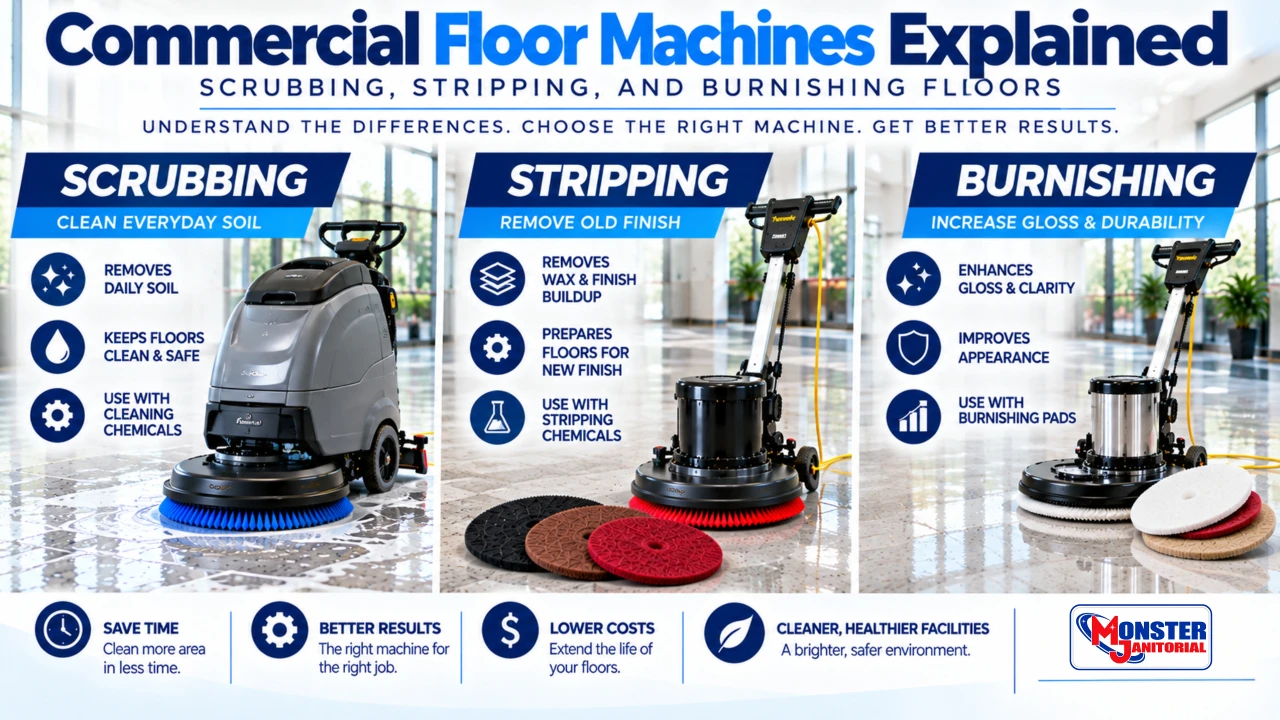
Commercial Floor Machines Explained
Compare low-speed rotary machines, dual-speed floor machines, orbital machines and high-speed burnishers for scrubbing, stripping, polishing and floor restoration.
The right machine depends on the floor surface, maintenance task, pad or brush, machine speed and the floor-care system being used.
Choose the Machine for the Floor-Care Task
Choose a low-speed rotary machine for stripping, deep scrubbing and floor preparation; a dual-speed machine when low-speed cleaning plus light polishing flexibility is useful; an orbital machine for compatible floor preparation and restoration processes; and a high-speed burnisher for maintaining gloss on compatible finished floors.
What Is a Commercial Floor Machine?
A commercial floor machine uses a rotating or oscillating pad, brush or accessory to perform hard-floor maintenance. The machine itself provides agitation; the installed accessory and operating process determine what work it can perform.
Scrubbing vs Stripping vs Buffing vs Burnishing
| Process | Main Purpose | Common Machine | Accessory |
|---|---|---|---|
| Scrubbing | Remove soil and residue | Low-speed or orbital | Compatible scrub pad or brush |
| Stripping | Remove compatible floor finish | Low-speed or compatible orbital | Stripping pad or approved system |
| Buffing | Light appearance maintenance | Low- or dual-speed machine | Compatible buffing or polishing pad |
| Burnishing | Maintain or restore gloss | High-speed burnisher | Manufacturer-approved burnishing pad |
Four Common Commercial Floor-Machine Systems
Low-Speed Rotary
Commonly used for stripping, deep scrubbing, floor preparation, spray buffing and other torque-dependent maintenance tasks.
Dual-Speed
Provides a lower setting for cleaning tasks and a higher setting for light buffing or polishing.
Orbital
Uses rapid oscillation for compatible floor preparation, grout cleaning, restoration and rectangular-pad processes.
High-Speed Burnisher
Designed for maintaining gloss on compatible finished floors rather than aggressive cleaning or stripping.
What Does RPM Mean?
RPM means revolutions per minute. It describes pad rotation speed on rotary equipment. Machine speed helps indicate the type of work a machine is designed to perform, but RPM alone does not determine cleaning performance.
Higher RPM Does Not Mean a Better Machine
A 175 RPM floor machine and a 2,000 RPM burnisher are designed for different jobs. Select the machine based on the maintenance process, floor finish, pad system and manufacturer recommendations rather than speed alone.
Low-Speed Floor Machines
Low-speed rotary machines are among the most versatile tools in commercial floor care because different pads, brushes and accessories can be installed for different tasks.
When Does a Dual-Speed Machine Make Sense?
A dual-speed machine can be useful when a facility wants one machine for lower-speed cleaning plus light appearance maintenance.
Important: A dual-speed floor machine is not the same as a dedicated high-speed burnisher. Compare actual machine speeds and the floor-finish program before choosing one.
What About Orbital Floor Machines?
Orbital machines use rapid oscillating motion rather than the traditional circular motion of a rotary machine. Their rectangular pad design can be useful for edge access and compatible floor-preparation processes.
High-Speed Burnishers
A burnisher is primarily an appearance-maintenance machine. It uses high pad speed with a compatible floor finish and burnishing pad to maintain or restore gloss.
Floor Machine vs Burnisher
| Feature | Low-Speed Floor Machine | High-Speed Burnisher |
|---|---|---|
| Primary Role | Cleaning, stripping and preparation | Gloss maintenance |
| Pad Speed | Lower | Higher |
| Accessories | Pads, brushes and pad drivers | Burnishing pads approved for machine speed |
| Finish Removal | Possible with compatible process | Not its primary purpose |
| Best Fit | Deep cleaning and restoration programs | Ongoing appearance maintenance |
Many Facilities Use Both Machines
A low-speed machine can handle stripping, deep scrubbing and preparation, while a burnisher maintains compatible floor finish after the floor has been cleaned and finished.
Match the Machine to the Floor
Floor type is only the starting point. Also determine whether the surface is bare, sealed, coated, finished, polished, textured or damaged.
The same floor type may require very different maintenance depending on its coating or finish. Confirm flooring and finish manufacturer instructions before using aggressive pads, stripping chemistry or high-speed burnishing equipment.
Choosing the Right Floor Pad
Pad color is commonly used to indicate relative aggressiveness, but color is not completely standardized across every manufacturer. Always verify the pad manufacturer's application, machine-speed rating and floor compatibility.
For compatible finish-removal processes.
For heavier soil removal and deep cleaning.
For lighter routine maintenance.
For compatible light appearance maintenance.
For high-speed machines and compatible finishes.
Used in specific polishing and restoration systems.
When Should You Use a Brush?
Flat pads work well where consistent contact can be maintained across the floor surface. Brushes can be useful where bristles need to reach into texture, grout lines or recessed surfaces.
Corded Electric vs Propane Burnishers
| Consideration | Corded Electric | Propane |
|---|---|---|
| Power Source | Electrical outlet | Propane engine |
| Mobility | Cord and outlet access affect route planning | Cord-free movement |
| Typical Fit | Buildings with convenient outlet access | Large open routes where permitted |
| Operational Considerations | Cord management and electrical requirements | Fuel handling, ventilation, emissions and manufacturer safety requirements |
Propane-powered equipment should be used only where permitted and by trained operators following manufacturer requirements for ventilation, emissions monitoring, maintenance, fuel storage and fuel handling.
Why Dust Control Matters When Burnishing
Burnishing can generate fine material from pad wear, floor finish and surface residue. Dust-control features can help reduce the amount that settles on surrounding surfaces.
Which Machine Should You Choose?
Floor Machine or Auto Scrubber?
A rotary or orbital floor machine focuses on agitation and does not normally include an integrated dirty-water recovery system. An auto scrubber applies solution, agitates the floor and recovers dirty solution with a squeegee and vacuum system.
Common Floor-Machine Selection Mistakes
Commercial Floor Machines & Burnishers
Compare machine type and application before selecting a model.
TASKI ergodisc 175
Low-speed rotary machine for compatible stripping, scrubbing and floor-preparation work.
View Machine →TASKI FLEXX
Orbital floor machine for compatible preparation, grout cleaning and restoration processes.
View Orbital Machine →TASKI ergodisc 1200
Burnisher for compatible commercial floor-finish maintenance.
View Burnisher →TASKI ergodisc 2000
High-speed floor-finish maintenance for compatible applications.
View Burnisher →Commercial Floor Machine FAQ
Related MJ University Guides
Schools, Government & Commercial Facilities
Monster Janitorial supports institutional and commercial buyers with equipment selection, quotes, purchase-order support, accessories and replacement parts.
Tax-exempt organizations can create an account and email their exemption certificate to sales@monsterjanitorial.com.
Need Help Choosing a Floor Machine?
Monster Janitorial can help compare low-speed rotary machines, orbital systems, burnishers, pads, brushes and accessories based on your floor type and maintenance goals.