
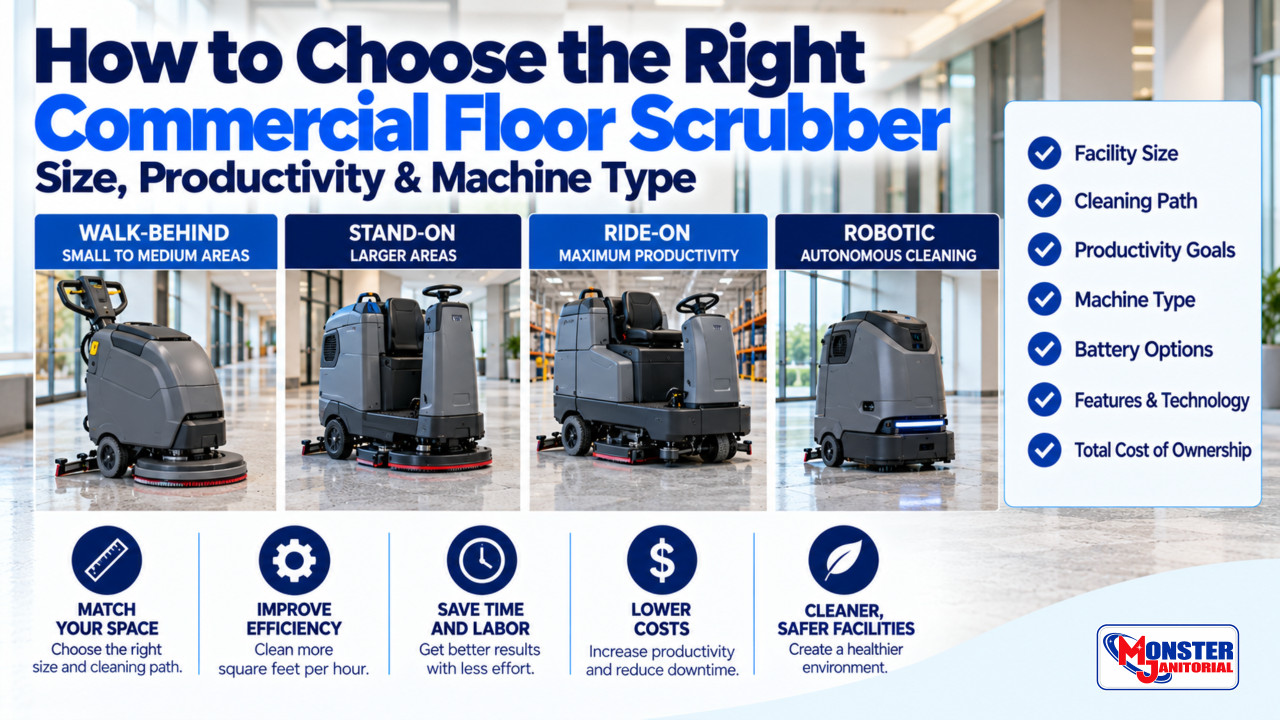
How to Choose the Right Commercial Floor Scrubber
Compare compact walk-behind, large walk-behind, stand-on, ride-on and robotic floor scrubbers for commercial facilities.
Learn how cleaning width, practical productivity, tank capacity, battery runtime, floor type, scrub deck, water recovery, storage and facility layout affect machine selection.
Choose the Scrubber for the Cleaning Route — Not Just Building Size
Use a compact walk-behind for tight rooms and smaller routes, a mid-size or large walk-behind for mixed commercial spaces, a stand-on scrubber for long corridors and medium-to-large routes, and a ride-on machine for large open areas. Robotic scrubbers can support repeatable routes when the facility layout, staffing and operating conditions are a good fit.
What Is an Automatic Floor Scrubber?
An automatic floor scrubber applies cleaning solution, agitates the floor with a brush or pad system and recovers the dirty solution with a vacuum and squeegee assembly.
Auto Scrubber vs Autonomous Scrubber
Map the Actual Cleaning Route
Total building square footage is not the same as the hard-floor area that will actually be cleaned. Map the real route before comparing machine sizes.
Cleanable Square Footage
Measure the hard-floor area the scrubber must actually clean during each route.
Doorways & Elevators
Check machine width, squeegee width, overall length, turning radius and elevator limits.
Cleaning Window
Determine how many minutes or hours operators have to finish the route.
Obstacles
Include furniture, fixtures, displays, columns, ramps, turns, narrow aisles and congested areas.
Questions to Answer First
Why Floor Scrubber Size Matters
Too Small
- More passes
- More refill and dump cycles
- Longer cleaning time
- Possible runtime limitations
- More operator walking
Too Large
- May not fit through doorways
- May be difficult to turn
- May miss tight rooms and aisles
- Requires more storage
- May leave more detail cleaning
Floor Scrubber Size Guide
Use these ranges only as an initial planning guide. Layout, cleaning window, tanks, runtime and maneuverability may change the best choice.
| Cleanable Area | Common Cleaning Path | Possible Starting Choice |
|---|---|---|
| Under 10,000 sq. ft. | About 12–17 in. | Compact walk-behind |
| 10,000–30,000 sq. ft. | About 17–22 in. | Mid-size walk-behind |
| 30,000–75,000 sq. ft. | About 20–28 in. | Large walk-behind, stand-on or compact rider |
| 75,000+ sq. ft. | About 26 in. and wider | Stand-on, ride-on or robotic scrubber |
A large building does not automatically require one large rider. A school, hospital or campus with classrooms, narrow corridors, elevators and multiple wings may be better served by multiple compact or mid-size machines.
Theoretical vs Practical Productivity
Manufacturer square-foot-per-hour ratings are useful for comparing machines, but actual productivity is lower once turns, overlap, obstacles, refilling, dumping and operator pace are included.
Theoretical Productivity
Calculated from cleaning width and travel speed under near-ideal operating conditions.
Practical Productivity
The floor area actually completed after real route delays are included.
What Reduces Real-World Productivity?
Required Practical Productivity
Cleanable Square Footage ÷ Available Cleaning Hours
Example: 40,000 sq. ft. ÷ 2 hours = 20,000 practical sq. ft./hr required. Because published ratings are typically theoretical, leave enough margin for route delays.
Choose the Right Cleaning Path
| Cleaning Path | Common Applications | Main Tradeoff |
|---|---|---|
| 12–15 in. | Restrooms, classrooms, kitchens, offices, exam rooms | High access, lower output |
| 17–20 in. | Schools, clinics, retail, hallways | Strong balance of maneuverability and productivity |
| 20–24 in. | Institutions, grocery, larger hallways | Higher output with more turning space required |
| 26–30 in. | Campuses, warehouses, airports, retail centers | Best for longer routes and larger open areas |
| 32 in. and wider | Warehouses, manufacturing, transportation facilities | High output with significant space requirements |
Walk-Behind, Stand-On, Ride-On or Robotic?
Compact Walk-Behind
Best for classrooms, restrooms, offices, kitchens, small retail and detail routes.
Best advantage: maneuverability.Mid-Size Walk-Behind
A versatile option for schools, clinics, retail stores, government buildings and commercial facilities.
Best advantage: balance.Large Walk-Behind
Useful when a smaller machine is too slow but the building layout is not ideal for a rider.
Best advantage: productivity with operator control.Stand-On Scrubber
Good for long corridors and medium-to-large routes where compact rider productivity is useful.
Best advantage: less operator walking.Ride-On Scrubber
Best suited to warehouses, airports, manufacturing, large retail and other long open cleaning routes.
Best advantage: high route productivity.Robotic Scrubber
Best for repeatable routes where mapping, obstacle detection, reporting and trained staff support fit the facility.
Best advantage: repeatable automated routes.Robotic Scrubbers Support Labor — They Do Not Eliminate Staff
Employees are still needed for route preparation, filling, emptying, charging, maintenance, edge cleaning, obstacle management and response to changing facility conditions.
Tank Capacity & Refill Cycles
A wide scrub deck does not provide much benefit if small tanks force repeated trips to the fill station and drain. Compare solution capacity, recovery capacity and distance to fill and dump locations.
Battery Runtime & Charging
Match the battery to the real route rather than relying only on a published maximum runtime.
Disc, Cylindrical or Orbital?
Disc
Common for smooth commercial floors and pad- or brush-based routine cleaning.
Cylindrical
Useful on textured surfaces, grout lines and routes with compatible light loose debris.
Orbital
Uses rapid oscillation and rectangular pads for compatible scrubbing, edge access and floor-preparation programs.
Match the Machine to the Floor
Squeegee Performance Matters as Much as Scrubbing
A scrubber must recover solution effectively. Poor pickup can leave water behind even when the scrub deck is cleaning correctly.
More Down Pressure Is Not Always Better
Higher pressure can improve agitation in some heavy-soil applications, but excessive pressure can reduce runtime, increase accessory wear, increase motor load and potentially damage the floor or finish. Match pressure to the floor, soil, chemistry and pad or brush.
Operator, Noise & Storage Considerations
Operator Fit
Compare steering effort, controls, visibility, handle or seat position, tank access and brush or pad changes.
Noise
Compare published sound levels and operating modes for occupied facilities and daytime cleaning.
Storage & Transport
Measure storage doors, elevators, ramps, charging space, drains and transportation equipment before purchasing.
Serviceability & Replacement Parts
Long-term equipment value depends on parts availability, maintenance access and service support.
Floor Scrubber Recommendations by Facility Type
Schools
Compact machines for classrooms and restrooms; mid-size or rider-style machines for hallways and campuses.
Healthcare
Prioritize recovery, maneuverability, cleanable tanks, low noise and facility-approved chemistry.
Retail
Balance aisle access, turning space, recovery performance and cleaning productivity.
Warehouses
Prioritize cleaning width, tank capacity, runtime and operator efficiency on long routes.
Government Buildings
Consider parts support, warranty, training, purchasing requirements and mixed-space versatility.
Grocery Stores
Balance maneuverability, aisle width, soil removal and water recovery for busy operating environments.
Machine Selection by Cleaning Need
| Cleaning Need | Possible Starting Choice |
|---|---|
| Restrooms, classrooms, small shops | Compact walk-behind |
| Mixed commercial routes | 17–22 in. walk-behind |
| Long corridors | Large walk-behind or stand-on |
| Large open warehouse or airport areas | Ride-on scrubber |
| Repeatable open routes | Robotic scrubber with staff support |
| Textured floors and compatible light debris | Cylindrical scrubber |
| Smooth finished floors | Disc scrubber with compatible pad |
| Floor preparation or compatible orbital process | Orbital scrubber |
Common Floor Scrubber Buying Mistakes
Route takes too long.
Machine does not fit the route.
Battery cannot finish the route.
Too many refill and dump stops.
Accessory system does not fit the floor.
Labor and ownership costs are overlooked.
Commercial Floor Scrubber Selection Checklist
Facility
- Cleanable square footage
- Door and elevator dimensions
- Floor type
- Obstacles
- Storage space
Cleaning Route
- Cleaning window
- Practical productivity
- Soil level
- Drying requirements
- Noise restrictions
Machine
- Cleaning width
- Tank capacity
- Runtime
- Scrub deck
- Recovery performance
Ownership
- Battery and charger cost
- Pads, brushes and squeegees
- Maintenance
- Parts availability
- Operator training
Related MJ University Resources
Need Help Choosing a Commercial Floor Scrubber?
Monster Janitorial can help compare walk-behind, stand-on, ride-on and robotic scrubbers based on your actual cleaning route, floor type, available cleaning time, tank requirements, battery options and facility layout.
Quotes, purchase-order support and tax-exempt purchasing assistance are available for qualifying schools, government agencies, municipalities, healthcare facilities and other institutional customers.
- #auto scrubber
- #automatic floor scrubber
- #autonomous floor scrubber
- #commercial floor cleaning equipment
- #facility maintenance equipment
- #floor scrubber for schools
- #government cleaning equipment
- #Karcher scrubber
- #municipal cleaning equipment
- #ride on scrubber
- #robotic scrubber
- #school custodial equipment
- #school maintenance guide
- #stand on scrubber
- #walk behind scrubber