
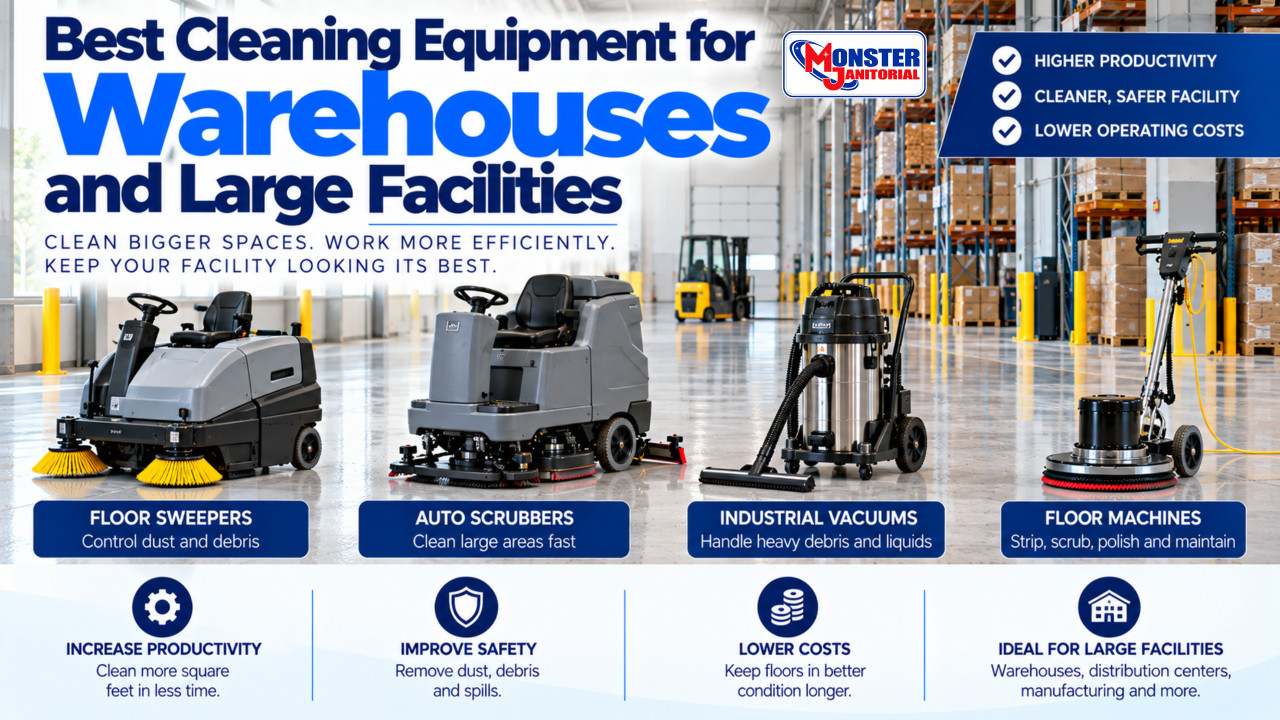
Best Cleaning Equipment for Warehouses & Large Facilities
Compare commercial sweepers, auto scrubbers, vacuums, burnishers and carpet extractors for warehouses, distribution centers, manufacturing facilities, schools and other large buildings.
The best equipment mix depends on floor type, debris, soil level, route size, cleaning frequency, indoor or outdoor use and the amount of time available for each cleaning shift.
Most Large Facilities Need More Than One Machine Type
Use sweepers for dry debris, auto scrubbers for wet floor cleaning and recovery, vacuums for carpet and detail work, burnishers for compatible finished floors, and extractors for carpeted offices, entry areas and soft-surface maintenance.
Match Equipment to the Facility
Before choosing equipment, identify the surfaces, debris and cleaning tasks that make up the actual route.
Commercial Floor Sweepers
Sweepers are designed to collect dry dust, dirt, packaging debris and other loose material before wet cleaning or as part of a daily dry-floor program.
Automatic Floor Scrubbers
Auto scrubbers apply cleaning solution, agitate the floor and recover dirty solution with a vacuum and squeegee system. They are often the primary wet-cleaning machine in large facilities.
Sweeper First, Scrubber Second?
When a route contains significant loose debris, dry sweeping before scrubbing can help keep larger debris out of the scrubber recovery system. Some cylindrical scrubbers can collect compatible light debris, but they do not replace a dedicated sweeper for heavy litter, packaging material or large dry debris.
Commercial Vacuums
Vacuums cover areas sweepers and scrubbers cannot, including carpeted offices, mezzanines, stairways, detail areas and fine dry soil.
HEPA Filtration Is About Fine-Particle Control
HEPA-equipped vacuums can support fine-particle control when the complete vacuum system is appropriate for the application. A HEPA filter alone does not automatically make a machine suitable for hazardous dust such as lead, asbestos, silica or mold-related remediation.
Commercial Burnishers
Burnishers are used in compatible floor-finish programs to maintain gloss and appearance after the floor has been cleaned.
Commercial Carpet Extractors
Large facilities often include carpeted offices, conference rooms, entry areas and mats that require a different cleaning system from warehouse hard floors.
Build a Combination Cleaning Strategy
One machine rarely performs every cleaning task well.
Which Equipment Does Your Facility Need?
| Cleaning Need | Possible Equipment | Primary Role |
|---|---|---|
| Loose dry debris | Floor sweeper | Dry pickup before wet cleaning or as routine maintenance |
| Large hard-floor routes | Auto scrubber | Solution application, agitation and recovery |
| Carpeted offices and detail areas | Commercial vacuum | Dry soil removal |
| Finished-floor gloss maintenance | Burnisher | Maintain compatible floor finish |
| Carpet restoration | Carpet extractor | Apply and recover carpet-cleaning solution |
| Spills or rinse-water recovery | Wet vacuum | Liquid recovery |
Battery Equipment for Large Routes
Battery-powered equipment can remove cord management from large cleaning routes, but runtime, charging time, battery chemistry and charger compatibility must match the actual schedule.
Common Large-Facility Equipment Mistakes
Examples for Large Facilities
These examples represent different equipment categories rather than one universal setup.
TASKI Balimat 3300
Battery sweeper for dry-debris pickup in warehouses, schools and commercial facilities.
View Sweeper →TASKI Balimat 6500
Ride-on sweeper for larger dry-debris routes and open commercial spaces.
View Sweeper →TASKI ULTIMAXX 2900
Large walk-behind scrubber for routine hard-floor cleaning and recovery.
View Scrubber →TASKI swingo XP-R
Stand-on scrubber for longer corridors and productivity-focused routes.
View Scrubber →TASKI swingo 4000B
Ride-on scrubber for larger hard-floor routes in warehouses, schools and commercial buildings.
View Scrubber →NSS Pacer 30
Wide-area vacuum for larger carpeted corridors and open indoor spaces.
View Vacuum →Warehouse & Large Facility Cleaning FAQ
Related MJ University Resources
Warehouses, Schools, Government & Large Facilities
Monster Janitorial supports commercial and institutional buyers with equipment selection, quotes, purchase-order support and replacement parts.
Tax-exempt organizations can create an account and email their exemption certificate to sales@monsterjanitorial.com.
Need Help Choosing Equipment for a Large Facility?
Monster Janitorial can help compare sweepers, auto scrubbers, vacuums, floor machines, burnishers and carpet extractors based on your facility layout, floors, debris and cleaning schedule.