
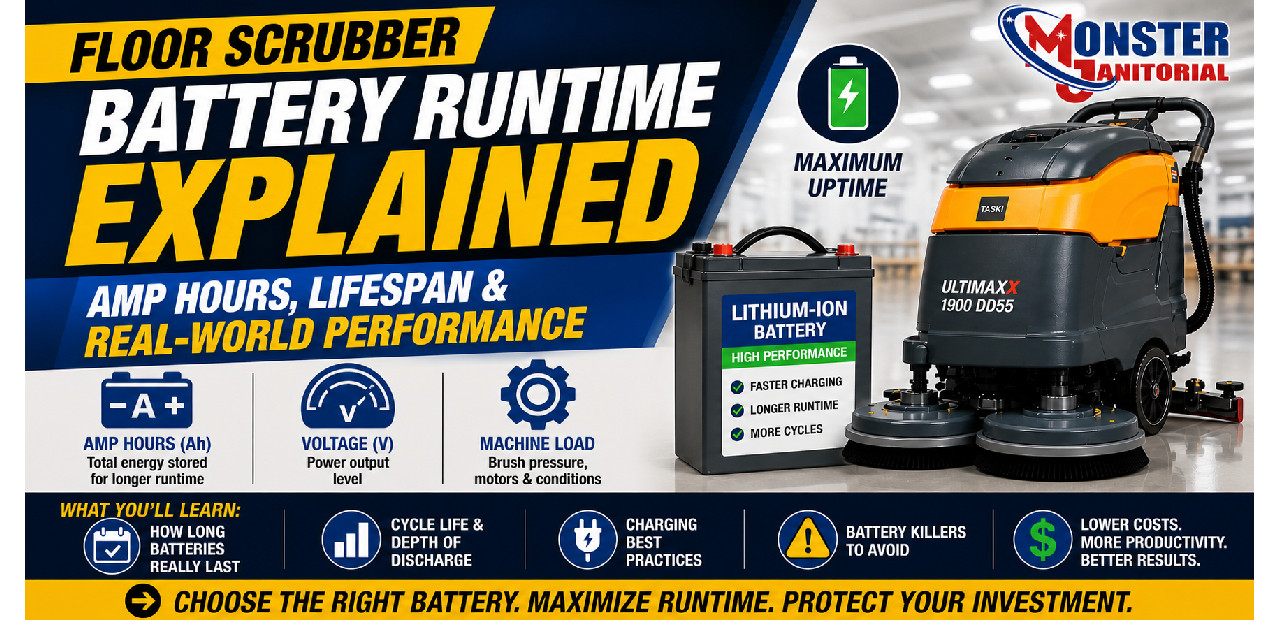
Understanding floor scrubber batteries goes beyond choosing lithium or AGM. Battery size, charging behavior, and usage habits all directly impact runtime, lifespan, and overall cleaning productivity.
This guide explains how batteries actually work in real-world cleaning environments so you can choose the right configuration and avoid costly mistakes.
What Determines Battery Runtime?
Battery runtime is based on three key factors:
- Amp Hours (Ah): Total energy stored in the battery
- Voltage (V): Power output level
- Machine Load: Brush pressure, motors, and floor conditions
A higher Ah rating means longer runtime, but only when matched correctly to the machine and application.
Understanding Amp Hours (Ah)
Amp hours (Ah) represent the total capacity of a battery. Think of it like a fuel tank:
- Higher Ah = longer runtime
- Lower Ah = shorter runtime
However, runtime is affected by how the machine is used, not just battery size.
As shown in the TASKI battery handbook, Ah represents the "volume of energy" stored in the battery.
Battery Types Explained: Wet vs AGM vs Gel vs Lithium
Not all floor scrubber batteries are the same. The type of battery you choose affects maintenance, runtime, lifespan, charging flexibility, and overall cost of ownership.
| Battery Type | Maintenance | Cycle Life | Best For |
|---|---|---|---|
| Wet/Flooded | High - requires watering, inspection, and proper charging | Approx. 700-1,000 cycles | Budget-focused facilities with trained maintenance staff |
| AGM | Low - sealed, no watering | Approx. 500-600 cycles | Schools, offices, and single-shift cleaning routes |
| Gel | Low - sealed, no watering | Approx. 700-1,000 cycles | Low-maintenance cleaning with better cycle life than AGM |
| Lithium | Very low - no watering or routine battery maintenance | Approx. 2,500-3,000 cycles | Large facilities, daily cleaning, and multi-shift operations |
Key Differences Explained
- Wet batteries: Often cost less upfront, but require watering, monitoring, and proper maintenance. They can be a good fit when staff are trained to maintain batteries correctly.
- AGM batteries: Sealed and low maintenance compared to wet batteries. AGM is a common choice for standard daily cleaning, but it usually has a shorter cycle life than Gel or Lithium.
- Gel batteries: Also sealed and low maintenance like AGM, but generally offer better cycle life and better resistance to deep discharge than AGM.
- Lithium batteries: Offer the longest cycle life, fastest charging flexibility, consistent runtime, and the lowest maintenance burden. Lithium is usually the best long-term choice for demanding commercial facilities.
Important: AGM and Gel batteries are both low-maintenance options compared to traditional wet batteries because they do not require watering. However, Lithium offers the strongest long-term value when cycle life, downtime, charging flexibility, and maintenance are considered together.
What Is a Battery Cycle?
A battery cycle is one full discharge and recharge.
- AGM: approximately 500-600 cycles
- Wet batteries: approximately 700-1,000 cycles
- Gel batteries: approximately 700-1,000 cycles
- Lithium: approximately 2,500-3,000 cycles
This is one of the biggest differences in long-term value between battery types.
Why Lithium Batteries Are Worth Considering
Lithium batteries are usually the best long-term choice for facilities that clean daily, run longer routes, or need consistent performance with less downtime. While lithium batteries cost more upfront, they offer a much longer cycle life than AGM, Gel, or wet batteries.
- Extended cycle life: Lithium batteries can provide approximately 2,500-3,000 cycles compared to about 500-600 cycles for AGM batteries.
- Longer useful service life: More cycles means fewer battery replacements over the life of the scrubber.
- Better runtime consistency: Lithium batteries typically maintain stronger performance throughout the cleaning route.
- Opportunity charging: Many lithium systems allow partial charging between shifts, lunch breaks, or route changes.
- Very low maintenance: No watering, acid checks, or routine battery maintenance like traditional wet batteries.
- Reduced downtime: Faster charging and longer cycle life help keep machines available when staff need them.
Bottom line: For schools, government buildings, healthcare facilities, warehouses, and multi-shift cleaning operations, lithium batteries can provide better long-term value because of their extended cycle life, reduced maintenance, and longer usable lifespan.

The Biggest Battery Killers
According to the TASKI battery handbook, batteries do not usually fail naturally - they are often damaged by improper use. These issues are most common with traditional wet batteries, AGM batteries, and Gel batteries, which are more sensitive to heat, deep discharge, and incorrect charging routines. Lithium batteries are more resilient, but proper usage still matters.
1. Heat
- Caused by heavy usage and charging
- Accelerates battery wear
- Can shorten the life of AGM, Gel, and wet batteries
2. Deep Discharge
- Running batteries too low damages internal components
- Common cause of early failure in AGM, Gel, and wet batteries
- Repeated deep discharge can destroy a battery in months instead of years
Lithium Advantage: Lithium batteries are designed to handle deeper discharge levels and demanding usage better than traditional AGM, Gel, or wet batteries. This makes lithium a more forgiving option in real-world cleaning environments where machines are used daily or across multiple shifts.
Cost Impact Over 3 Years
Battery choice affects more than the upfront price of the machine. Over a 3-year period, traditional wet, AGM, and Gel batteries may require more maintenance, more careful charging habits, or earlier replacement depending on usage. Lithium batteries usually cost more upfront, but they can reduce downtime, lower maintenance demands, and extend the useful battery life of the machine.
Why Lower Battery Stress Saves Money
- Fewer battery replacements over the life of the machine
- Less downtime from machines losing power before the route is finished
- More consistent runtime for nightly cleaning routes
- Lower maintenance costs when batteries are charged correctly
- Better long-term value for schools, government buildings, and commercial facilities
3-Year Cost Example
| Battery Use Habit | What Happens | 3-Year Impact |
|---|---|---|
| Recharge Before Empty | Less stress on the battery and more usable cycles. | Lower replacement cost and better machine reliability. |
| Run Battery Dead Often | More stress on the battery and shorter battery life. | Higher replacement cost, more downtime, and interrupted cleaning schedules. |
Lithium vs Traditional Batteries: In many commercial environments, lithium batteries deliver more usable cycles, more consistent runtime, and lower long-term operating cost, even though the initial investment is higher.
Battery Recommendation by Facility Type
The best battery choice depends on how often the scrubber is used, how long each route takes, and whether the facility can afford downtime during cleaning hours.
| Facility Type | Recommended Battery | Why |
|---|---|---|
| Small offices and light-duty facilities | AGM or Gel | Lower upfront cost, low maintenance, and enough runtime for shorter cleaning routes. |
| Schools and single-shift buildings | AGM, Gel, or Lithium | AGM and Gel can work well for standard nightly cleaning. Lithium is better when routes are longer or downtime is a concern. |
| Healthcare, airports, and high-traffic facilities | Lithium | Consistent runtime, faster charging, and less downtime are important in facilities that clean daily or throughout the day. |
| Warehouses and large campuses | Lithium | Longer routes and larger square footage usually justify the higher upfront cost of lithium. |
| Multi-shift operations | Lithium with opportunity charging | Lithium supports demanding schedules where machines may need to charge between shifts or during short breaks. |
Lithium ROI: Why the Higher Upfront Cost Can Make Sense
Lithium batteries are not always the cheapest option at the time of purchase, but they can be the lowest-cost option over the working life of the machine. The value comes from longer cycle life, reduced maintenance, fewer replacements, and better machine availability.
| Cost Factor | AGM / Gel / Wet Batteries | Lithium Batteries |
|---|---|---|
| Upfront Cost | Lower initial purchase price | Higher initial purchase price |
| Maintenance | Wet batteries require watering; AGM and Gel are low maintenance but still sensitive to charging habits | Very low maintenance with no watering or routine battery service |
| Cycle Life | Shorter cycle life, especially with AGM | Longest cycle life, often 2,500-3,000 cycles |
| Downtime Risk | Higher risk if batteries are not charged properly or lose runtime over time | Lower risk because lithium provides more consistent runtime and charging flexibility |
| Best Long-Term Value | Good for light use or budget-focused purchases | Best for daily use, large buildings, and high-productivity cleaning programs |
ROI takeaway: If the scrubber is used daily, covers a large area, or supports a cleaning team that cannot afford downtime, lithium is usually the stronger long-term investment.
Best Charging Practices by Battery Type
Charging habits have a major impact on battery life. Always follow the machine and battery manufacturer’s charging instructions, and make sure the charger is programmed for the correct battery type.
| Battery Type | Best Charging Practice | Avoid |
|---|---|---|
| Wet/Flooded | Charge fully after use, water only after charging when needed, and keep terminals clean. | Avoid running completely dead, skipping watering, or using the wrong charger profile. |
| AGM | Recharge after each use and allow the battery to reach a full charge whenever possible. | Avoid frequent deep discharge, partial charging as a daily habit, and overcharging. |
| Gel | Use a Gel-compatible charger setting and recharge before the battery is deeply discharged. | Avoid high charging voltage, fast charging with the wrong profile, or using an AGM/wet charger setting. |
| Lithium | Use the lithium-approved charger and take advantage of opportunity charging when allowed by the manufacturer. | Avoid using chargers meant for lead-acid batteries unless approved for that lithium system. |
Charging tip: The charger profile matters. Wet, AGM, Gel, and Lithium batteries charge differently, so using the wrong charger setting can shorten battery life or damage the battery.
Charging Is More Important Than You Think
Proper charging is one of the most critical factors in battery lifespan. The same battery can perform very differently depending on how it is charged, stored, and maintained.
- Each battery type requires a specific charging profile
- Incomplete charging can lead to long-term damage
- Wet, AGM, and Gel batteries are more sensitive to incorrect charging habits
- Lithium batteries usually offer better charging flexibility, including opportunity charging on many systems
Real-World Runtime vs Rated Runtime
Battery runtime is often lower than manufacturer estimates due to:
- Operator speed
- Floor conditions
- Machine settings
- Stops and turns
Plan for real-world runtime, not just specifications.
How to Choose the Right Battery Setup
Ask these questions before selecting a battery:
- How many hours per shift does the machine run?
- Are multiple shifts required?
- Is opportunity charging available?
- What is the total square footage cleaned?
- Is the facility trying to reduce maintenance and downtime?
Choosing the right battery is about matching the application - not just picking the largest option.
Best Battery Setup by Application
- Small facilities: AGM or Gel
- Single-shift schools: AGM, Gel, or Lithium depending on route length
- Large campuses: Lithium
- Multi-shift operations: Lithium with opportunity charging
- Facilities wanting lower maintenance: AGM, Gel, or Lithium instead of wet batteries
- Facilities wanting the longest battery life: Lithium
Shop Floor Scrubbers
Key Takeaways
- Batteries are not interchangeable - application matters
- Runtime depends on Ah, voltage, usage, and floor conditions
- AGM and Gel batteries are low maintenance compared to wet batteries
- Wet batteries require the most maintenance because they need watering and monitoring
- Charging behavior directly impacts lifespan
- Lithium offers the highest cycle life, lowest maintenance, and strongest long-term value for daily commercial use
Upgrade Insight: Many facilities move from wet or AGM batteries to lithium to reduce maintenance, extend cycle life, improve charging flexibility, and lower long-term operating costs.
Need Help Choosing the Right Battery?
Our team can help you match the right battery configuration to your facility and cleaning schedule.
Email sales@monsterjanitorial.com or call 956-772-4842 for a custom recommendation based on your facility size and cleaning schedule.