
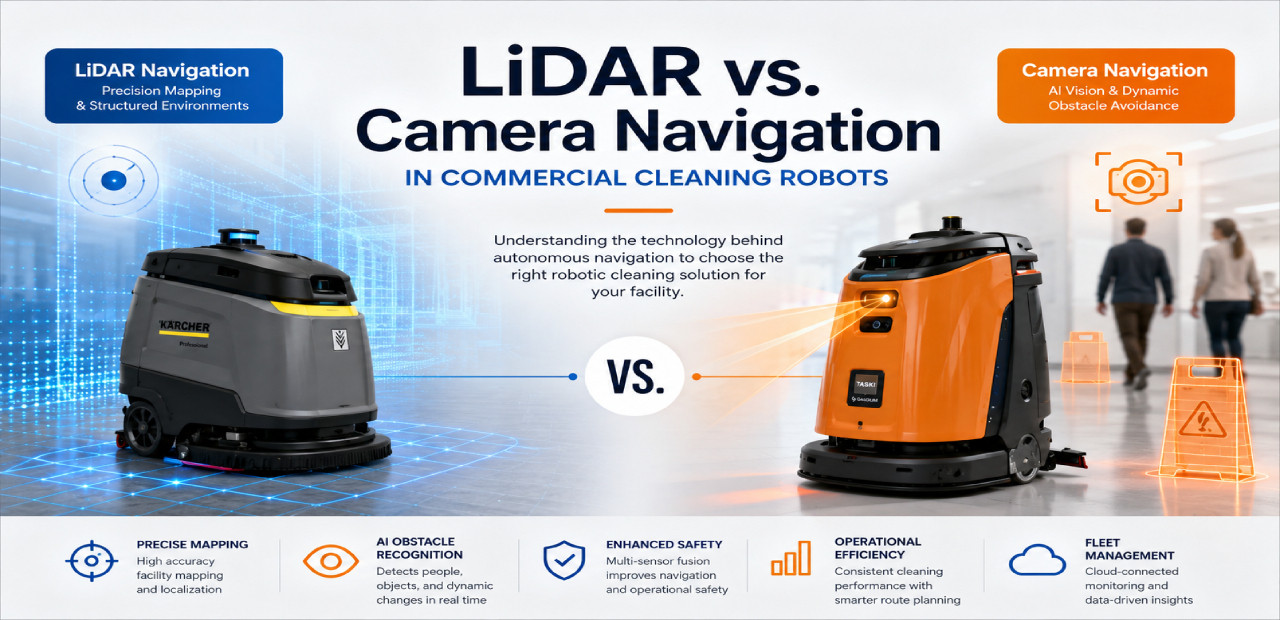
As autonomous commercial cleaning equipment continues evolving, one of the biggest technology differences between robotic floor scrubbers is how the machine actually “sees” and navigates the facility.
Some robotic scrubbers rely heavily on LiDAR laser mapping, while others use AI camera vision systems, and many newer platforms combine both technologies together using sensor fusion.
Why This Technology Matters
Understanding the differences between LiDAR navigation, AI camera systems, and sensor fusion robotics helps facilities make smarter long-term automation decisions based on their environment, staffing, traffic patterns, and cleaning goals.
Schools & Universities
Navigate crowded hallways, changing classroom layouts, and high daily foot traffic.
Healthcare Facilities
Support safer cleaning operations around patients, staff, carts, and sensitive environments.
Airports & Transit Hubs
Handle massive open areas with constantly moving travelers and unpredictable obstacles.
Warehouses & Logistics
Operate efficiently around pallets, forklifts, inventory movement, and large floor plans.
What Is LiDAR Navigation?
LiDAR stands for Light Detection and Ranging. LiDAR systems use rapidly pulsing lasers to measure distances around the machine and create a highly accurate map of the environment.
- Laser-based positioning
- Real-time facility mapping
- Precision navigation
- Digital wall and obstacle measurement
How LiDAR Navigation Works
Step 1: Laser sensors scan the environment
Step 2: The robot builds a live digital map
Step 3: SLAM software tracks machine position in real time
Step 4: The robot adjusts route positioning while cleaning
Many LiDAR robotic systems use SLAM technology (Simultaneous Localization and Mapping), which allows the robot to build and update a live digital facility map while continuously tracking its own position.
What Is Camera-Based Navigation?
Camera navigation systems use visual AI processing to help robots understand objects, people, movement, obstacles, floor edges, and open pathways.
- RGB cameras
- Depth cameras
- 3D vision systems
- AI object recognition
- Neural-network obstacle detection
How Camera Navigation Works
Step 1: Cameras capture live environmental images
Step 2: AI software identifies obstacles and pathways
Step 3: The robot predicts movement around people and objects
Step 4: Navigation continuously adapts during cleaning
Why Navigation Technology Matters in Real Facilities
Commercial facilities are constantly changing environments. Chairs move, doors open and close, carts appear in hallways, inventory shifts, people gather unexpectedly, and cleaning routes may change throughout the day.
Modern autonomous cleaning robots must continuously react to these changing conditions while maintaining cleaning productivity, safety, navigation accuracy, and operational reliability.
Daytime vs Overnight Autonomous Cleaning
Some facilities deploy robotic cleaning equipment overnight in low-traffic structured environments, while others require daytime autonomous cleaning around students, patients, travelers, shoppers, or staff.
- Overnight cleaning: Often favors structured route consistency and predictable mapping
- Daytime cleaning: Often benefits from stronger obstacle recognition and adaptive navigation behavior
- Mixed-use facilities: Frequently benefit from multi-sensor fusion systems
Why Sensor Fusion Is Becoming the Industry Standard
Most next-generation commercial robotic scrubbers now combine multiple navigation technologies together rather than relying on only one sensor type alone.
Sensor fusion allows autonomous cleaning machines to blend LiDAR mapping, AI camera systems, depth sensing, ultrasonic sensors, bump sensors, edge detection, and obstacle recognition software into a more intelligent navigation platform.
This helps improve navigation accuracy, obstacle handling, dynamic route adjustments, safety performance, crowded-facility operation, and long-term autonomous reliability.
Real-World Robotics Deployment Considerations
When evaluating commercial robotic cleaning equipment, navigation technology is only one part of the decision-making process.
- Docking station requirements
- Battery runtime and charging
- Cleaning route setup
- Cloud reporting features
- Fleet management software
- Staff training requirements
- Wi-Fi and connectivity needs
- Floor type compatibility
- Service and support availability
Why Most Modern Robots Use Both
Many next-generation robotic scrubbers no longer rely on only one navigation method. Instead, advanced systems combine LiDAR mapping, AI camera vision, ultrasonic sensors, bump sensors, depth sensing, and edge detection.
This is called sensor fusion. Sensor fusion allows autonomous cleaning machines to blend multiple data sources into a more intelligent navigation platform for better obstacle handling, safety, route adjustment, and long-term reliability.
LiDAR vs Camera Navigation Comparison
| Technology | Primary Strength | Best Environment | Typical Platform Style |
|---|---|---|---|
| LiDAR Navigation | Precise positioning and mapping | Large structured facilities | Enterprise robotics |
| AI Camera Navigation | Dynamic obstacle detection | Busy public environments | AI-adaptive robotics |
| Sensor Fusion | Balanced navigation intelligence | Mixed-use facilities | Next-generation autonomous platforms |
How Major Robotics Platforms Approach Navigation
Karcher KIRA Robotics
Karcher KIRA robotic cleaning systems focus heavily on enterprise safety, structured deployment, and reliable autonomous operation. Karcher platforms primarily emphasize LiDAR-centered navigation, structured facility mapping, predictable repeatable routes, and controlled autonomous operation.
TASKI Ecobot + Gausium OMNIE
TASKI robotic scrubbers powered by Gausium technology combine 3D LiDAR mapping, AI camera vision, depth sensing, AI obstacle recognition, cloud connectivity, and AI-adaptive navigation. These systems are designed to operate more dynamically in active commercial environments.
Tennant + BrainOS
Tennant robotic scrubbers powered by BrainOS combine commercial LiDAR mapping, AI-assisted navigation, teach-and-repeat operational consistency, and proven large-scale deployment reliability.
Nilfisk Liberty Systems
Nilfisk Liberty robotic scrubbers emphasize practical autonomous deployment, enterprise integration, consistent commercial operation, and ease of adoption into existing cleaning programs.
Which Robotic Navigation System Is Best?
There is no single best robotic navigation technology for every facility. The right platform depends on facility size, traffic patterns, cleaning schedules, staffing structure, deployment goals, safety requirements, and operational complexity.
- Karcher KIRA systems often excel in structured enterprise environments needing repeatable cleaning routes.
- TASKI Ecobot systems powered by Gausium technology are designed for adaptive AI-assisted navigation in active public environments.
- Tennant BrainOS platforms are known for proven large-scale commercial deployment reliability.
- Nilfisk Liberty systems focus on practical autonomous cleaning integration and commercial facility usability.
Featured Robotic Cleaning Platform
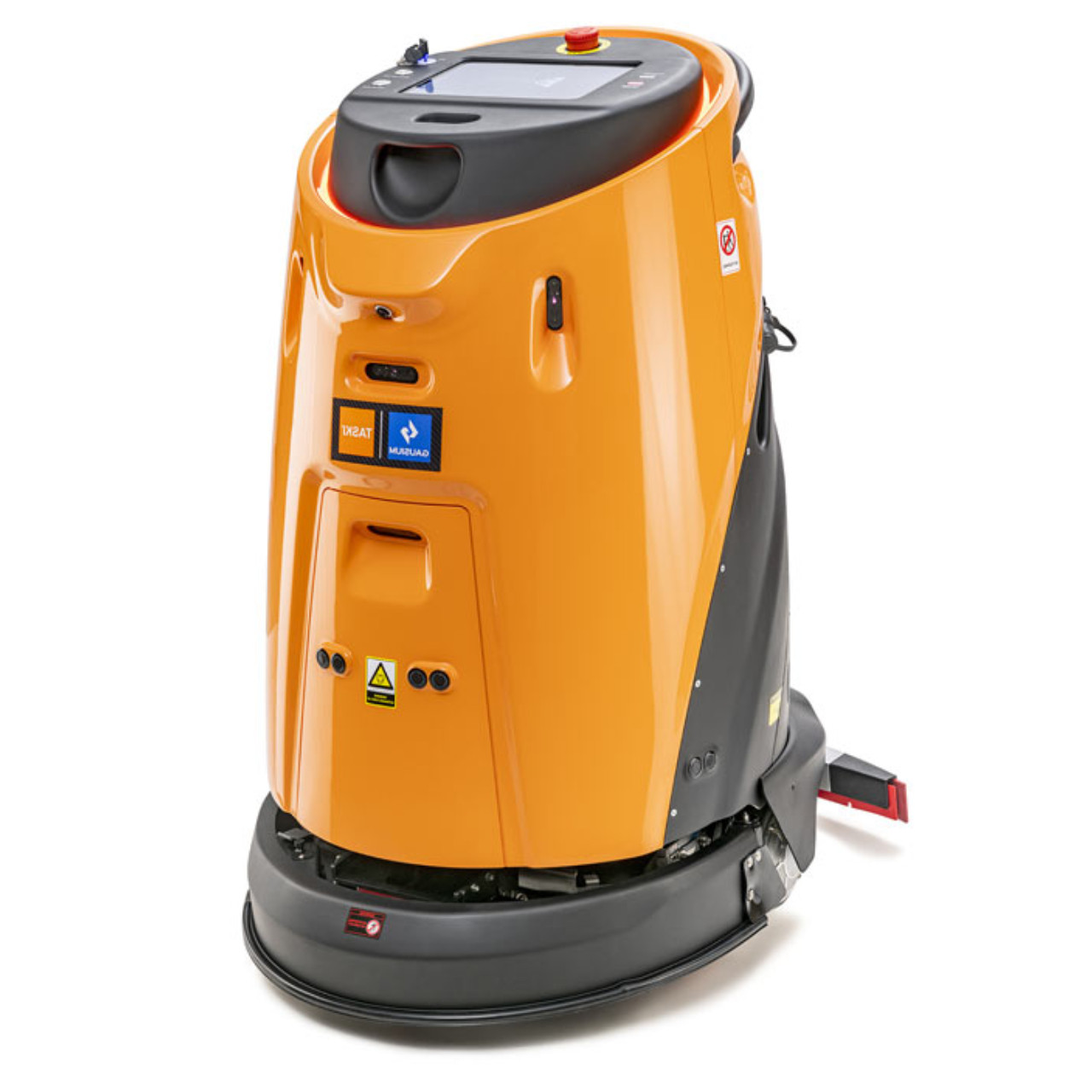
TASKI Ecobot 50 Pro
The TASKI Ecobot 50 Pro is a premium autonomous floor scrubber powered by OMNIE AI and 3D LiDAR navigation, designed for facilities that need adaptive robotic cleaning in active, high-traffic environments.
- Best for: healthcare, schools, airports, retail, and public facilities
- Navigation: OMNIE AI + 3D LiDAR sensor fusion
- Cleaning path: 18"
- Use case: AI-adaptive robotic scrubber drier for hard floor cleaning
Compare Robotic Cleaning Equipment
Use the quick comparison below to match robotic cleaning equipment to your facility needs.
TASKI Ecobot 50 Pro
Best for: Dynamic public environments
AI-adaptive autonomous floor scrubber with OMNIE AI and 3D LiDAR navigation.
View TASKI Ecobot 50 Pro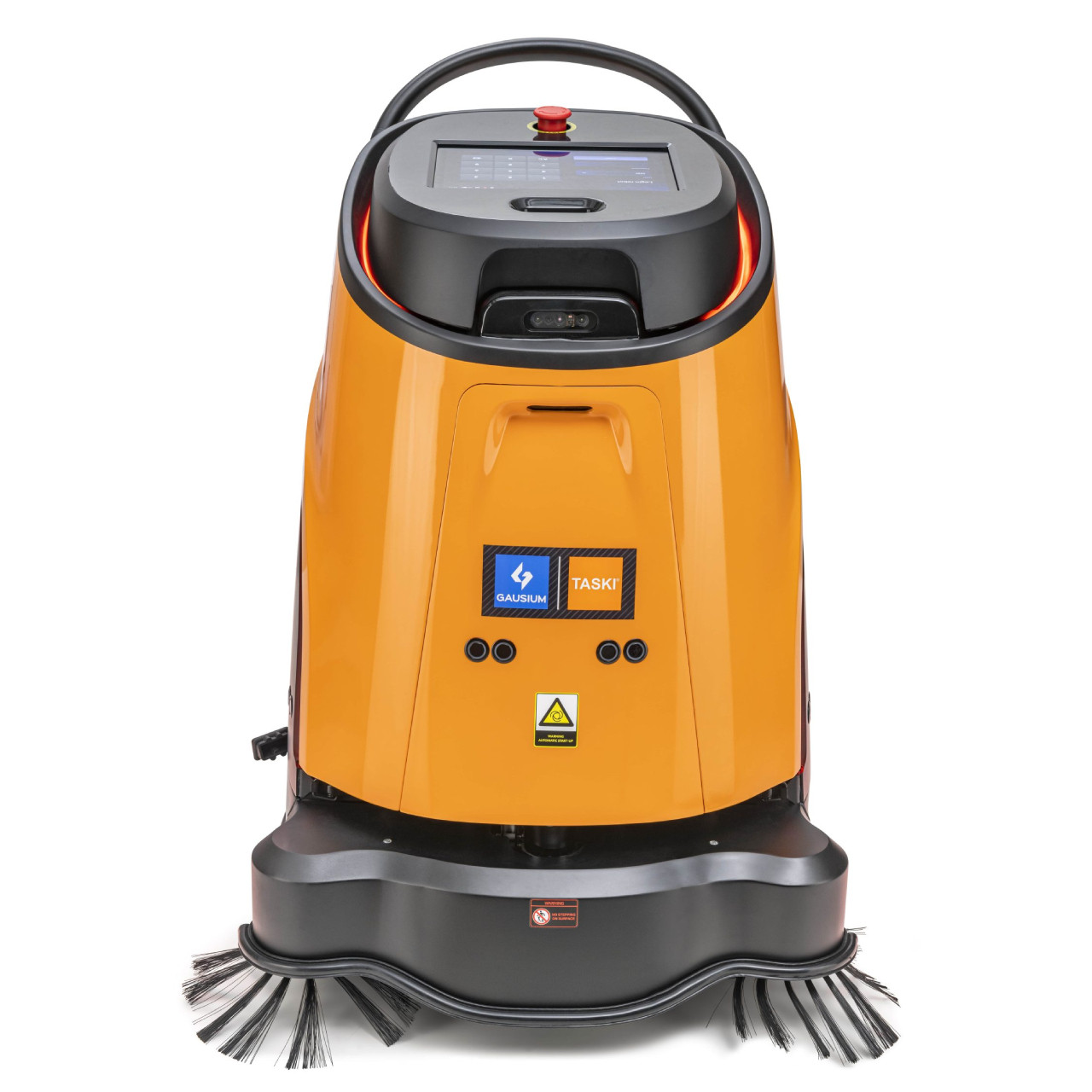
TASKI Ecobot 40
Best for: Autonomous sweeping and debris pickup
Robotic sweeper vacuum system with HEPA H13 filtration.
View TASKI Ecobot 40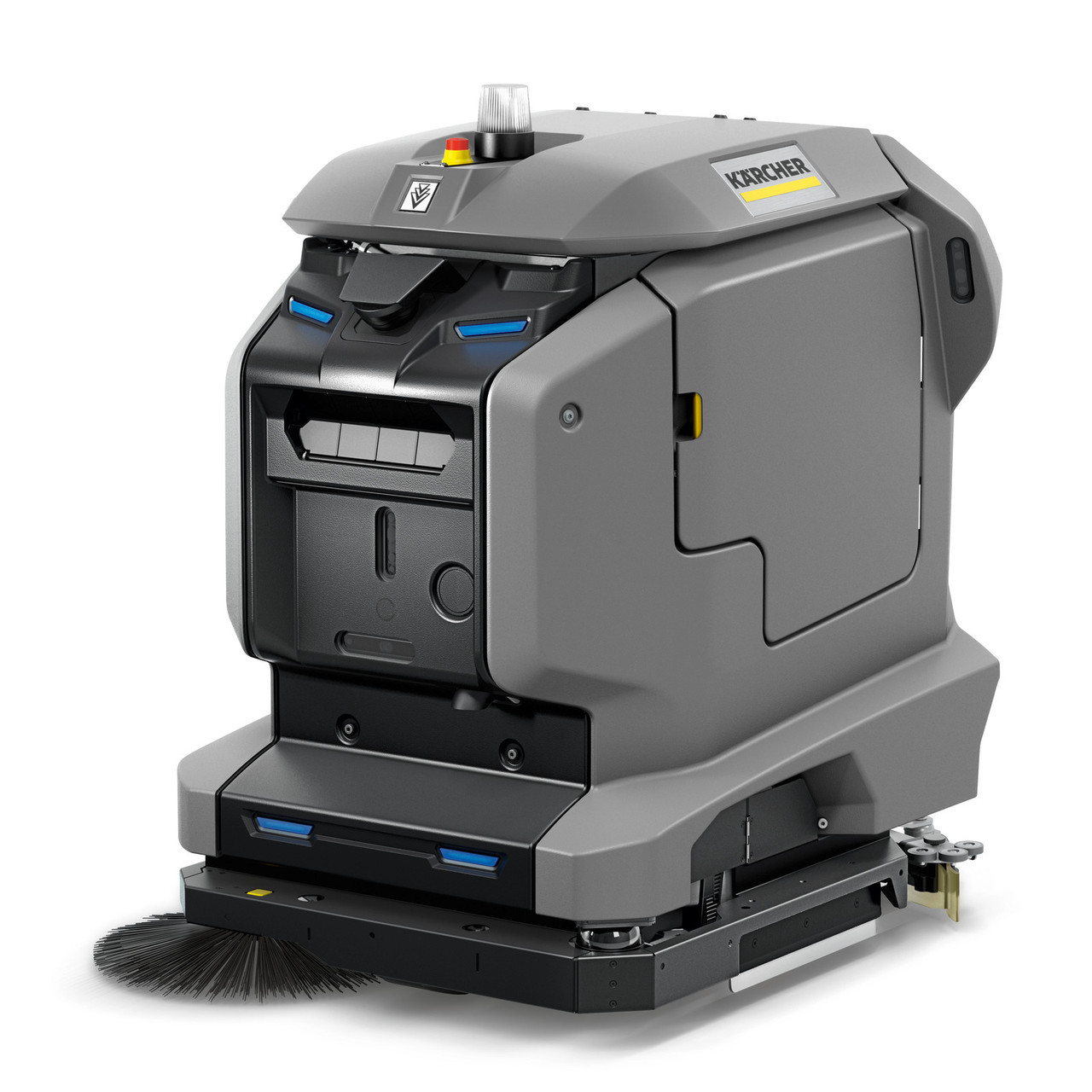
Karcher KIRA B 50
Best for: Structured repeatable routes
22" autonomous robotic floor scrubber for predictable enterprise cleaning.
View Karcher KIRA B 50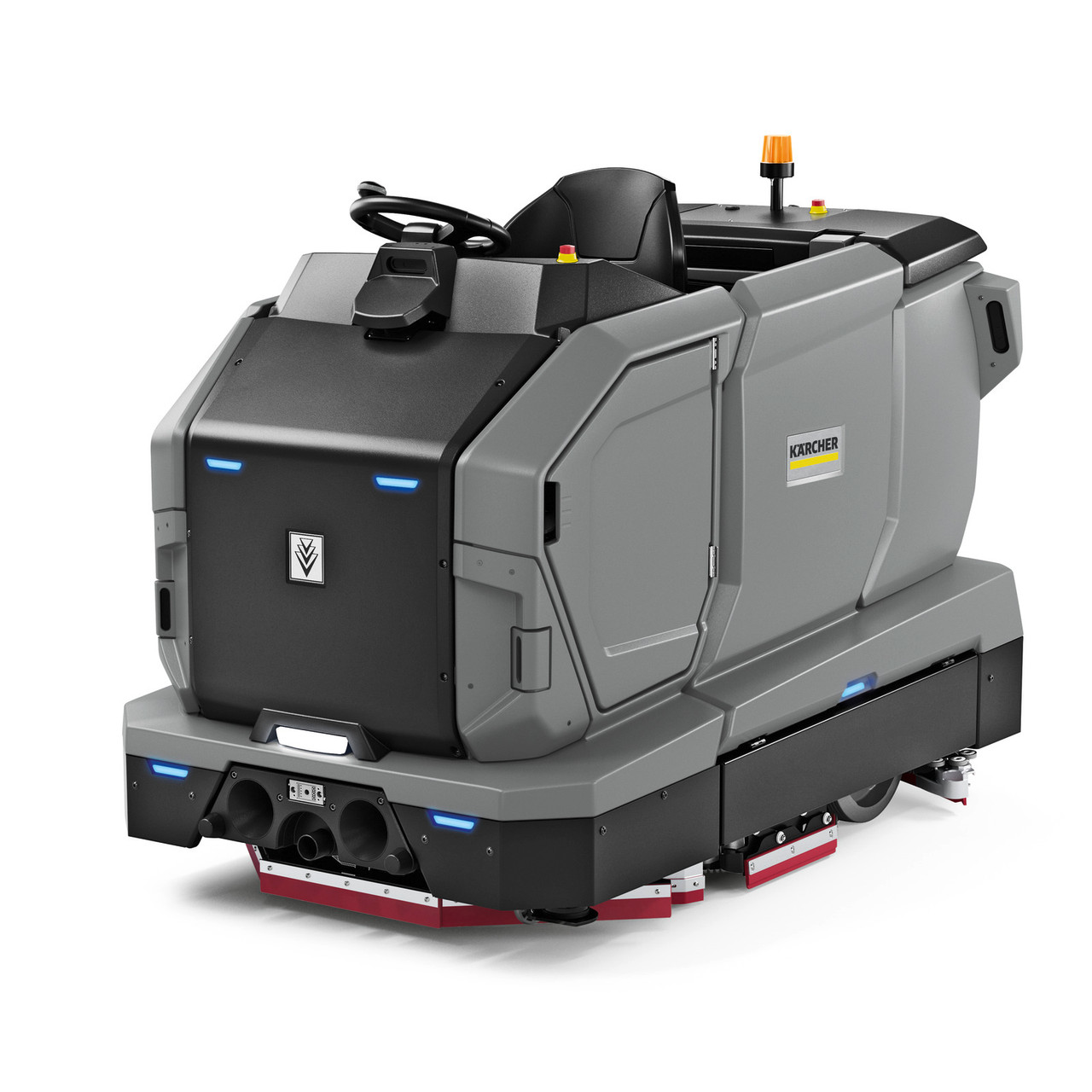
Karcher KIRA BD 200
Best for: Large enterprise facilities
33.5" autonomous floor scrubber with docking station options.
View Karcher KIRA BD 200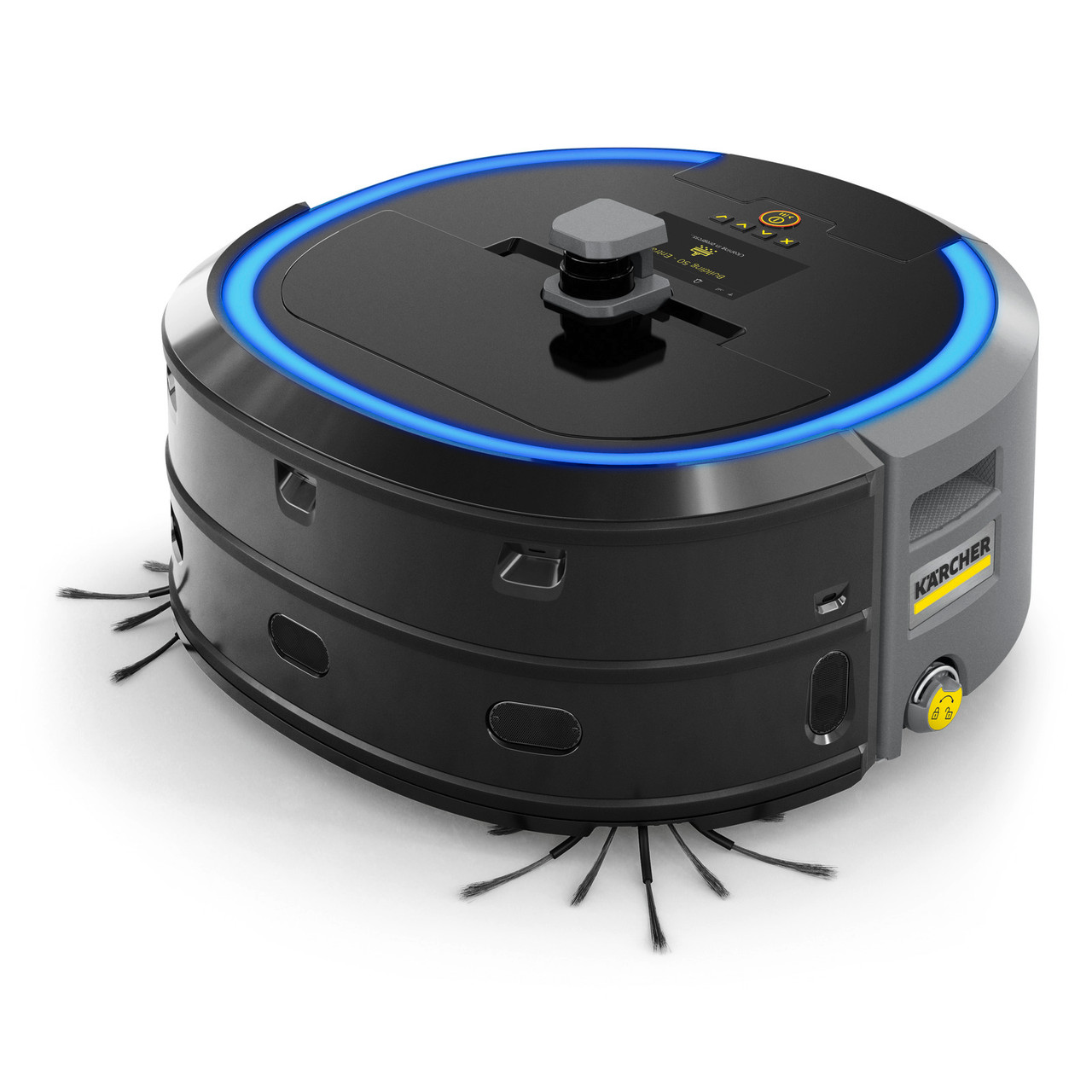
Karcher KIRA CV Vacuums
Best for: Autonomous vacuuming
Commercial robotic vacuum systems for carpet and hard floor vacuuming.
View Karcher KIRA CV 50Need Help Comparing Robotic Cleaning Equipment?
Monster Janitorial can help compare autonomous scrubbers, robotic vacuums, docking stations, navigation systems, brushes, pads, batteries, and facility deployment needs.
Email sales@monsterjanitorial.com or call 956-772-4842.
The Future of Commercial Cleaning Robotics
The commercial cleaning industry is rapidly shifting toward AI-adaptive robotics, cloud-connected machines, autonomous docking systems, remote monitoring platforms, fleet management dashboards, and predictive maintenance systems.
Final Thoughts
There is no single “best” robotic navigation technology for every facility. Some facilities benefit from highly structured LiDAR mapping systems, while others may benefit from more AI-adaptive robotics platforms that react dynamically to constantly changing environments.
As commercial robotics technology continues advancing, understanding these navigation systems helps facilities make smarter long-term investments in autonomous cleaning equipment.