
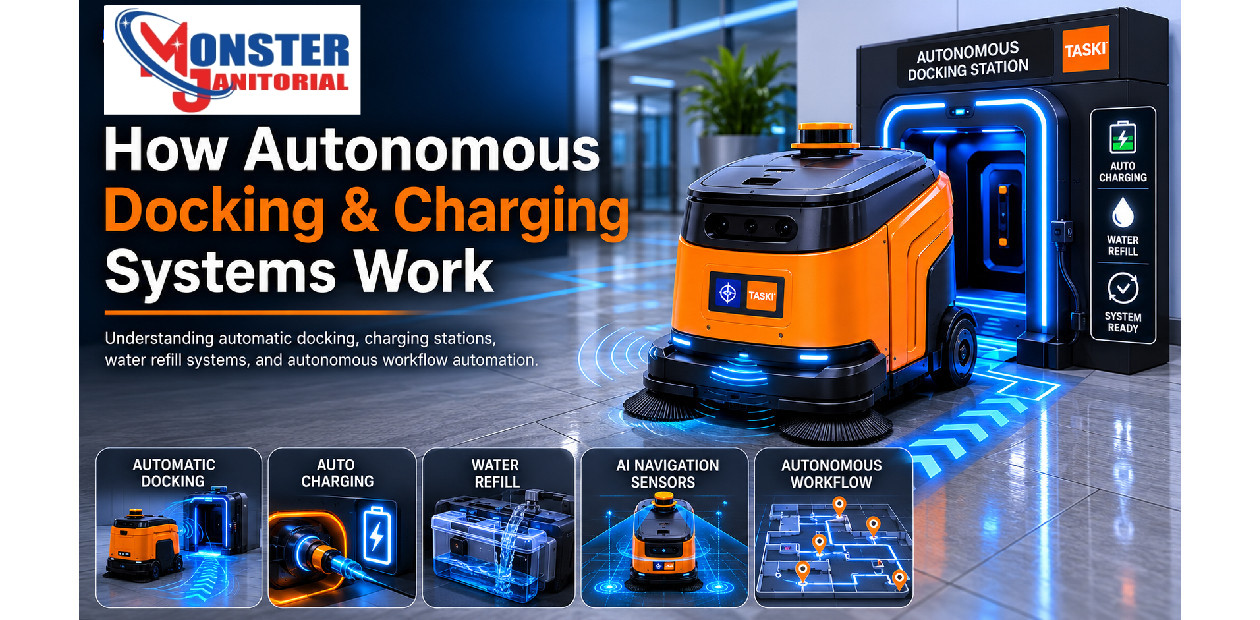
One of the biggest advancements in modern robotic floor scrubbers is the development of autonomous docking and charging systems.
Why Cleaning Robots Still Needed Operators
First-generation robotic scrubbers improved cleaning consistency, but many systems still depended heavily on manual operator support throughout the cleaning process.
Battery Charging
Robots often needed employees to manually transport and reconnect machines for charging.
Solution Refilling
Operators still had to refill clean water and chemicals between cleaning cycles.
Recovery Tank Dumping
Dirty water tanks required manual emptying before robots could continue cleaning.
Route Restarting
Many systems required operators to manually restart cleaning programs after interruptions.
Manual Transportation
Robots frequently needed to be physically moved between cleaning zones or floors.
Today’s more advanced commercial cleaning robots can automatically return to charging docks, recharge themselves, resume cleaning routes, and in some cases even manage water handling with minimal operator involvement.
For facilities managing labor shortages, overnight cleaning operations, and large square footage, autonomous docking has become one of the most important technologies in commercial robotics.
What Is Autonomous Docking?
Autonomous docking allows a robotic scrubber to automatically navigate back to a designated charging station without human assistance.
When battery levels drop below a programmed threshold, the robot:
- Stops its cleaning route
- Calculates the best return path
- Navigates safely back to the dock
- Aligns itself with charging contacts
- Begins automatic charging
After charging is complete, some systems can automatically resume cleaning exactly where they left off.
Why Autonomous Charging Matters
Without autonomous charging, robotic scrubbers still require frequent operator interaction.
That limits the true labor-saving potential of robotics.
Autonomous docking systems help facilities:
- Reduce manual labor requirements
- Extend usable cleaning hours
- Support overnight autonomous cleaning
- Improve robotics uptime
- Reduce operator interruptions
- Increase route automation consistency
In many facilities, autonomous charging is what transforms a robot from a “smart machine” into a true operational automation platform.
How Docking Systems Actually Work
Autonomous Docking Workflow
Robot monitors battery level during cleaning
Robot calculates return route to docking station
Sensors align robot precisely with charging dock
Charging begins automatically
Robot resumes cleaning after charging
Different Types of Autonomous Docking Systems
Basic Charging Dock Systems
Entry-level autonomous robots typically use simple charging docks.
These systems focus only on battery charging and still require operators to:
- Empty recovery tanks
- Refill clean water
- Restart cleaning routes manually
This approach is common in smaller facilities with shorter cleaning routes.
Advanced Enterprise Docking Systems
More advanced robotics platforms support:
- Automatic charging
- Automated route continuation
- Fleet scheduling
- Cloud monitoring
- Autonomous task management
These systems are designed for larger facilities operating multiple robots simultaneously.
Full-Service Docking Stations
The newest robotics platforms are beginning to integrate:
- Automatic water refill systems
- Recovery tank evacuation
- Chemical management
- Minimal-touch maintenance systems
This represents the future direction of commercial cleaning robotics automation.
Examples of Autonomous Docking Platforms
| Platform | Docking Approach | Deployment Style |
|---|---|---|
| Karcher KIRA | Enterprise autonomous docking systems | Large facility automation |
| TASKI Ecobot Pro | AI-driven autonomous charging and route continuation | Adaptive smart facilities |
| BrainOS Platforms | Cloud-connected fleet charging management | Multi-robot enterprise deployment |
| Gausium OMNIE Robotics | AI-first autonomous charging architecture | Dynamic public environments |
TASKI Robotics and the Gausium OMNIE Platform
TASKI autonomous scrubbers combine TASKI’s commercial floor care expertise with the advanced robotics architecture developed by Gausium. This allows TASKI robotic platforms to leverage OMNIE AI navigation, 3D LiDAR mapping, adaptive obstacle avoidance, autonomous docking systems, and cloud-connected fleet management while still focusing on TASKI’s sustainability and facility workflow approach.
Docking Accuracy & Navigation Technology
Successful autonomous docking requires extremely accurate navigation.
Robots commonly rely on:
- LiDAR positioning
- SLAM mapping
- AI camera vision
- Sensor fusion
- Ultrasonic positioning sensors
- Precision alignment algorithms
Even small docking alignment errors can prevent successful charging.
That is why newer robotics platforms increasingly combine multiple navigation technologies together.
Why This Technology Matters for Facilities
For schools, airports, hospitals, and large public facilities, autonomous docking dramatically changes operational efficiency.
Instead of assigning employees to constantly monitor robots, facilities can:
- Schedule autonomous overnight cleaning
- Run longer cleaning cycles
- Support multi-floor robotics programs
- Improve labor allocation
- Increase overall cleaning consistency
As robotics technology continues advancing, autonomous docking systems will likely become standard across enterprise commercial cleaning platforms.
Final Thoughts
Autonomous docking and charging systems are one of the key technologies driving the future of commercial cleaning robotics.
While navigation and AI obstacle avoidance receive most of the attention, docking systems are what allow robots to operate with greater independence and reduced operator involvement.
The future of robotic floor cleaning is moving toward:
- Fully autonomous charging
- Automated water handling
- Cloud-connected fleet coordination
- Minimal-touch robotic maintenance
- 24/7 autonomous cleaning operations
As these technologies mature, facilities will increasingly evaluate not only cleaning performance — but the overall automation ecosystem behind the robot.