
Chemical Guides & Resources
Understanding Cleaning, Sanitizing & Disinfecting Terms
Learn the difference between cleaning, sanitizing, and disinfecting, when each process should be used, and why proper contact time matters.
Understanding the difference between cleaning, sanitizing, and disinfecting is important for schools, offices, healthcare facilities, restaurants, gyms, and commercial buildings. These terms are often used together, but they do not mean the same thing.
Each step plays a different role in reducing soil, bacteria, viruses, and other contaminants on surfaces. Choosing the right process helps create a cleaner, safer environment for employees, visitors, students, customers, and building occupants.
Quick Answer
Cleaning removes dirt and some germs from surfaces. Sanitizing reduces bacteria to safer levels. Disinfecting kills many disease-causing germs on surfaces when the product is used correctly and left wet for the required dwell time.
Shop cleaning supplies: Disinfecting and Cleaning Solutions
Know the Difference
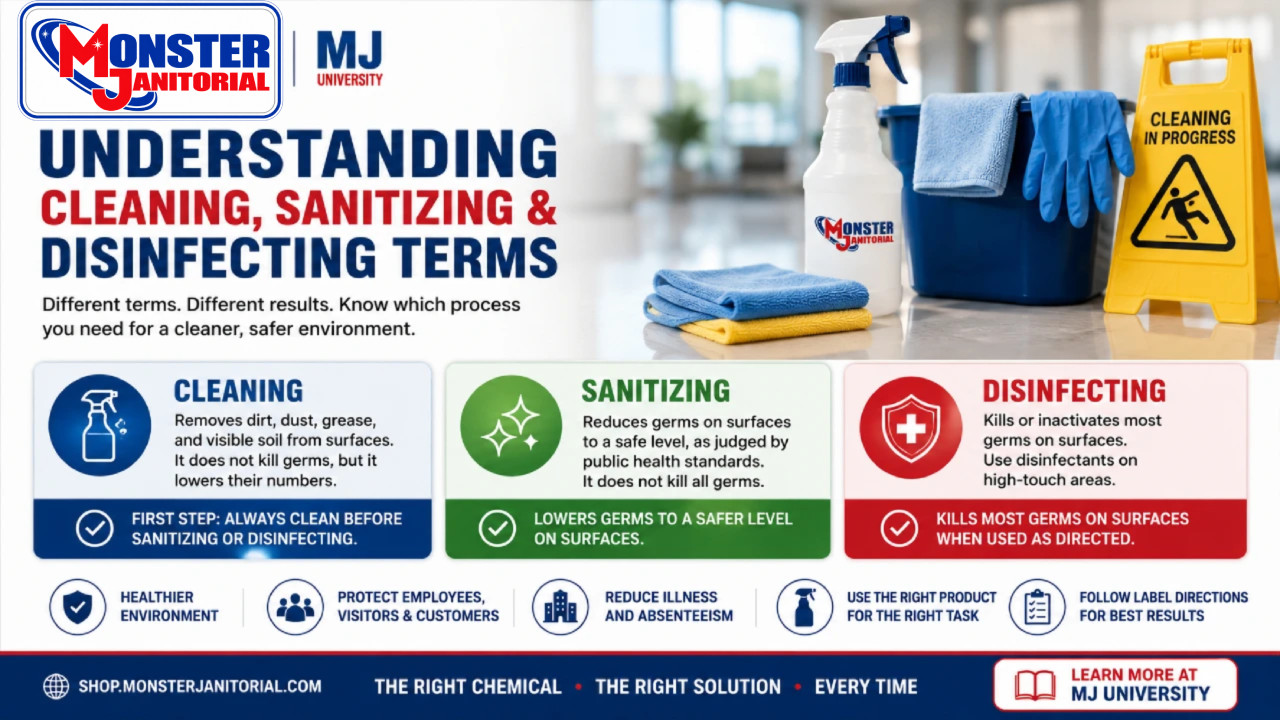
Cleaning vs Sanitizing vs Disinfecting
Cleaning should usually happen first because visible soil and organic matter can reduce the effectiveness of sanitizers and disinfectants.
Step 1
Cleaning
Removes visible dirt, soil, dust, debris, and some germs from surfaces through physical removal.
Step 2
Sanitizing
Reduces bacteria on surfaces to safer levels according to public-health standards.
Step 3
Disinfecting
Uses chemical disinfectants to kill many disease-causing germs when required contact time is met.
What Is Cleaning?
Removes Soil and Some Germs
Cleaning is usually done with detergent, soap, cleaner, solvent, wipes, mops, brushes, or cloths.
- Removes dirt, dust, fingerprints, and visible soil
- Prepares surfaces for sanitizing or disinfecting
- Supports routine facility maintenance
- Reduces contamination through physical removal
What Is Sanitizing?
Reduces Bacteria to Safer Levels
Sanitizing is commonly used where bacteria reduction is the primary goal.
- Food-contact surfaces
- Kitchen-preparation areas
- Restaurants and cafeterias
- High-touch routine hygiene areas
- Surfaces that have already been cleaned
What Is Disinfecting?
Kills Many Disease-Causing Germs
Disinfecting is used when reducing pathogen spread is especially important.
- High-touch surfaces
- Restrooms
- Healthcare and clinical spaces
- Schools, gyms, and offices
- Public buildings and shared areas
Product Performance
Why Dwell Time Matters
Many disinfectants require the surface to remain visibly wet for a specific amount of time. This is called dwell time or contact time.
Important: Always read the product label for the correct dwell time, dilution, surface compatibility, PPE requirements, and whether rinsing is required.
Quick Comparison
Cleaning, Sanitizing and Disinfecting Comparison
Cleaning
Primary purpose: Removes soil, debris, and some germs.
Best use: Routine maintenance and surface preparation.
Sanitizing
Primary purpose: Reduces bacteria to safer levels.
Best use: Food-contact surfaces, kitchens, cafeterias, and hygiene programs.
Disinfecting
Primary purpose: Kills many disease-causing germs.
Best use: High-touch and higher-risk surfaces.
Recommended Process
Best Practice: Clean First, Then Sanitize or Disinfect
Soil, dust, grease, and organic matter can interfere with sanitizer and disinfectant performance.
Step 1
Clean
Remove visible dirt, dust, debris, grease, fingerprints, and organic matter.
Step 2
Sanitize
Use when bacteria reduction is the goal on food-contact or routine hygiene surfaces.
Step 3
Disinfect
Use when the goal is to kill many disease-causing germs on higher-risk surfaces.
Facility Hygiene
Common High-Touch Surfaces to Clean and Disinfect
Shop Cleaning and Disinfecting Solutions
Browse commercial cleaning products, disinfecting solutions, janitorial supplies, and facility-maintenance products.
Need Help Choosing Products?
Monster Janitorial can help you compare cleaners, sanitizers, disinfectants, contact times, surface compatibility, and facility-hygiene products.
Call: 956-772-4842
Email: sales@monsterjanitorial.com